

When an automatic case erector repeatedly stalls, or a case sealer starts producing “open corners” halfway through a shift, the machine usually gets the blame. In our experience commissioning end-of-line equipment at SunAura Packaging Machines, roughly half of those stoppages are not machine faults at all. They are corrugated case problems — board that is too weak to hold its score, boxes that arrive out of tolerance, or a case style the sealer was simply never designed to close. The case is the single most variable input on the line, and it is also the one most buyers specify last.
This guide explains how to specify corrugated cases so they run cleanly through an automatic case erector and an automatic case sealer: which board grade to choose, what the common box styles are, how tight the dimensional tolerances really need to be, and how tape and hot-melt sealing change those requirements. We have kept it practical — the numbers here are the same ones our commissioning engineers use on the factory floor in Qingdao.
Why the case controls machine performance
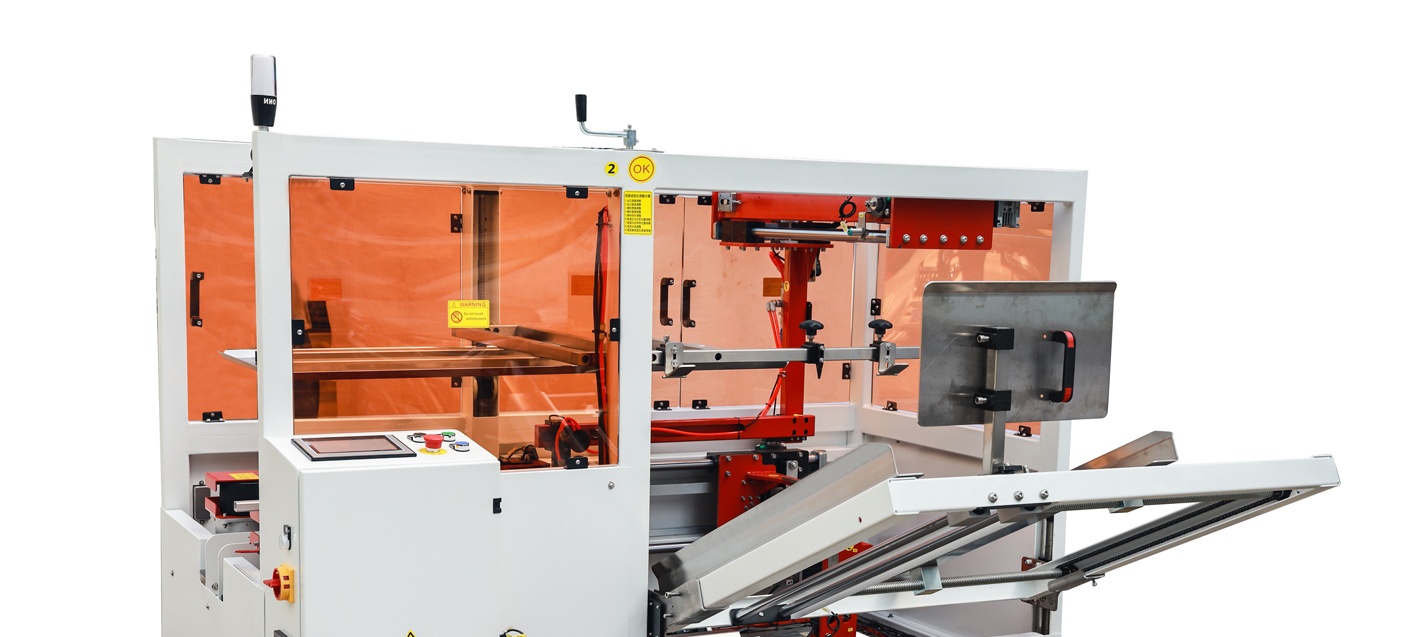
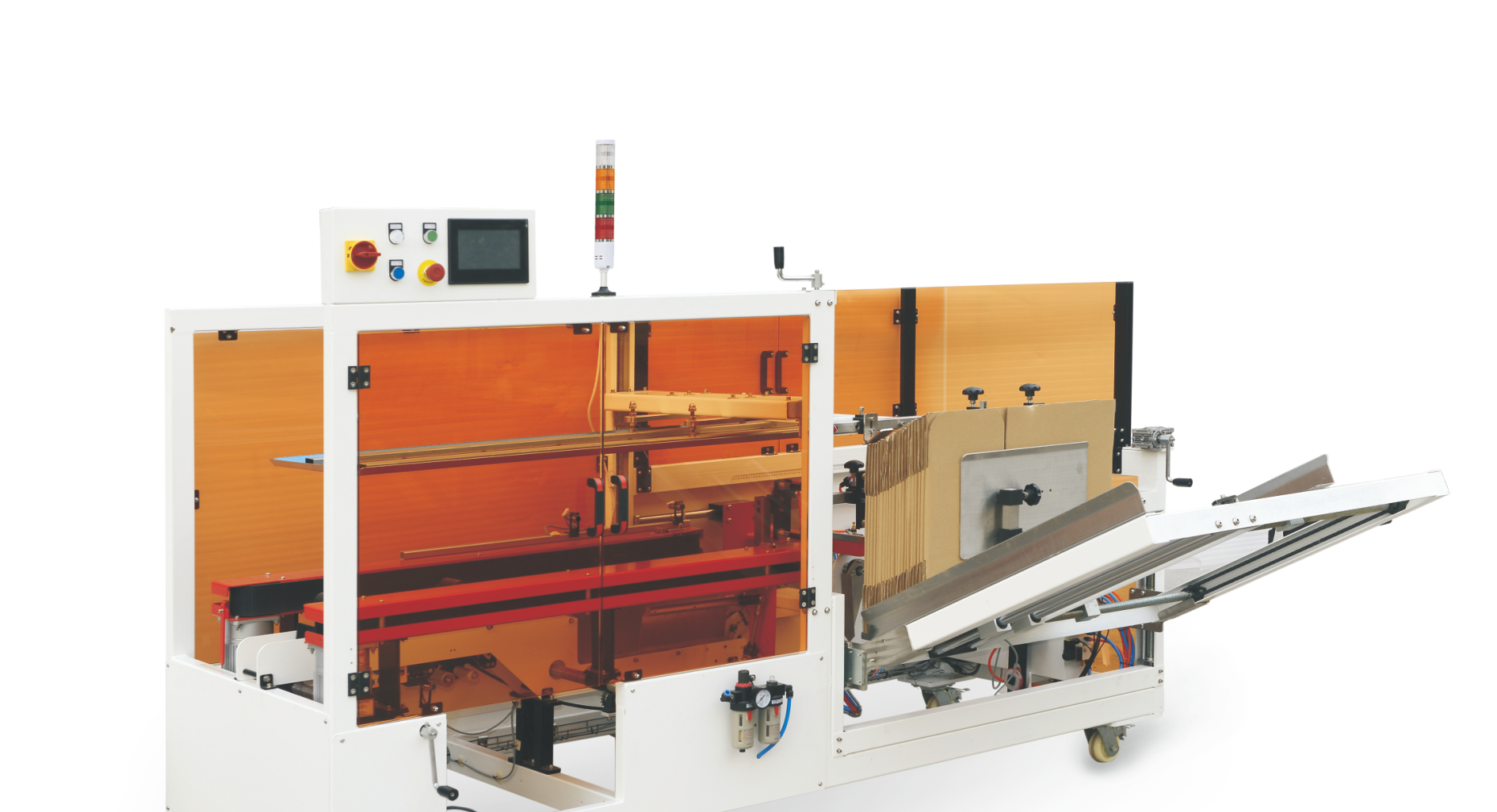
A case erector does three things: it pulls a flat knocked-down case from the magazine, opens it into a rectangle, and folds and seals the bottom flaps. A case sealer then folds the top flaps and applies tape or glue. Every one of those actions assumes the case behaves predictably. The board must have enough stiffness to be picked by suction cups, the scores (the creased lines) must fold at exactly the right place, and the flaps must meet without forcing.
Corrugated board is a living material. It absorbs and loses moisture, it crushes under clamping pressure, and it remembers how it was stored. Two cases printed on the same die can behave differently if one sat on a humid dock for a week. The machine cannot compensate for all of that. Specifying the case correctly, and controlling how it is stored, removes most of the variability before it reaches the line.
The common case styles, and which ones automate well
The style of the box — how the flaps are cut and arranged — matters more than buyers realise. A few styles dominate automated lines.
- Regular Slotted Container (RSC, FEFCO 0201). All flaps are the same length; the two outer flaps meet in the middle when closed. This is the workhorse of automated end-of-line packaging and the style every erector and sealer is built around. If you are automating for the first time, standardise on RSC wherever possible.
- Full Overlap Container (HSC/FO, FEFCO 0203). The outer flaps overlap fully, adding stacking strength for heavy or loose products. It seals well but needs a machine sized for the wider flap travel, and the overlap must be consistent.
- Half Slotted Container (HSC, FEFCO 0202). RSC without one set of flaps, often used as a lid-and-base pair. Common for products that are top-loaded and then capped.
- Die-cut trays and special styles (FEFCO 03xx, 04xx). Trays, telescope boxes and crash-lock bases can be automated, but they need dedicated tooling and a machine configured for that specific blank. They are not drop-in compatible with a standard RSC erector.
The practical rule is simple: the more case styles you run, the more changeover and the more risk. Many of our customers consolidate dozens of SKUs onto a small family of RSC cases precisely so one erector and one sealer can handle the whole range.
Choosing the right board grade
Corrugated board is described by its flute profile and the combined weight of the paper liners. The flute is the wavy layer: B-flute is thinner and gives a flat printing surface; C-flute is thicker with better cushioning and stacking strength; BC double-wall combines both for the heaviest loads. The grade is then stated as an Edge Crush Test (ECT) value or as a combined board weight (for example, a 125/112/125 board lists the inner liner, fluting and outer liner weights in grams per square metre).
For automation, board grade affects two things directly: stacking strength and magazine behaviour. Board that is too light folds and crushes in the erector; board that is far too heavy is stiff, resists the scores, and can fail to open square. A practical starting point for ordinary export cartons in the 10–25 kg range is a single-wall C-flute around ECT 32 (roughly a 140/110/140 board). Heavier products or long pallet stacks move to BC double-wall around ECT 48. These are starting points, not substitutes for a stack calculation on your own product.
| Loaded case weight | Typical board | Typical ECT | Notes |
|---|---|---|---|
| Up to ~10 kg | B or C single-wall | ECT 24–28 | Light products; watch crushing in the magazine |
| 10–25 kg | C single-wall | ECT 32 | The common export-carton range |
| 25–40 kg | BC double-wall | ECT 44–48 | Needs a heavy-duty erector and sealer |
| Above 40 kg | BC/AC double-wall | ECT 56+ | Confirm machine frame and flap force with the supplier |
Do not select purely on price per case. A lighter board that saves a few cents per box can cost far more in jammed line time and rejected pallets. We cover the broader cost picture in our total cost of ownership analysis.
Dimensional tolerances: how tight is tight enough?
This is where most case-related downtime starts. Automatic machines work in a narrow window, and cases that are a few millimetres off accumulate into misfeeds, open corners and jammed flaps. When you order cases, give your box supplier the internal dimensions in the standard order — length, width, depth — and hold them to the following practical tolerances.
- Cutting and creasing dimensions: within roughly ±2 mm on single-wall and ±3 mm on double-wall for ordinary case sizes. Consistent scores matter more than the absolute number.
- Squareness: the diagonal measurements of an opened case should match within about 3–5 mm. A case that is a parallelogram will never seal square.
- Score (crease) alignment: the crease must sit on the same line across the flap. Offset scores are the main cause of bent and dog-eared corners.
- Flap length: on an RSC the outer flaps should meet cleanly without a visible gap or a forced overlap. Gaps leave product exposed; over-long flaps buckle when folded.
Buyers sometimes loosen tolerances to get a cheaper box, then ask why the erector misfeeds. It is worth paying for die-cut accuracy if you run high speeds. When you change box supplier, run a trial batch through the machine before committing to a full order — board and die differences between suppliers are common even when the printed dimensions are identical.
Tape sealing vs hot-melt sealing
Bottom and top sealing use either pressure-sensitive tape or hot-melt adhesive, and the choice changes how you specify both the machine and the case.
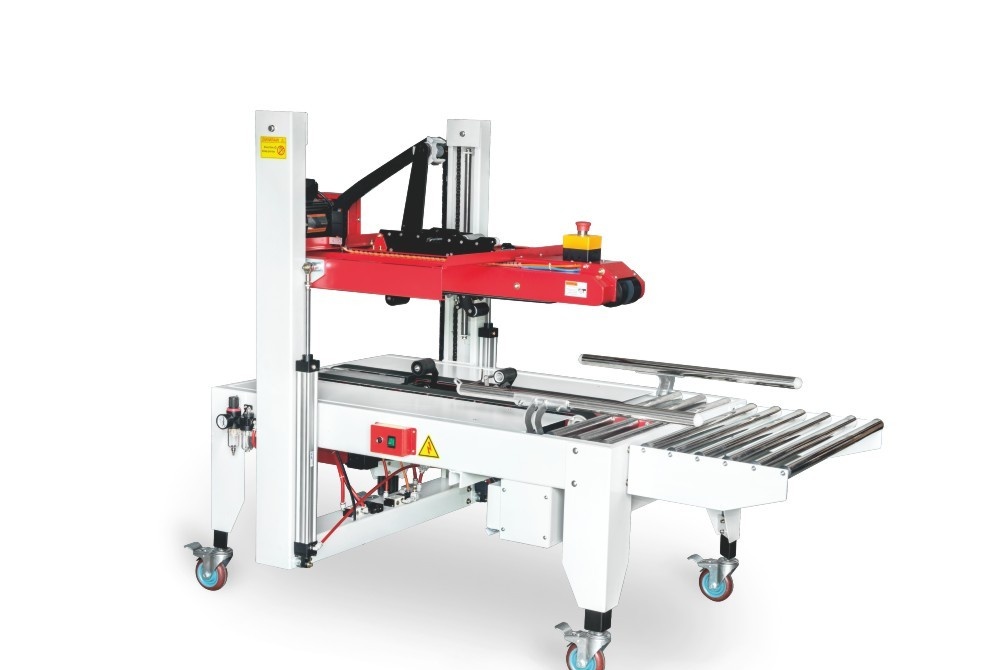
Tape is the default because it is forgiving, easy to change and works across a wide moisture range. It needs a clean, dry board surface to bite; dusty or heavily recycled liners reduce adhesion. Tape width is typically 48 mm for standard cases and 72 mm for heavy loads. A semi-automatic case sealer is a low-cost way to start with tape before moving to a fully automatic line.
Hot melt applies beads of molten adhesive to the flaps and is faster on high-speed lines, with no tape tab to open. It demands more: the board surface must be consistent, bead placement and temperature must be controlled, and the case must hold while the glue cools. If you choose hot melt, the case converter must know — surface treatments and recycled content change how the glue wets out. Our hot-melt case erector is built around those requirements. We compare the two methods in more depth in our article on carton sealing defects.
Moisture, storage and the conditions nobody controls
Corrugated board is at its best around 6–8% moisture. In a humid warehouse or a sea container, it absorbs water, loses stiffness and can warp; in an over-dried environment it becomes brittle. The result is cases that ran perfectly in autumn start misfeeding in the wet season. You cannot change the weather, but you can control exposure: keep cases wrapped and off the floor, use them in delivery order, and avoid opening bundles until needed. For export goods that themselves travel by sea, remember the case has to survive the same humid journey your product does.
Inspecting incoming case deliveries
A two-minute check when each pallet of cases arrives prevents hours of line downtime. You do not need a laboratory; a tape measure, a set square and a quick visual pass catch the defects that actually stop machines. The table below lists the faults our engineers see most often, how to spot them, and what they do to the line.
| Defect | How to check | Effect on erector/sealer |
|---|---|---|
| Warped or “banana” blanks | Sight along a stack of flattened cases | Suction cups miss; double picks from the magazine |
| Crushed flutes along edges | Look for flattened, soft edges | Poor opening; soft corners that fail to seal |
| Offset or shallow scores | Fold a sample; check the crease line | Bent corners, dog-ears, flaps folding out of place |
| Inconsistent flap length | Measure flaps across several samples | Gaps or buckled, forced overlaps on the sealer |
| Dusty or powdery liners | Wipe a finger across the surface | Tape and hot melt fail to adhere |
| Mixed board in one batch | Compare stiffness and print across the pallet | Intermittent faults that are hard to diagnose |
Sample more than the top few boxes: pull cases from the middle and bottom of the pallet as well. Keep a short record of what you find; if a supplier drifts over time, that record is far more useful than a single complaint. When a batch fails, quarantine it before it reaches the line — a bad case mixed into the magazine can cause a jam that takes longer to clear than the inspection ever would.
A practical specification checklist
Before you sign off a case for an automated line, confirm the following with your box supplier and your machine builder:
- Case style fixed (preferably RSC/0201) and the full range of case sizes listed.
- Internal dimensions in length × width × depth, with tolerances of ±2 mm (single-wall).
- Board flute and grade stated, matched to loaded weight and pallet stack height.
- Scores aligned, flaps meeting square, diagonal match within 3–5 mm.
- Sealing method chosen — tape width or hot-melt bead pattern — and the board surface confirmed compatible.
- Moisture and storage conditions agreed, with a trial batch run through the actual machine.
The single most valuable step is the last one: run real cases through the real machine at the real speed. At SunAura Packaging Machines we test every line with the customer’s own cases before shipment wherever possible, because it catches specification problems in our bay rather than on your floor.
When to involve the machine builder
If you are designing a new range of cases alongside a new line, bring the machine builder in early — ideally before the cases are finalised, not after. Small changes to a case are almost free at the design stage and expensive once thousands are printed. Our engineers can confirm the case size window your chosen erector and sealer accept, advise on tape versus glue, and size the line for the board grade your product needs. You can browse the equipment range on the Products page, or read our broader case erector and sealer selection guide before you specify anything.
Specifying corrugated cases is not glamorous, but it is one of the highest-return things you can do for end-of-line reliability. Get the style, grade and tolerances right, and the erector and sealer do exactly what they were built to do — run, shift after shift, with nobody standing over them.

Sarah evaluates packaging consumables against machine capability: film gauge and prestretch, PP versus PET and steel strapping, core width, tension settings and corner board use. Her articles connect film and band choice to machine settings, freight damage rates and total cost per pallet, rather than recommending the cheapest consumable on paper.
See Full Bio ›