

A case that leaves the line looking sealed but opens in the back of a container is one of the most expensive small failures in packaging. A single popped carton does not just damage its own contents — it can trigger a retailer chargeback, a rejected shipment or a customer complaint that overshadows every good product inside. Yet when engineers search for “case sealer machine”, “carton sealing machine for sale” or “tape vs hot melt case sealing”, the comparison usually stops at price and speed, and the questions that actually determine whether a carton stays shut — closure method, case uniformity, flap geometry and tape grade — go unasked.
This article explains why cartons fail to seal, how tape and hot-melt closure compare, and how to choose between a uniform (fixed-size) and a random (auto-adjusting) case sealer. SunAura Packaging Machines manufactures semi-automatic, fully automatic, cross (H-type) and corner-edge case sealers, and the relevant machines are linked throughout.
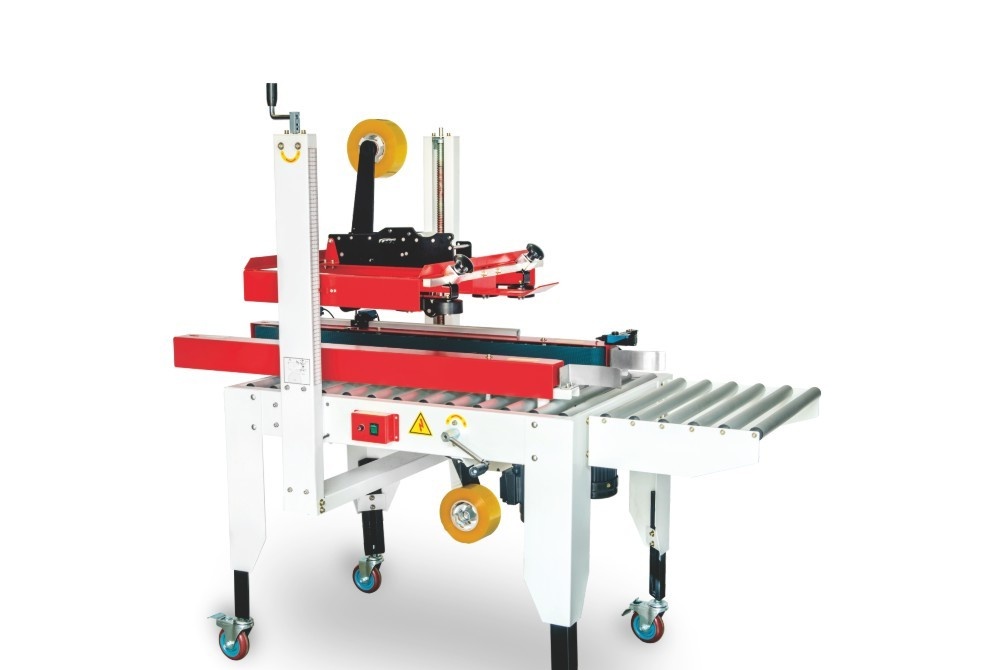
How a case sealer actually closes a carton
Most case sealers do two jobs in sequence. First the four top flaps are folded — either by the operator on a semi-automatic unit, or mechanically by flap-folding rails and a plow on an automatic machine — and then the carton is driven through a sealing station, where tape (or hot-melt adhesive) is applied along the centre seam on the top and, usually, the bottom. Side belts grip the carton and carry it at a constant speed; the tape is laid down as the box passes a tape head, with a roller pressing it flat and a blade cutting it at the trailing edge.
That simple description hides the point where most faults begin: sealing depends on the flaps meeting cleanly, the carton moving squarely, and the tape making full contact along the seam. If any one of those is off — warped flaps, a tilted box, tape applied over dust — the joint looks acceptable on the line but peels open under load. This is why the reliability of a sealing step is decided upstream, at case erection and flap folding, as much as at the tape head. For the complete picture of the two machines together, see our guide to building a reliable case erector and sealer.
The most common sealing defects and their real causes
When a carton fails, the instinct is to blame the tape or the machine. The root cause is usually one of the following, and each has a specific fix.
1. Tape lifting or peeling at the ends
If the tape ends curl up rather than lying flat, the box is often being released before the front and rear tape tabs are fully pressed, or the tape grade is too light for the carton’s weight. Heavier, overfilled cartons pull on the seam the moment they are stacked, and a thin tape will release from the edge. The fix is usually a wider or higher-tensile tape and correct roller pressure, not a new machine.
2. The centre seam opens under stacking
An open centre seam almost always means the flaps did not meet — the box is overfilled, the flaps are warped from humid storage, or the flap-folding rails are mis-set so the flaps overlap with a gap. Tape laid over a gap has nothing to bond to. Reducing overfill, conditioning the board and re-adjusting the folding rails solve this; if cartons are consistently overfilled, the real issue is that the case size is wrong for the product.
3. Tape applied crooked or split
Crooked tape points to a box entering the sealer at an angle or a tape head out of alignment. Split or torn tape usually means the tension on the roll is too high or the blade is dull and dragging. These are adjustment and wear-item issues; a dull blade and worn feed rollers are inexpensive parts that should be changed on a schedule rather than after they cause defects.
4. Cartons jamming or stalling in the machine
Jams on a fixed-size sealer usually mean the machine is being fed a box size it was not adjusted for — a frequent problem where several case sizes share one line. On a random sealer the cause is more often a sensor or side-belt issue. Either way, repeated jamming is a sign that the machine architecture does not match the variety of cases being run.
5. Seals that fail in cold or humid conditions
Pressure-sensitive tape relies on the adhesive making intimate contact; in very cold conditions a cold adhesive wets out poorly, and in dusty or humid environments the surface it must bond to is contaminated. Specifying an adhesive grade matched to the application temperature and keeping the flap surfaces clean matter more than the machine brand in these conditions.
Tape versus hot-melt closure
The two dominant closure methods are pressure-sensitive (self-adhesive) tape and hot-melt adhesive applied by the machine. Each has a different cost and reliability profile.
| Factor | Pressure-sensitive tape | Hot-melt adhesive |
|---|---|---|
| Machine complexity | Simple tape head, low maintenance | Glue tank, pumps and nozzles, more maintenance |
| Consumables | Tape rolls, easy to change | Adhesive pellets; very low per-box cost at volume |
| Appearance | Visible tape strip | No visible tape, clean retail look |
| Best fit | General shipping, varied lines, simpler operation | High-volume uniform production, retail-ready cases |
| Start-up / changeover | Fast, minimal skill | Requires heat-up and nozzle maintenance |
The practical guidance is straightforward: for most general shipping lines, especially those running several case sizes or wanting the simplest operation, tape is the lower-risk, lower-maintenance choice. For a high-volume line running one or two case sizes where a clean, tape-free appearance or the lowest consumable cost matters, hot melt pays back — but only if the maintenance discipline to keep nozzles clean and the adhesive at temperature is in place. A hot-melt machine that is neglected produces stringing, missed dots and weak seams far faster than a tape machine ever produces defects.
Uniform (fixed) versus random (auto-adjusting) case sealers
This is the decision that most directly prevents jams and defects, and it comes down to how many case sizes you run.
Uniform case sealers
A uniform or fixed-size sealer is manually adjusted — side belts and top head height — to one case dimension, and then runs that size until an operator changes it. It is mechanically simple, lower cost and very reliable when a line genuinely runs one box for long production runs. The semi-automatic case sealer and the fully automatic case sealer are typical. They are the wrong choice only when operators must change size many times per shift, because every adjustment is downtime and every imperfect adjustment is a jam or a crooked seal.
Random case sealers
A random (or automatic, self-adjusting) sealer senses each carton’s height and width and adjusts the belts and sealing head on the fly, so mixed case sizes can run consecutively with no manual changeover. This is the correct architecture for fulfilment and e-commerce lines that ship many box sizes in the same hour. For high-volume mixed lines the high-speed fully automatic case sealer adds the rate to match upstream equipment.
Special patterns: cross (H-type) and corner-edge sealing
Some loads need more than a single centre seam. A cross sealer applies the centre tape and then a second perpendicular strip, producing an H-pattern that reinforces heavy or overfilled cartons and stops the flaps opening under stacking. The cross case sealer FA500L is built for these heavier duties. Corner-edge (L-type) sealers tape along the edges rather than only the centre, which suits narrow or tall cartons and e-commerce packs where edge strength matters; the L-type corner-edge sealer FG500L is typical. For mailer and die-cut boxes that are folded rather than centre-taped, a dedicated unit such as the e-commerce fold case sealer FC500DS handles the geometry that a standard tape head cannot.
Sizing the sealer for real line speed
As with every packaging machine, rated cases-per-minute describe an ideal box at ideal conditions. Real throughput is set by how fast cartons are erected and filled upstream, how square they arrive, and the time taken for any size changeover. Size the sealer to be comfortably faster than the slowest upstream step, and remember that on a fixed machine the effective rate across a mixed batch includes the changeover downtime — which is precisely where a random sealer can be faster despite a similar peak speed. Our method for calculating real throughput applies directly here.
Specifying the tape itself: width, grade and tensile strength
The machine is only half of a tape closure; the tape grade is the other half, and buying a capable sealer and then running the cheapest light tape defeats it. Three variables matter: width, film backing and adhesive. Width is the simplest lever — heavier cartons generally warrant wider tape because the bond area across the seam is larger. The backing’s tensile strength sets how much the strip resists splitting when a stacked load pulls on it, while the adhesive determines how reliably it wets out and holds on the board grade and at the application temperature.
For general shipping, a standard hot-melt or acrylic packaging tape on a normal corrugated box is adequate. For heavy, overfilled or damp-chilled cartons, a high-tensile or reinforced grade in a wider size prevents the seam and the end tabs from releasing. It is worth testing the specific combination rather than assuming: seal a representative box, stack it as it will actually be stacked, and inspect the seam after it has spent time under load. The cost difference between a light and a capable tape is small per carton; the cost of a failed shipment is not. Buyers should also confirm the tape head on the machine accepts the width they intend to run, because heads are sized around a roll and core.
What the operator actually does on each machine type
Understanding the operator’s workflow clarifies the real labour requirement and often changes a buyer’s choice. On a semi-automatic sealer, an operator folds the four top flaps by hand, pushes the carton into the machine, and the side belts take it through the tape station. That is a genuine saving over hand taping, but one person is still dedicated to folding and feeding. On a fully automatic unit, the flaps are folded mechanically and the box is sealed as it passes, so the operator’s role shifts to loading and monitoring rather than handling every carton. On an unmanned random sealer inside an integrated line, mixed boxes arrive, are sensed, adjusted for, sealed and released with no manual intervention at all.
The practical implication is that labour savings increase at each level, but so does capital cost and the importance of keeping the upstream equipment running. A fully automatic machine is only unmanned to the degree that case erection and filling are automatic as well; pairing an automatic sealer with a manual packing step simply moves the bottleneck rather than removing it.
A short worked example
Consider a fulfilment operation shipping roughly 300 mixed-size cartons a day across eight box sizes. A fixed-size sealer would require an adjustment for each new size — several changeovers an hour, each a brief stop and an opportunity for a mis-set jam. A random sealer removes those changeovers and lets mixed boxes run consecutively; despite a similar peak speed, its effective throughput across the mixed batch is higher and the labour lower. By contrast, a producer running one case size at 2,000 cartons a day gets no benefit from random adjustment and is better served by a simpler, faster fixed machine at lower cost. The deciding factor is never the headline speed but the variety of sizes and the frequency of changeover.
Maintenance that prevents sealing defects
The majority of case-sealing faults are prevented by a short, disciplined routine: clean the tape head and rollers, check the blade and replace it on schedule, verify belt tension and tracking, and confirm the flap-folding rails stay aligned. Keep the wear items — blades, feed rollers, belts and tape-head springs — on the shelf, because a single dull blade can generate hours of defective cartons. Follow the preventive maintenance schedule and the guidance on spare-parts management; for hot-melt machines, add nozzle cleaning and adhesive-temperature checks to the daily routine.
Recommended SunAura Packaging Machines case sealers
- Low volume, operator-fed: semi-automatic case sealer
- One size at volume: fully automatic case sealer
- Mixed sizes, high rate: high-speed fully automatic case sealer
- Heavy H-pattern reinforcement: cross case sealer FA500L
- Edge reinforcement for narrow/e-com packs: L-type corner-edge sealer FG500L
- Mailer / fold boxes: fold case sealer FC500DS
When your cartons or line are non-standard
If you run unusual case dimensions, very heavy loads, or need sealing integrated into a bespoke end-of-line, a standard catalogue unit may not be the right answer. SunAura Packaging Machines will modify a proven platform — adjusting the sealing head, conveyor and folding geometry — rather than starting from scratch, as described on the custom packaging machine page, and real projects are shown in the case studies. To get a precise recommendation, send your case dimensions and how many sizes you run, your closure preference (tape or hot melt), your target cases per minute and a note on the load weight; the team can be reached through the help and support centre.

Kevin works on machine development for shrink bundling, shrink hoods and vacuum packaging. He tests film shrink ratios, tunnel heat zones, seal bar performance and chamber cycle times, and feeds that back into machine frame and conveyor design. He writes technical articles on shrink film selection, tunnel temperature balancing and vacuum packaging for industrial and food-adjacent secondary packs.
See Full Bio ›