

A case erector at the front of an end-of-line and a case sealer at the end look like two simple machines, but together they decide whether your packing line runs or waits. Under-specify either and you accumulate a queue of flat boxes or open cartons every shift. This guide walks through how SunAura Packaging Machines engineers case erecting and sealing cells, how to match them to real line speed, and what to verify before you order.
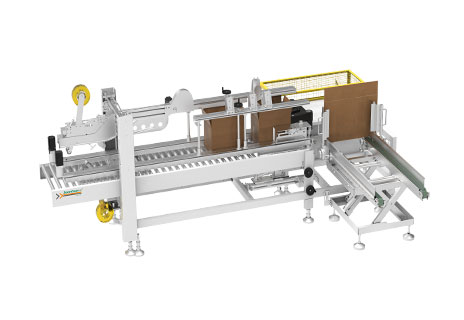
Where case erecting and sealing sit in the line
A typical end-of-line follows a clear sequence: a case erector pulls a flat corrugated blank, opens it into a square, folds the bottom flaps and seals them with tape or hot-melt glue; the erected carton is then conveyed to a packing station where product is loaded manually or automatically; a case sealer folds and seals the top; and the closed carton may pass through labelling, strapping or stretch wrapping before palletizing. When these stations are balanced, boxes and product move continuously. When they are not, the slowest station sets the pace of the entire line.
Purchasing searches such as “automatic case erector for sale”, “carton box sealing machine supplier” or “case packing line manufacturer” usually come from plants that have outgrown manual box forming — a point that arrives surprisingly early once output rises or labour becomes unreliable.
Manual, semi-automatic and automatic: where the breakpoints fall
Manual forming and sealing
At low volumes an operator opens boxes and folds flaps by hand, often using a simple tape dispenser. This needs almost no capital and tolerates frequent box-size changes, but it is slow, inconsistent and physically tiring. It makes sense for very low output or highly variable, short runs.
Semi-automatic sealing
A fixed case sealer folds and tapes the top while an operator pushes the carton through; the operator still forms the box and loads it. This is the most common first upgrade because it immediately removes the slowest, least ergonomic step — taping — at modest cost. Plants doing a few hundred cases a shift often start here.
Automatic erecting and sealing
Once output is continuous, automatic machines pay back quickly. A case erector can form and bottom-seal 10–25 or more cartons per minute without an operator, and an automatic sealer matches that pace downstream. For robotic flexibility across box sizes, the AIS400 robotic case erector uses a robotic pick-and-place arm to open blanks rather than a fixed mechanical magazine, which shortens changeover between case dimensions.
Tape versus hot-melt glue sealing
Both erectors and sealers offer two closure methods. Pressure-sensitive tape is simple, clean, easy to change and well suited to general export cartons; it is the default for most buyers. Hot-melt glue eliminates consumable tape, gives a tamper-evident seal and can be cheaper per carton at high volume, but it adds a glue system, maintenance and warm-up time, and it is less forgiving on dusty or recycled board. If you export through humid climates or require security seals, discuss glue with the supplier; otherwise tape is the lower-risk starting point.
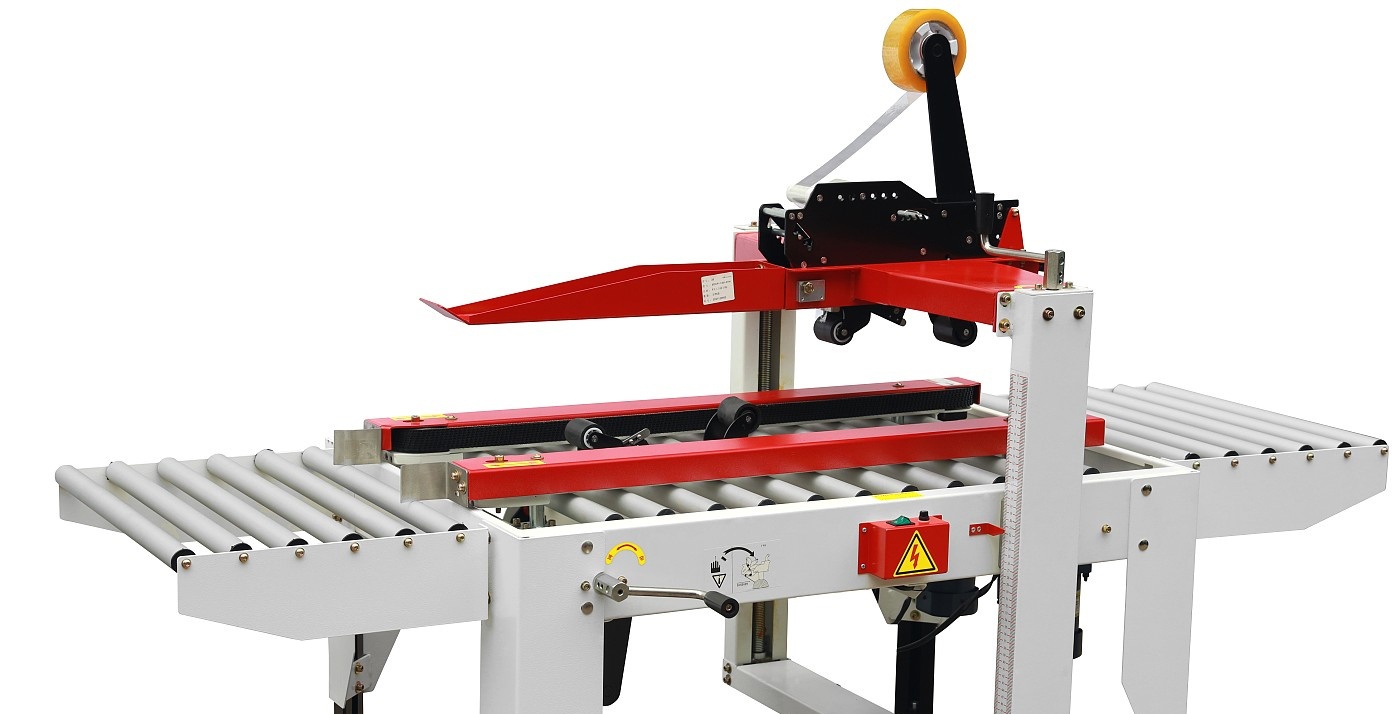
The key specifications to size correctly
- Case range and minimum/maximum dimensions. Provide the length, width and height of every corrugated case you run, including the heaviest loaded weight. Magazine and flap-folding geometry are sized to this envelope.
- Cases per minute, measured at the constraint. The erector, packing station and sealer must all meet your peak. An automatic erector feeding a manual packing cell only helps if packing is not the bottleneck.
- Blank quality and board type. Heavily recycled or warped blanks jam magazines. Automatic erectors perform best with consistent, dry board; specify your board grade.
- Closure method and consumables. State tape width or glue type and confirm spare parts availability.
- Changeover time between case sizes. If you run many SKUs, prioritise tool-less, repeatable adjustments; robotic erectors excel here.
- Safety guarding and interlocks. Automatic machines should include guarded magazines, emergency stops and interlocked access.
Balancing the cell: the most overlooked step
The majority of poorly performing case lines are not broken — they are unbalanced. A common pattern is a fast erector, a single manual packer and an adequate sealer: the packer is the real constraint and boxes queue regardless of machine ratings. The fix is either to add packing labour or move to automatic loading. Engineers should map the cycle time of each station in seconds, identify the slowest, and balance to it. When automatic product loading is required, the line graduates to a case erecting–packing–sealing–palletizing system, which removes the manual station entirely.
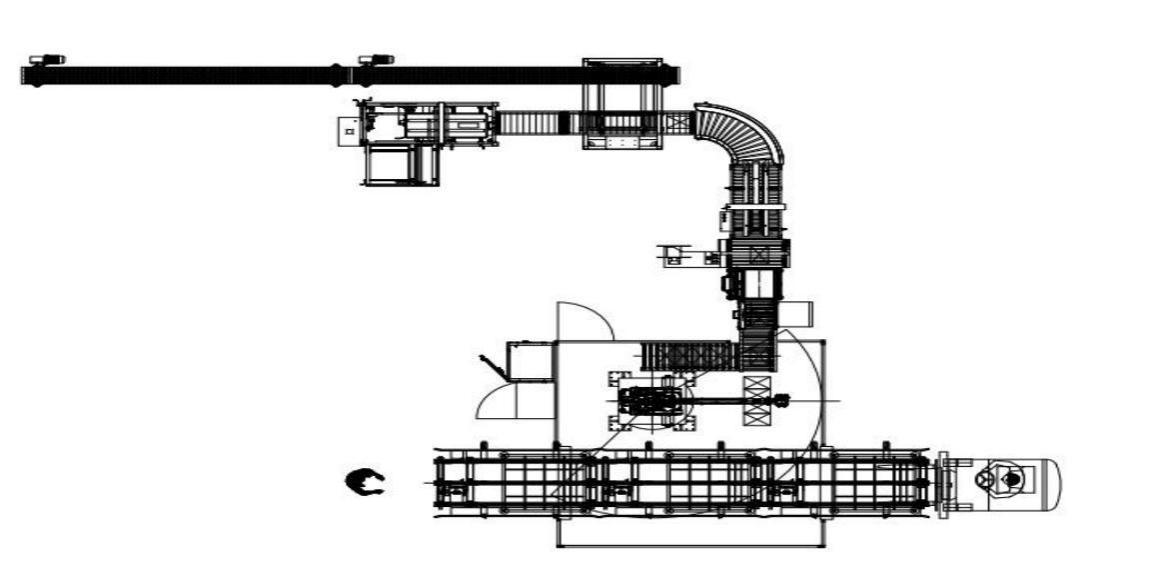
Downstream steps that close the loop
After sealing, most export cartons require one or more finishing steps. A labeller applies shipping or traceability labels; a strapping machine bands cartons or bundles; and a pallet wrapper unitises the load. For unattended bundling, plants often add an automatic unmanned strapping machine, and pallet loads are then stretch-wrapped for stability in transit. Specifying these together ensures conveyor heights, signals and speeds match from day one.
Common mistakes and how to avoid them
- Buying the erector and sealer from different suppliers without confirming communication and conveyor compatibility, leaving the integrator to fix mismatches.
- Sizing to today’s output with no headroom, so a modest sales increase saturates the line within a year.
- Ignoring blank quality, then blaming the machine for jams caused by warped board.
- Forgetting the manual packing constraint when automating only the box forming.
- Overlooking access for magazine loading and maintenance — a fast machine that is awkward to refill loses its advantage.
What to send in your inquiry
Provide case dimensions for all SKUs with loaded weights; required cases per minute at peak; tape versus glue preference; board grade and supplier; whether product loading is manual or automatic; downstream steps such as labelling and palletizing; available power, air and floor space; and your delivery destination. The more complete the inquiry, the fewer the surprises. Submit these details via the SunAura Packaging Machines contact page, and explore related equipment on the products overview.
Frequently asked questions
How many cases per minute justifies an automatic erector?
There is no universal number, but plants consistently forming more than roughly 5–8 cases per minute across a shift usually recover the cost through labour savings and consistency; your own labour rate decides it.
Can one erector handle many different box sizes?
Yes, within a specified range. Robotic erectors and tool-less changeover designs handle mixed sizes best; fixed mechanical machines are faster but less flexible.
Should the sealer match the erector’s exact speed?
It should meet or exceed the line’s balanced peak, including the packing station. Matching brand-new peak ratings is less important than matching real cycle times.
Is hot-melt glue better for export cartons?
Tape remains the safer default for general export; glue suits high-volume, tamper-evident or humid-environment applications after a proper evaluation.
Recommended equipment
- AIS400 robotic case erector — flexible, fast changeover box forming.
- Automatic case sealer FA500F — consistent top sealing at line speed.
- Integrated erecting–packing–sealing–palletizing line — hands-free end-of-line.
- Unmanned strapping machine — secure bundling before palletizing.
A worked example of line balancing
Consider a plant targeting 12 sealed cartons per minute. The erector is rated at 15, the sealer at 18, but a single operator loads product in about seven seconds per carton — roughly 8.5 cartons per minute. Regardless of the machine ratings, the line produces about 8.5 cartons per minute and open boxes queue at the packing station. Adding a second loader raises manual capacity to roughly 17, at which point the target of 12 is achievable and the erector becomes the nearest constraint. The same arithmetic, expressed in seconds per station, reveals the true bottleneck without spending anything. This is the exercise SunAura Packaging Machines runs with every inquiry: list each station’s cycle time, balance to the slowest, and only then decide where automation pays.
Where even two loaders cannot keep pace — common on three-shift, high-output lines — the solution is automatic product loading, which folds the packing step into the machine and lets the whole cell run at a single synchronised speed. That is precisely the configuration delivered as an integrated end-of-line system.
Carton design and how it affects the machines
Corrugated case design is treated as an afterthought in many projects, yet it drives both machines. The manufacturer’s joint, the flap geometry, the score depth and the board flute all influence how cleanly a blank opens in the erector and how reliably the top folds in the sealer. Cases that are over-scored collapse during forming; cases that are under-scored resist folding and jam. A consistent blank from a quality converter is therefore not a luxury on automatic equipment — it is a precondition. Buyers should lock the case specification, including board grade and dimensions, with their box supplier and provide sample blanks for machine testing.
Loaded weight matters as much as dimensions. Heavy cases demand robust conveyor rollers and positive flap folding, while very light cases can move unpredictably and need guiding rather than force. Communicating the full weight range prevents a machine specified for an average load from mishandling the lightest and heaviest SKUs at the ends of the range.
Changeover discipline for mixed SKUs
Plants running many case sizes lose real output to changeover even when each machine is fast. The practical answer is a combination of the right machine and the right discipline: tool-less adjustments, marked or numbered settings, and saved recipes remove the trial-and-error that extends every size change. Robotic erectors are particularly valuable here because the arm’s motion is reprogrammed rather than mechanically reset, and a servo sealer can store flap and conveyor settings per SKU. Documenting a repeatable changeover procedure and training operators on it protects the throughput gains that automation is meant to deliver.
Maintenance, spare parts and uptime
End-of-line machines are mechanically simpler than a high-speed wrapper but they still need routine attention. Tape-knife blades wear, glue filters block, photo-sensors collect dust, and conveyor bearings need lubrication. A short scheduled-maintenance routine and a small spare-parts kit — blades, sensors, belts and fuses — prevent a minor wear item from stopping the whole line. For lines that run across multiple shifts, identifying the consumable and wear parts at handover and agreeing on availability is part of a sound purchasing decision. Downstream, an automatic strapping machine and pallet wrapping should share the same maintenance logic so the finishing section runs as reliably as the forming and sealing cells.
Commissioning and operator training
A well-specified line still depends on the people running it. During commissioning the sequence should run from single-station checks to a dry run without product, then a loaded run at increasing speed, with sensors, flap folders and sealing settings confirmed at each stage. Training operators on loading the magazine, clearing the predictable minor jam, changing tape or film, and recognising when a fault needs an engineer protects the line’s throughput after the supplier leaves. Capturing these procedures in a short, site-specific checklist — rather than relying on the generic manual — makes the knowledge survive staff changes. SunAura Packaging Machines commissions its integrated lines this way and verifies the balanced cycle under real conditions before handover, so the throughput agreed in the layout is the throughput the customer actually achieves.
Throughput verification after handover
The final discipline is to verify performance against the data that started the project. Once the cell is commissioned and operators are trained, run a representative production period — a full shift across the normal SKU mix — and record the cases actually sealed, the stops and their reasons, and the changeover time between sizes. Comparing those figures to the balanced cycle from the layout confirms whether the line is delivering its intended throughput and points to any remaining adjustment. Treating throughput as something to be measured after installation, rather than assumed from a catalog rating, is what turns a purchased line into a reliably productive one. For plants planning that verification, SunAura Packaging Machines supports the first production runs of its integrated end-of-line equipment and reviews the recorded cycle data with the customer’s team.
Conclusion
Case erecting and sealing are best treated as one balanced cell rather than two independent purchases. Define your case envelope, measure each station’s cycle time, and size to the genuine constraint — which is often manual loading rather than the machines. SunAura Packaging Machines supplies the erectors, sealers, conveyors and integrated lines as a single scope, so the cell is specified, synchronised and commissioned together. Send your case dimensions and peak cases per minute and we will return a balanced layout with realistic cycle times.

Michael designs automated palletizing stations and ties upstream case or bag flow to downstream stretch wrapping. His work spans conventional layer palletizers, robotic arm cells, conveyor routing, safety fencing and handover logic between machines. He writes about palletizer selection, load stability and how an end-of-line sequence should be balanced.
See Full Bio ›