

High-speed packaging equipment does not fail without warning. It fails after months of tiny, accumulating neglect: a bearing that gets no lubrication, a belt that was never retensioned, a sensor that was never cleaned, a seal bar whose Teflon cracked and was left on. The job of a preventive maintenance schedule for high-speed packaging equipment is to catch those degradations on a planned stop, long before they become an unplanned, expensive breakdown. For plant engineers and maintenance managers running multi-shift lines, a written, followed maintenance routine is the single most reliable lever for uptime.
SunAura Packaging Machines commissions packaging lines for food, cosmetic, and pharmaceutical customers, and the lines that hold efficiency for a decade are almost always the ones with a disciplined upkeep program. This article provides a practical schedule you can adapt to your own equipment, organized by interval.
Why preventive maintenance pays back
Corrective maintenance—fixing something after it breaks—is expensive in three ways: emergency parts shipping, overtime labor, and lost production during a window you did not plan. A line that stops on a Friday night costs far more than a line serviced on a planned Tuesday morning. Preventive maintenance trades small, scheduled labor blocks for large, unscheduled losses. On a high-speed line, a single unplanned eight-hour stoppage can cost more than an entire year of scheduled maintenance. The math is not close.
Preventive maintenance also protects quality. A worn seal bar that starts leaking, a drifted sensor that starts misreading, or a glazed belt that starts slipping all produce defects before they produce a fault. A line that looks “fine” to a production manager may quietly be shipping a rising reject rate. The inspection rounds below catch that drift before it reaches the customer.
Safety is the first maintenance rule
No maintenance task is worth an injury. Before any inspection beyond a visual walk-around, apply lockout/tagout and confirm the machine is de-energized. Sealing bars and shrink tunnels retain heat long after power is cut; servo axes can drift under load; compressed-air lines can cycle. Verify zero residual energy before reaching in. Make the lockout step part of the written checklist so it is never skipped to save two minutes. Auditors and insurers increasingly expect this discipline, and it is simply the right way to treat a machine that runs at high speed for hours every day.
The principle: inspect, clean, lubricate, adjust, replace on schedule
Every maintenance task is one of five actions. Inspect means look and measure. Clean means remove dust, film dust, product residue. Lubricate means apply the right grease or oil to the right point at the right interval. Adjust means retension, re-align, recalibrate. Replace means swap a wear item before it fails. A good schedule assigns each action to the right interval: daily for cleaning and visual checks, weekly for lubrication and adjustment, monthly for deeper inspection, quarterly for calibration, and annually for major component review.
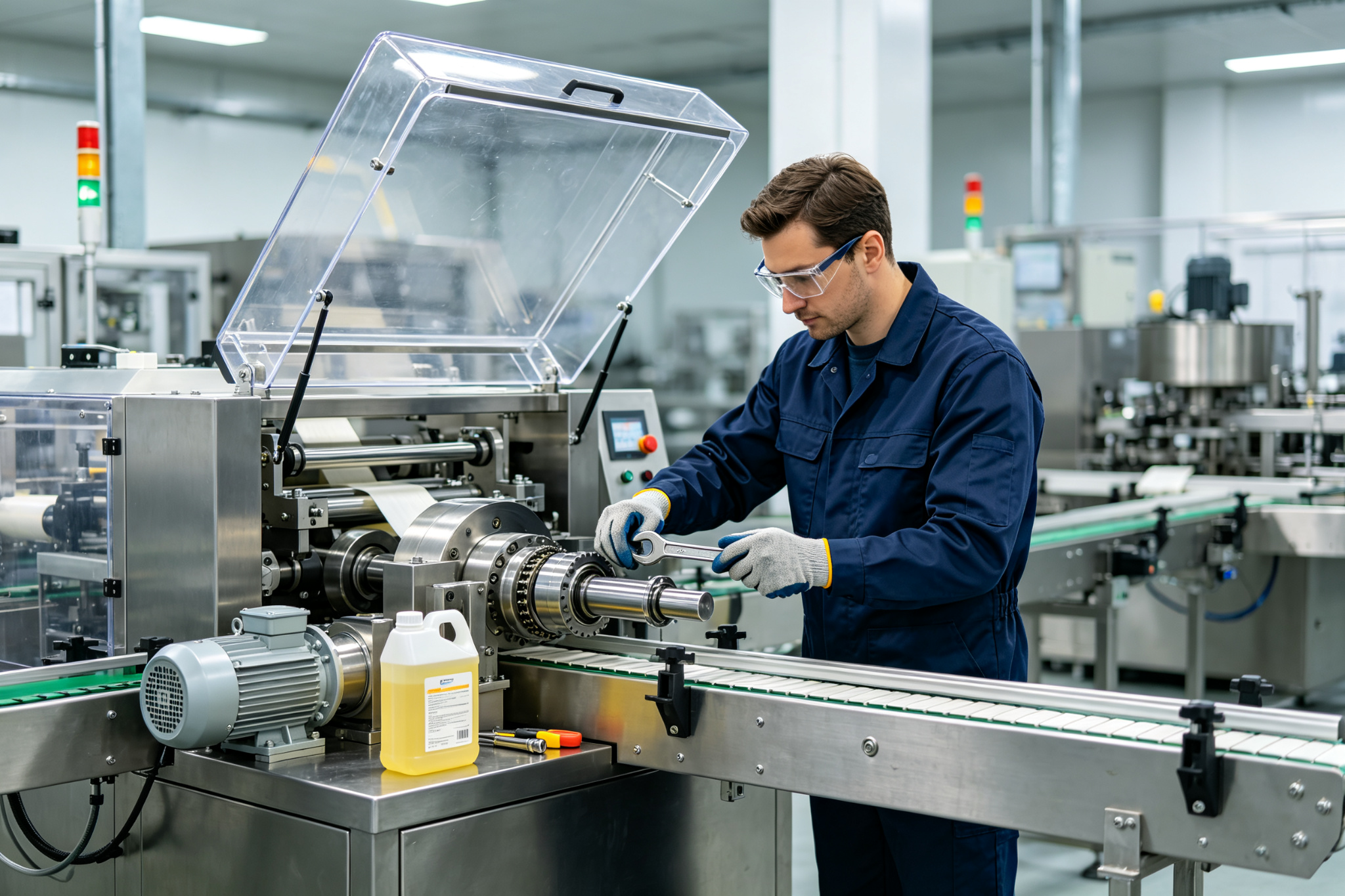
Daily maintenance (each shift start and end)
Daily tasks are quick but non-negotiable. They prevent the slowest degradations and catch obvious problems before a run.
- Visual walk-around. Look for loose guards, leaking air, oil drips, film dust buildup, and any product jam traces. Listen for unusual noise at startup.
- Clean the sealing and forming areas. Film dust, adhesive residue, and product crud build up fast and cause defects. Brush or vacuum the seal bars, former, and fold areas.
- Check safety devices. Test the e-stop and interlocked guards. A guard that bypasses its interlock is a safety failure waiting for an audit.
- Record starting counts and alarms. Note any fault code shown on the HMI at shift handoff so recurring faults are not lost between shifts.
- Check air pressure and drain the filter. Low or wet compressed air causes erratic pneumatic operation. Drain the compressor filter and confirm line pressure at the machine.
Weekly maintenance
Weekly tasks touch wear and adjustment that change over days rather than hours.
- Lubricate per the grease chart. Every machine has labeled lubrication points. Use the specified grease; never substitute a product that is not food-safe where required. Over-greasing is as damaging as under-greasing.
- Inspect and adjust belt tension. Drive belts stretch and slip. Check the run at the prescribed tension and replace any belt that is glazed, cracked, or frayed.
- Check film web path and dancer. Confirm the unwind brake is smooth, the dancer floats freely, and there are no worn rollers or bearings.
- Inspect seal jaws and Teflon. On sealers, look for scored or blistered Teflon cloth; a damaged surface causes weak or uneven seals. Replace at the first sign of damage, not after defects appear.
- Clean and confirm sensors. Photoeyes and proximity sensors covered in dust lose sensitivity. Wipe them and confirm they trigger correctly.

Monthly maintenance
Monthly tasks require the machine stopped and often guarded down.
- Inspect bearings and linear guides. Feel for play, listen for noise under load. A linear bearing with play causes positional errors that no amount of cleaning fixes.
- Check electrical cabinet condition. Confirm fans and filters are clean, doors are sealed, and there is no overheating. A hot cabinet ages electronics fast.
- Inspect chains, sprockets, and conveyor slats. Look for chain stretch and sprocket wear; a worn chain skips and drives product-pitch errors.
- Verify product-transfer hardware. Check pushers, flights, suction cups, and collating guides for wear; these are the parts that actually touch the product.
- Review the alarm log. Pull the HMI alarm history and look for patterns. A fault that appears twice a week is a maintenance appointment waiting to be scheduled.
Quarterly maintenance and calibration
Quarterly work is where measurement and calibration enter.
- Calibrate temperature sensors and controllers. On sealers and shrink tunnels, compare thermocouple readings against a reference probe. A drifted sensor that reads high lets the controller overheat the film. Recalibrate or replace out-of-tolerance sensors.
- Verify safety circuits. Test that every e-stop and guard interlock actually removes power as designed. This is also an audit requirement in most regulated plants.
- Check servo and gearbox condition. Listen for noise, check for oil leaks, and review motor temperatures during a running period. Servo drives rarely fail suddenly; they complain for months first.
- Tighten fasteners and check grounding. Vibration loosens bolts over months; a quarterly torque check on critical mounts prevents a drifting alignment.
Annual major maintenance
Annual tasks are the deep reviews that align with a planned holiday shutdown.
- Replace wear items proactively. Change the belts, hoses, and seal-wire set at their recommended life, not after failure, during a window when the line is already down.
- Inspect and clean the control cabinet internally. Dust and coolant creep into cabinets over a year; clean contacts and confirm every connector is seated.
- Review and update the spare-parts stock. Cross-reference last year’s actual failures against the stock list. A part you never needed can be reduced; a part you had to emergency-order should be added.
- Recalibrate the line as a whole. Re-align conveyors, re-check product pitch, and confirm changeover recipes still load correctly after a year of edits.
- Have the supplier perform an annual inspection where the contract includes one. Fresh eyes on the machine find what your crew has learned to ignore.
Common failure modes and the maintenance task that prevents them
It helps to know what you are preventing. Weak or leaking seals trace back to worn Teflon, jaw misalignment, or drifted seal temperature—all caught in weekly and quarterly checks. Product jams and skew trace back to glazed belts, worn flights, or dirty sensors—caught in weekly cleaning. Premature servo failure traces back to overheating cabinets, loose connectors, or ignored bearing drag—caught in monthly cabinet and bearing inspection. Film and web defects trace back to a worn dancer, tired rollers, or a mis-tensioned unwind—caught in the weekly web-path check. In nearly every case, the failure was announced by a slow drift that the right interval catches before it reaches production.
Keep a simple failure log alongside the maintenance log. When a repair happens, record what broke, how many hours it had run, and what symptom appeared first. After a year, this log tells you which wear items deserve shorter intervals and which are being over-serviced. Maintenance schedules should be living documents, tuned by your own data rather than copied blindly from a manual.
Train the team that does the work
A schedule on paper is useless if the operators and technicians doing the work have never been shown how. Schedule a short practical session when a new line is commissioned: demonstrate each lubrication point, show how to read the HMI alarm history, and walk through the lockout procedure. Cross-train two people on every machine so illness or turnover never leaves the schedule uncovered. When maintenance is treated as everyone’s responsibility rather than a specialist’s afterthought, the line stays healthy; when it is left to a single overloaded technician, the schedule quietly stops being followed.
Building the schedule: by hours, not just by calendar
High-speed machines run differently depending on duty cycle. A line on three shifts wears far faster than a line on one shift. Prefer scheduling by actual running hours where the machine’s HMI tracks them—lubricate after X hours, inspect after Y hours—because calendar intervals ignore how hard the machine actually works. A CMMS or even a simple spreadsheet that logs run hours against task intervals makes this automatic. The schedule should be visible to every operator, not buried in an engineer’s desk drawer.
Spare parts: the maintenance enabler
A schedule without spares is a plan to wait on deliveries. Keep the wear items that actually fail—seal wires, Teflon strips, belts, suction cups, sensors, thermocouples, fuses—on the shelf. Holding the right spares turns a six-hour emergency repair into a thirty-minute swap. For a worked view of how the maintenance program protects the line, the same discipline feeds the total cost of ownership calculation for automatic packaging lines, because downtime and parts cost are two of the biggest lifetime line items. For the shrink side specifically, our heat shrink packaging machine troubleshooting guide lists the wear items to watch on sealers and tunnels.
How this applies to your SunAura Packaging Machines equipment
SunAura Packaging Machines ships each machine with an operation and maintenance manual, a labeled lubrication chart, and a recommended spare-parts list. The schedule above is the general framework; your machine’s manual supplies the exact intervals and part numbers. On servo equipment such as a servo cartoner, the HMI can report runtime and alarm history so the schedule is driven by actual use. On flow wrappers such as the five-servo flow wrapper, the film path and seal assembly are the weekly focus. On end-of-line palletizing with a collaborative palletizing robot, the focus shifts to cable dress, tooling, and safety scanners. Wherever the machine sits in your line, the principle is the same: inspect, clean, lubricate, adjust, and replace on a written schedule.
When a line is being extended or modified, fold the new equipment into the maintenance program from day one; our guide on integrating new packaging machinery into existing production lines explains why that handover matters. And when you specify a new machine, the maintenance burden is a purchase criterion, not an afterthought—the cartoning machine buying guide for pharma and cosmetic manufacturers flags service access and spares support explicitly.
A one-page maintenance calendar to start today
- Daily: walk-around, clean sealing area, test e-stop, drain air filter, note alarms.
- Weekly: lubricate, check belts, inspect Teflon and sensors, check dancer.
- Monthly: inspect bearings and guides, clean cabinet fans, review alarm log.
- Quarterly: calibrate thermocouples, test safety circuits, check servo condition.
- Annually: replace wear items, deep-clean cabinet, refresh spares, re-align line.
Preventive maintenance turns a packaging line from a source of surprises into a predictable asset. It is not glamorous work, but on a high-speed line it is the difference between meeting the shipment plan and explaining a missed order. SunAura Packaging Machines supports customers with manuals, spare parts, and after-sales service; for a copy of the recommended schedule for your specific machine or to discuss a service agreement, reach our team through the contact page.

James oversees the engineering architecture for full end-of-line projects: defining machine sequence, conveyor layout, line balance, footprint and expansion capacity before individual machines are ordered. He reviews customer specifications, production rates and facility constraints, and signs off on the engineering drawings and acceptance tests. His articles take the system-level view a procurement manager needs.
See Full Bio ›