

Packaging machines are full of motion that can hurt people: a case erector folds flaps with a sharp closing arm, a case packer picks and places at high speed, a palletising robot sweeps an arc through a large envelope, and a wrapper rotates a load weighing a tonne. The machines are safe when guards, interlocks, stopping logic and operating procedures are designed together, and dangerous when they are not. This guide walks through the safety framework that a properly built end-of-line packaging cell should follow — the standards, the risk assessment, the hardware and the documentation — whether the destination is the EU, the UK, the US or the Middle East.
SunAura Packaging Machines builds end-of-line equipment for export, and we treat safety as an engineering discipline, not a sticker. The points below reflect what is actually specified on our integrated packaging lines, from the case erector at the start of the line to the pallet wrapper at the end.
The standards that govern packaging machine safety
Machine safety is not governed by a single document. It is a stack of standards, and each one answers a different question.
- ISO 12100 is the risk-assessment and risk-reduction standard. It defines how to identify hazards, estimate risk and reduce it by design, guarding and information.
- ISO 13849-1 covers the safety-related parts of the control system. It assigns a Performance Level (PL) from a to e, and a Category (B, 1, 2, 3 or 4) to each safety function. A light curtain on a palletiser is usually a different PL to a simple door lock on an enclosure.
- ISO 13855 sets the minimum safety distance between a detection device (such as a light curtain or safety mat) and the nearest hazard, based on the machine’s stopping time and the operator’s approach speed.
- ISO 14120 covers fixed and movable guards, and ISO 14119 covers interlocking devices associated with guards.
- ISO 10218-1 and -2 cover industrial robots, and ISO/TS 15066 provides guidance for collaborative robots — the machines that share a workspace with people.
- IEC 60204-1 is the electrical equipment standard, covering control circuits, emergency stops, colour coding and protection against electric shock.
- The EN 415 family is specific to packaging machinery, with parts covering form-fill-seal, strapping, wrapping and pallet load-securing machines.
CE marking and the changing machinery rules
For the European market, machinery has been placed on the market under the Machinery Directive, which requires the manufacturer to carry out a conformity assessment, build a technical file and issue a Declaration of Conformity. The EU is moving to a new Machinery Regulation, which tightens a few requirements and changes the conformity process; the transition period runs through the mid-2020s, and buyers specifying equipment now should ask the supplier which regulation the machine is being declared against and when the declaration is dated.
For North America, the equivalent packaging-machine standard is ANSI/PMMI B155.1, and the United States adds OSHA requirements including the point-of-operation guarding rule and the lockout-tagout (LOTO) standard for maintenance. Robotic cells follow the ANSI/RIA standards, which are aligned with ISO 10218. A machine that satisfies EN 415 and ISO 13849 will usually be close to the US requirements, but the guarding distances and the LOTO procedure must be checked against the local standard.
The risk assessment is the starting point
Every safety decision should trace back to a documented risk assessment. The method is straightforward, but it must be done machine by machine and then again for the integrated line, because hazards appear at the interfaces between machines that no single OEM owns.
- Identify the hazards. Crushing, shearing, cutting, entanglement, drawing-in, impact, puncture, friction, pressure (pneumatic and hydraulic), electricity and slips from film or packaging debris.
- Estimate the risk. Consider severity of the injury, the frequency of exposure, and the possibility of avoiding the hazard. A rotating wrapper arm that an operator approaches every shift is a higher-frequency exposure than a guarded gearbox that is opened once a year.
- Reduce the risk in order. First remove the hazard by design (slow the motion, change the geometry), then guard it, then add detection devices, and finally rely on warnings and procedures.
- Document the residual risk. Some hazards cannot be fully engineered out — a jam that requires an operator to open a machine is the classic example — and these become part of the operating procedure and training.
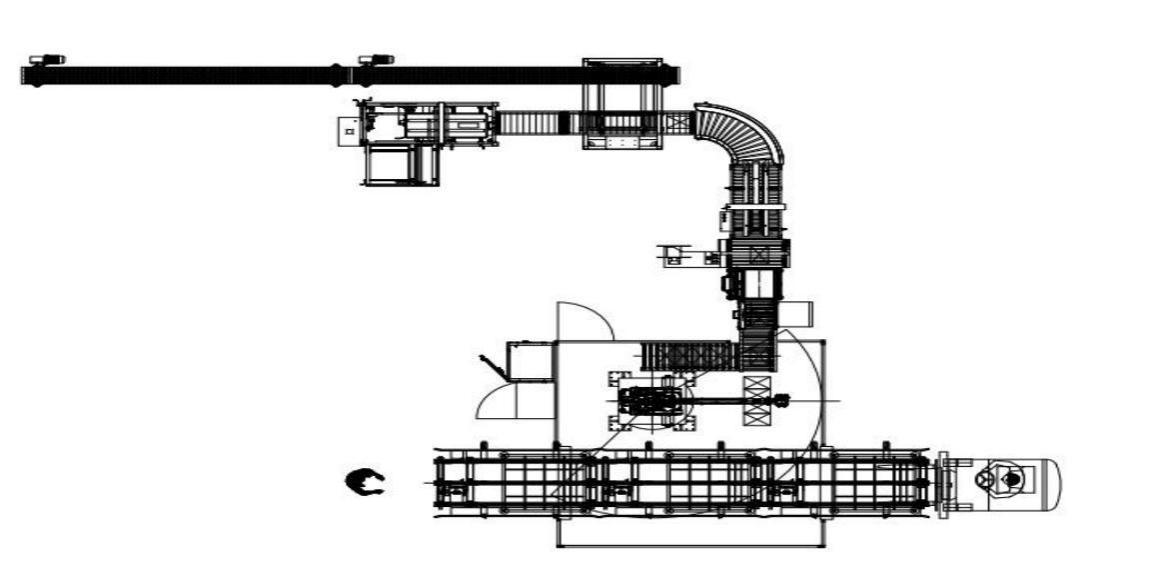
The integrated assessment matters because the line-level hazards are often the ones that injure people. The gap between the case sealer and the case packer, the pinch point where a case transfers between two conveyors, and the palletiser’s infeed are each owned by a different machine but encountered by the same operator. SunAura Packaging Machines treats these interface points in the line-level design and shows them in the line layout.
Guards, interlocks and the hierarchy of access
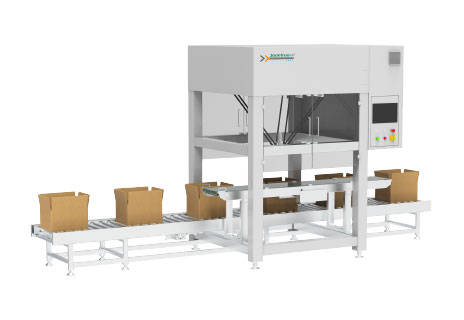
Most fixed hazards on a case erector or case sealer are covered by fixed guards bolted in place; these are the most reliable guards because they cannot be bypassed. Movable guards — the doors that must open for loading, changeover or clearing — use interlocking devices. Under ISO 14119, an interlocked door stops the hazard before an operator can reach it, and the designer must account for how easily the interlock can be defeated.
Interlocks are chosen to match the risk. A lower-risk door may use a tongue-actuated switch; a high-risk door on a palletiser typically uses a tamper-resistant, coded (RFID) interlock with a guard-locking function that keeps the door locked until the robot has actually stopped. This distinction — interlocking alone versus interlocking with guard locking — is important. Interlocking removes power when the door opens; guard locking physically prevents the door from opening while the machine is in a dangerous state. For machines with a long run-down time, locking is required.
Stopping time and safety distance
A light curtain or safety mat only protects the operator if it is mounted far enough from the hazard that the machine has stopped before the person can reach the moving part. ISO 13855 calculates this from the response time of every component in the chain — the light curtain, the safety relay or controller, the drive’s braking time — plus a standard approach speed. A common mistake is to install a light curtain at a convenient distance and assume it is safe; the correct distance is a measured value, and it must be re-checked if the machine speed or the drive is ever changed.
Emergency stops and safety controls
Emergency-stop buttons must be red with a yellow background, located at every operator station and at key points around a long line, and they must be latching so that the machine cannot restart until the button is reset. On a packaging line, the e-stop should be wired so that stopping one machine brings the connected line to a controlled stop in the correct order — a case packer that stops while the erector keeps feeding will simply jam the whole cell.
Under ISO 13849, the safety function is built from components whose reliability is understood: a safety relay or safety PLC, two-channel inputs on the critical devices, and monitoring that detects faults. Cat.3 / PL d is the most common target for the hazardous functions on a palletising or case-packing cell. This does not mean every single device is PL d; the assessment sets the required level per function, and over-specifying everything is both wasteful and a sign that no real assessment was done.
Collaborative robots are not fence-free by default
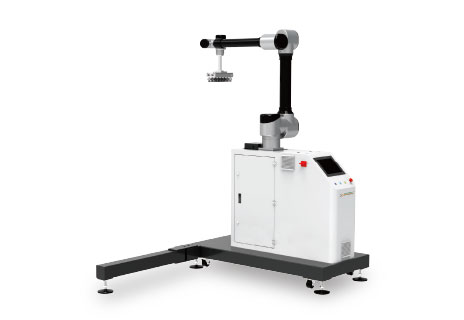
A frequent misunderstanding is that a collaborative palletiser is automatically safe without guarding. It is not. Collaborative operation describes one of four modes — most cobot palletisers use power-and-force-limiting, where the robot is designed to stop on contact. That mode is valid only inside a defined envelope, with the payload, the end-of-arm tool, the case weight and the speed all within limits, and with a risk assessment that shows the contact energy is below the threshold for the body region that could be struck.
Add a heavier case, a faster cycle or a sharp gripper, and the same robot is no longer collaborative and must be guarded as a conventional industrial robot. This is why our collaborative palletising guide insists on checking case weight and layout first. A robot that is genuinely collaborative for 10 kg cases at six cases per minute may require a light curtain or fencing at 15 kg and a faster pattern. The line in the catalogue is not the safety boundary; the assessed application is.
High-risk machines within the end-of-line
Some machines deserve specific attention because their hazards are less obvious than a robot’s sweep.
- Upenders and tilters rotate or tip heavy loads (coils, moulds, drums) and create a large moving mass plus a clamping action. They require guarding of the rotation envelope, interlocked access during the tilt and positive clamping that holds the load on power loss. Our upender and tilter engineering guide covers the drives and clamping in detail.
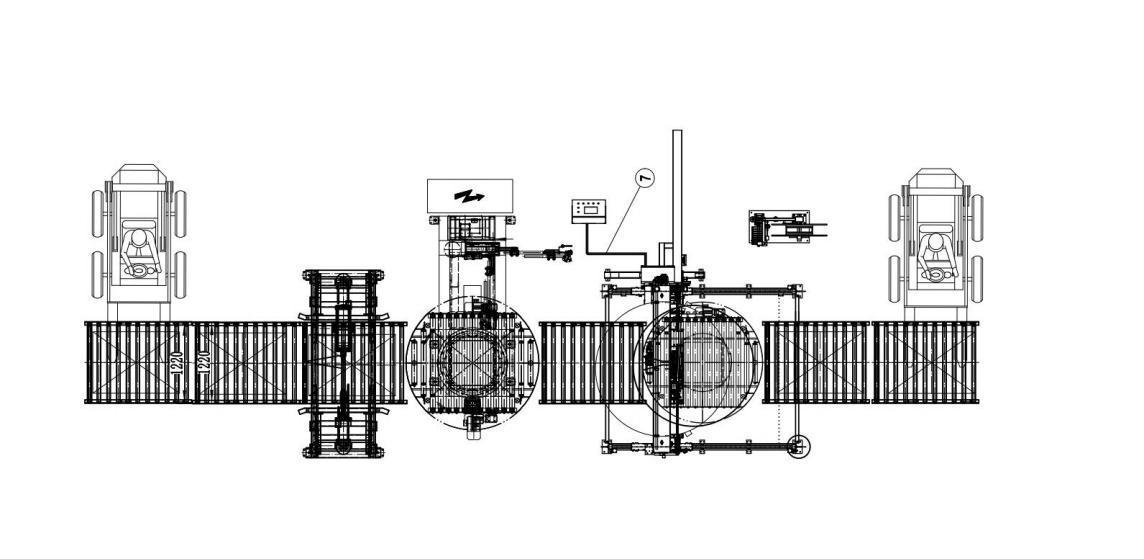
- Stretch wrappers have a rotating turntable or rotating arm, a moving film carriage and a tall mast. Automatic inline wrappers must stop the rotation if an operator enters the envelope, usually with a safety scanner and slow-speed approach logic.
- Strapping machines combine a heated sealing head, a feed mechanism that pulls band and, on horizontal or through-eye units, a frame that travels over a pallet. The band path and sealing head are both guarded, with access interlocked.
- Shrink tunnels add heat and moving conveyor; guarding here must also account for the hot surfaces and exhaust.
Safety during changeover, maintenance and clearing jams
A large share of packaging-machine injuries happen not during normal running but during the moments when the machine is “not supposed to be moving” — clearing a jam, changing a roll of film, cleaning a sealing head or changing a tape head. These tasks must be covered by a written procedure.
- Lockout-tagout. Energy isolation (electrical, pneumatic, hydraulic and stored spring energy) with a personal padlock, so the machine cannot be restarted by a colleague while someone is inside it.
- Slow or jog mode. Tasks that genuinely need motion, such as timing a case packer, use a hold-to-run control at reduced speed so the machine moves only while the operator is actively commanding it.
- Defined clearing procedures. A jammed case is removed with the guards open and the interlock in stop mode — never by reaching through a gap while the machine is running.
- Changeover by recipe. Machines that store size recipes as HMI settings reduce the number of physical adjustments and the time the guard doors are open.
Preventive maintenance itself prevents safety problems: a worn guard hinge, a loose interlock or a failing brake all degrade the safety system silently. The preventive maintenance checklist includes safety devices for exactly this reason.
Common safety defects found at commissioning
Most safety defects that surface after delivery trace to a small set of causes that are easy to miss during a fast commissioning. Check for these before the line is signed off:
- Bypassed interlocks never restored. A gate or guard interlock bridged during setup must be reconnected and tested before production; a bypass left in place defeats the guard entirely.
- Light curtains muted without a defined rule. Muting must follow a documented, risk-based condition; an always-muted curtain provides no protection.
- Ordinary contacts used in a safety circuit. Safety functions must use the contacts and architecture the required Category and PL call for, not standard industrial contacts.
- E-stop wired to a non-safety circuit. The emergency stop must act through the safety function defined in the risk assessment, not an ordinary stop relay.
- Missing LOTO points on pneumatic sections. Compressed-air and stored-energy sections need their own isolation and lockout points, not only the electrical supply.
When a fault appears, troubleshoot the machine-side cause; guards and interlocks must never be disabled to keep production running. Our reference on 15 common packaging machine problems and fixes covers the operational faults without compromising the safety circuit.
What to ask a machine supplier before you buy
Documentation is the fastest way to tell a machine that was actually engineered for safety from one that simply arrived with a CE sticker. Request the following:
- The Declaration of Conformity and the standards list it references.
- The risk assessment for the machine and, for a line, the integrated risk assessment.
- The ISO 13849 safety functions and their required Performance Level and Category.
- Layout drawings showing guard dimensions, e-stop positions and light-curtain safety distances.
- The electrical schematic showing the safety circuit and device list.
- The lockout-tagout procedure and the changeover and clearing procedures.
- Confirmation that the guarding and interfaces between machines are included, not left to the integrator on site.
When these documents are supplied in advance and they match the machine as built, the FAT and SAT become straightforward. When they are missing, vague or produced only after the order, the safety work will be left to the installer, and that is where the most expensive and dangerous gaps appear.
SunAura Packaging Machines’ case packers, palletisers and full packaging lines are built to this framework, with the safety dossier provided as part of the standard export package. If you are evaluating a cell, send the layout and your local safety requirements with the RFQ; the guarding and control design are most cost-effective when they are considered at the layout stage rather than retrofitted once the machine is on the floor.

Kevin works on machine development for shrink bundling, shrink hoods and vacuum packaging. He tests film shrink ratios, tunnel heat zones, seal bar performance and chamber cycle times, and feeds that back into machine frame and conveyor design. He writes technical articles on shrink film selection, tunnel temperature balancing and vacuum packaging for industrial and food-adjacent secondary packs.
See Full Bio ›