

Palletizing is the job most plants automate first and most want to stop doing by hand. Lifting cases, bags or bundles all shift, bending and stacking them layer after layer, is repetitive, physically hard and increasingly difficult to staff, and a single missed case on a manual pallet is enough to shift a load in a truck. For mid-speed lines that do not justify a large conventional palletizer, a collaborative palletizing robot has become the standard answer: a compact, force-sensing robotic cell that stacks cases onto pallets from stored patterns, works alongside people without a full safety cage and moves between lines when production changes. SunAura Packaging Machines supplies three such cells — the WP-20, WP-40 and WP-50 — and this guide explains how they work, how they compare and how to specify one.
If you stack cases by hand, have a line running between roughly five and twelve picks per minute, or struggle to keep pallet positions staffed across shifts, the sections below cover the robot’s mechanics, its safety model, the payload and pattern calculations, the layout it needs and the questions that decide which cell fits your line.
What a collaborative palletizing cell is
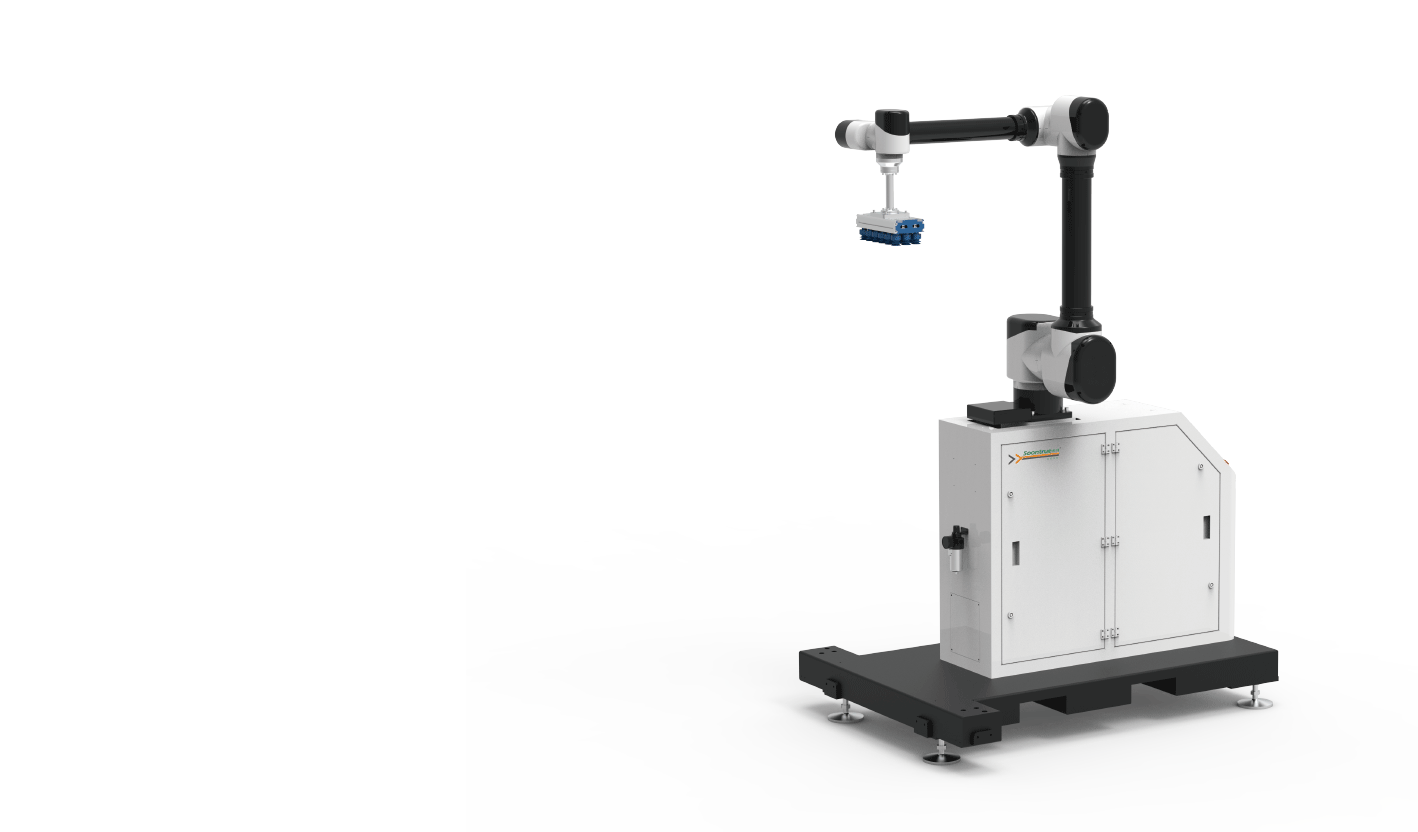
A palletizing cell pairs a multi-axis robot with a lifting column or fixed base, a gripper suited to the product, an infeed conveyor for cases and one or two pallet positions. Cases arrive on the infeed, the robot picks one or several at a time and places them according to a layer pattern, and the cell indexes upward as the pallet builds. Patterns are stored as recipes: after basic parameters such as case and pallet dimensions are entered, the robot builds each layer automatically, and changing from one product to another is a recipe selection rather than a mechanical rebuild. The whole unit is compact — the WP-20 occupies roughly 3.4 × 1.7 m including its lift — and can be moved with a forklift, which suits plants that run different products on different lines.
The three cells, with verified numbers
SunAura Packaging Machines publishes factory-verified specifications, and the three models span the payload and speed range mid-speed lines need:
| Specification | WP-20 | WP-40 | WP-50 |
|---|---|---|---|
| Max payload (incl. gripper) | 30 kg | 45 kg | 45 kg |
| Reach | — | 1780 mm | 1780 mm |
| Palletizing rate | 8–12 picks/min | ≤8 picks/min | ≤6 picks/min |
| Max pallet height | ≤2600 mm | ≤2550 mm | ≤2450 mm |
| Repeatability | — | ±0.05 mm | ±0.04 mm |
| Installed power | 3 kW | 3.5 kW | 3.5 kW |
| Air consumption | 200 L/min | 240–460 L/min | 240–460 L/min |
| Net weight | 600 kg | ≈650 kg | ≈650 kg |
| Max pallet size | 1200×1200 mm | 1200×1200 mm | 1200×1100 mm |
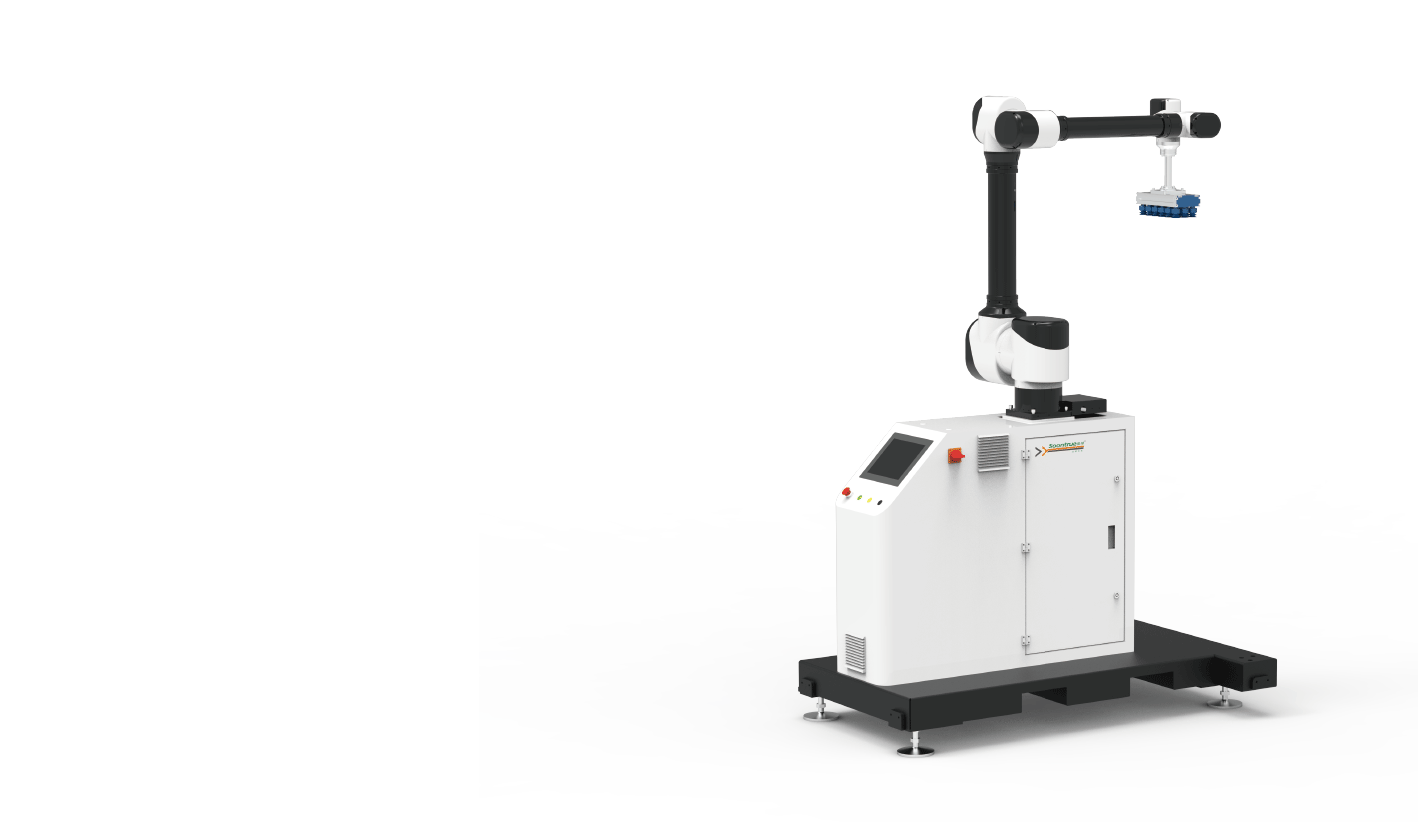
The WP-20 collaborative palletizing robot is the fastest cell and suits lighter cases at the highest rates; the WP-40 carries heavier cases with a 1780 mm reach; and the WP-50 is built around a simplified structure with EtherCAT communications and IP54 protection for heavier, slower duty. As always, planning should use the rate achievable with the actual case and pattern rather than the top figure, the discipline in SunAura Packaging Machines’ guide to real throughput.
The payload calculation buyers miss
The single most common specification error is treating the rated payload as the case weight. The payload figure includes the gripper, and a robot rated at 30 kg carrying a 5 kg gripper has 25 kg left for product. If the robot picks multiple cases per cycle — which is how higher effective rates are reached — their combined weight plus the gripper must stay within the rating. The calculation is therefore: case weight × cases per pick + gripper weight ≤ rated payload, checked at the furthest reach of the pattern, where a robot’s capacity is at its lowest. A line packing 18 kg cases two at a time needs a 45 kg class cell even though each case is well under 30 kg, and SunAura Packaging Machines works this through with the customer’s actual cases rather than applying the model name as a rule.
Gripper choice follows the product. Vacuum grippers handle sealed cases and smooth bundles; mechanical or fork grippers handle bags, open-top trays and porous surfaces; and custom grippers handle mixed or unusual products. Bags of grain, cement or pet food deform when lifted and need grippers designed for that, while rigid RSC cases suit vacuum. The gripper also affects air consumption, which is why the specifications list air use alongside power.
The safety model: what collaborative really means
A collaborative robot uses force- and torque-sensing to detect contact and stop, which allows it to run beside people without the fully enclosed cage a conventional robot requires, but collaborative is not the same as unguarded in every arrangement. The safety assessment covers the specific application: the speed and force limits, the gripper and product being carried — a robot swinging a heavy case is not harmless on contact — and the areas where operators approach for pallet removal. Where people enter the cell frequently, scanners slow the robot as they approach and stop it at close range; where pallet exchange keeps people out, light curtains or fixed guarding may be used instead, and the WP-50 can be specified with optional protective doors or light curtains.
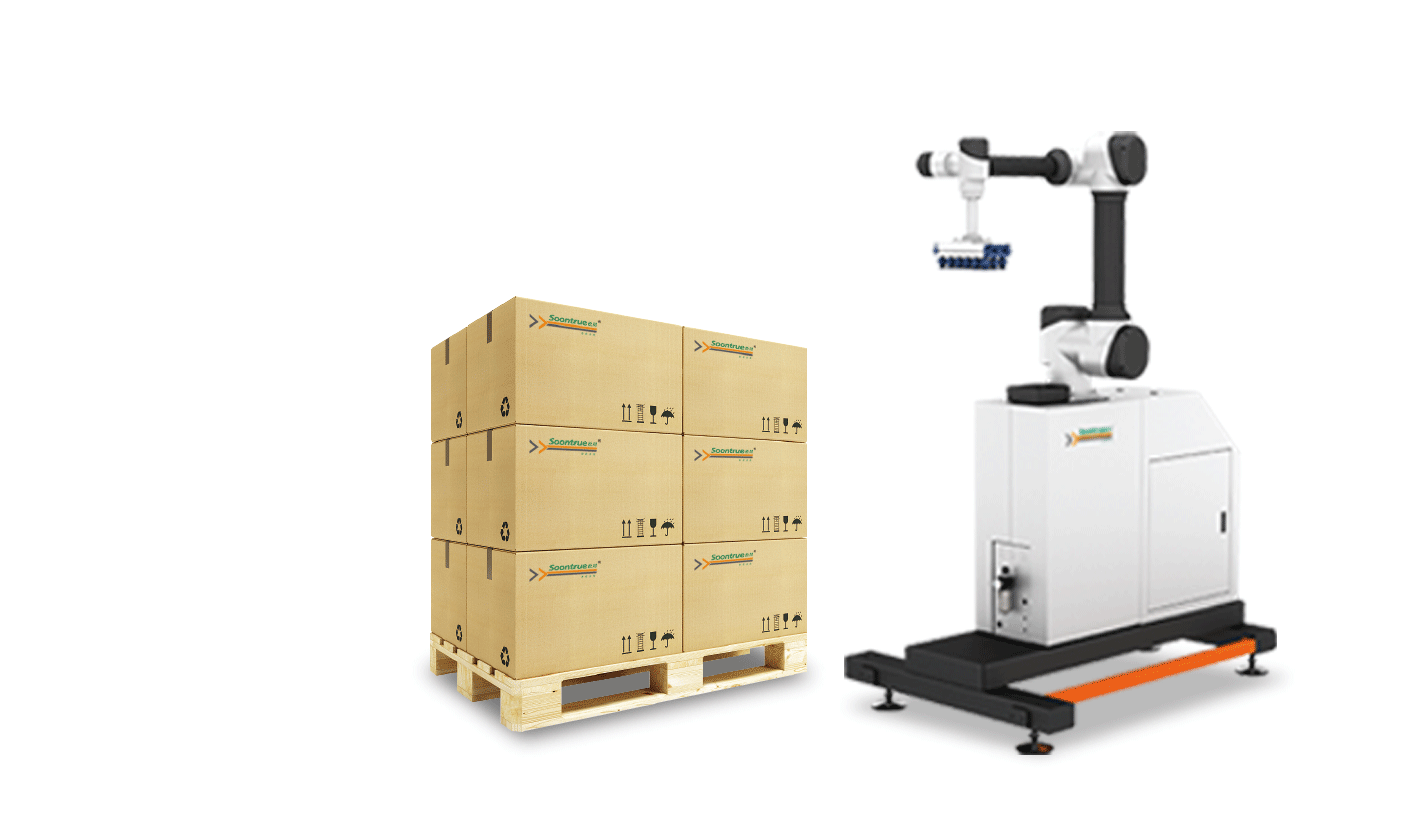
The practical result is a cell that occupies far less floor than a caged conventional robot and lets operators remove full pallets and supply empties without a fenced perimeter, while still meeting the machinery safety requirements. SunAura Packaging Machines completes the risk assessment for the actual layout at commissioning, because a robot safe in one configuration — slow, light cases, scanner area — is not automatically safe run faster with heavier product.
Patterns, pallet positions and empty-pallet handling
Pallet patterns are where a robot shows its flexibility. Interlocked patterns, where cases overlap between positions, produce the most stable loads and are generated automatically once case and pallet dimensions are entered; the robot stores patterns for every product and recalls them in seconds. Cells are configured with one or two pallet positions — the WP-20 and WP-40 can place to either side — and two positions let the robot move straight onto an empty pallet while a full one is removed, eliminating the exchange pause. Automatic empty-pallet dispensers can be added so the cell runs unattended for longer, while manual placement suits smaller operations. For mixed production, where pallet heights and patterns change with each order, stored recipes replace the inconsistent stacks hand stacking produces, which is the main reason loads shift and get rejected at goods-in.
Layout, utilities and integration
The cell needs a flat floor, the infeed conveyor delivering cases at a fixed orientation, and space for pallet removal by forklift or hand pallet truck; two-pallet layouts are planned so the truck can reach one position while the robot works the other. Power is 380 V three-phase for the WP-20 and 220 V for the WP-50, with compressed air at 0.5–0.7 MPa for pneumatic grippers, and the upstream line must feed cases at least as fast as the robot’s pick rate, with a short accumulation section so the robot never waits. The integration principles match SunAura Packaging Machines’ wider guidance on conveyors and product handling, and the cell is often placed after an automatic sealer, with wrapped pallets then moving to a wrapper — the combination described in the guide to end-of-line layout and the selection of pallet wrappers.
Cobot versus conventional palletizer
Buyers sometimes compare a collaborative cell with a high-speed conventional palletizer, and the dividing line is rate and variety. Conventional machines palletize faster and suit a single product at high volume, but they are larger, more fixed and less flexible across patterns. Collaborative cells trade top speed for compactness, mobility, recipe flexibility and lower guarding requirements, and they fit the mid-speed, multi-SKU lines most plants actually run, often at lower total installed cost. For lines above roughly a dozen picks per minute on a single product, a conventional or robotic high-speed cell is considered; below that, and wherever products and layouts change, the collaborative cell wins, a comparison SunAura Packaging Machines develops case by case.
A worked layout scenario
The cell’s value is clearest in a concrete layout. Imagine a household-products plant running two lines into one shared palletizing area, cases of tissue and cleaning goods sealed at the end of each line and conveyed to a single WP-40. The robot is configured with two pallet positions, so while it stacks one pallet the forklift removes the completed one and places an empty, and the line never stops for exchange. Cases of different products carry different patterns, each stored as a recipe and recalled when the product changes, and the scanner-defined area slows the robot when a forklift approaches. On a day when the second line runs a heavier product, the same cell handles it because the 45 kg payload covers both, and at the weekend the cell is moved with a forklift to palletize a third line in another bay — the flexibility a fixed conventional palletizer cannot offer.
That scenario also shows the planning discipline: the infeed conveyor must orient every case the same way, the accumulation ahead of the robot must hold enough cases for a pallet exchange, and the forklift routes must not cross the robot’s working area. Plants that work these out before installation reach production in days; plants that improvise spend weeks chasing misoriented cases and blocked exits.
Maintenance and the practical return
A collaborative cell needs little maintenance compared with a conventional palletizer — there are few mechanical adjustments and no layer-forming mechanisms to set. The practical checks are the gripper and its suction cups or fingers, the vacuum system where fitted, the lifting column and its guides, and the safety scanners and emergency circuits, which are tested on a schedule because their correct function is what makes the open layout safe. The robot’s own joints are sealed and rated for long life, and the HMI logs faults for diagnosis. The return is counted in the labour removed from a job plants increasingly cannot staff, in the consistent patterns that stop loads shifting and being rejected, and in the absence of the strain injuries manual stacking produces; for a two- or three-shift operation the labour saving alone typically justifies the cell well within its first years, alongside the lower total installed cost versus a caged conventional machine.
Frequently asked questions
How many cases per minute will it handle?
From 6 to 12 picks per minute depending on model, with multi-pick cycles raising the effective case rate; the real figure is confirmed against your case weight, pattern and pallet height.
Can it work safely next to my operators?
Yes, within the assessed force and speed limits, using force sensing and, where needed, scanners or light curtains; the safety assessment is completed for the specific gripper and product.
How are patterns changed?
Patterns are stored recipes generated from case and pallet dimensions, recalled at the HMI, so product changes take seconds rather than mechanical adjustment.
Can it stack bags as well as cases?
Yes, with a gripper suited to bags or trays; bag handling is specified separately because filled bags deform and do not suit vacuum grippers.
What utilities are required?
A flat floor, 220 or 380 V supply per model, compressed air for pneumatic grippers and forklift access for pallet exchange.
Conclusion
A collaborative palletizing robot gives mid-speed lines a compact, movable, recipe-based cell that stacks cases and bags without a full cage, replacing the manual lifting plants struggle to staff and the inconsistent patterns that cause loads to shift. Specified by the real payload — cases plus gripper, checked at full reach — the pick rate, the safety arrangement and one or two pallet positions, the WP-20, WP-40 and WP-50 cover the range from fast light cases to heavier slower duty, and they sit naturally after the sealer and before the wrapper in a balanced end-of-line.
If you want to stop hand-stacking pallets, contact SunAura Packaging Machines’ applications engineers with your case weights, dimensions and line rate, or review the cells in the products hub, including the three collaborative robots and the conveyors and wrappers that complete the line. Where the cell replaces manual stacking across two or three shifts, the saving in labour alone usually covers it within the first years, and the consistent, interlocked patterns reduce the rejected loads that arrive shifted at customer goods-in. SunAura Packaging Machines sizes each cell against the real case weights and pick rate, with grippers, scanners and pallet positions confirmed for the actual layout, so buyers receive a line that reaches production quickly rather than a machine matched only to its model name.

Sarah evaluates packaging consumables against machine capability: film gauge and prestretch, PP versus PET and steel strapping, core width, tension settings and corner board use. Her articles connect film and band choice to machine settings, freight damage rates and total cost per pallet, rather than recommending the cheapest consumable on paper.
See Full Bio ›