

When buyers picture a packaging line, they usually picture the machines: the case erector clicking boxes open, the sealer taping them shut, the robot stacking pallets. The machines are where the visible work happens, and they tend to get the budget and the attention. But walk onto a line that actually runs well and the thing that ties it together is far less glamorous — the conveyors and product-handling systems between the machines. A fast erector feeding a slow conveyor is a pile of boxes. A packer that receives products at the wrong pitch is a jam. A palletiser starved by a gap in accumulation is a robot standing idle. At SunAura Packaging Machines we treat line logistics as a piece of engineering in its own right, and the projects that commission fastest are the ones where the conveyors were specified before the machines were ordered, not after.
This guide explains how to choose the conveyors and handling equipment that move product through a packaging line: the difference between belt, roller, slat and modular-plastic conveyors; why accumulation and buffering decide whether a line stops; how products are aligned, turned, merged and singulated; and how to size transfer heights, speeds and controls so that machines hand product off cleanly. We will look at integrated logistics systems, random product feeders and the automated handling cells that replace manual carrying between stations. If you are laying out a new end-of-line or trying to understand why an otherwise capable set of machines keeps stopping, the sections below follow the same logic our applications engineers use.
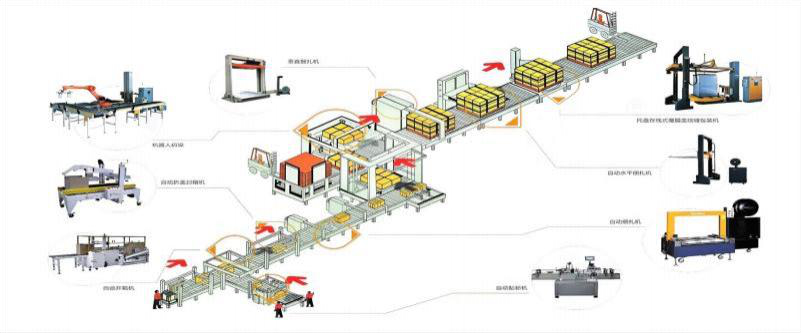
Why the conveyor is the line, not the space between it
A packaging line is a series of processes, each with its own cycle time, and the conveyor system has to absorb the differences between them. The erector may produce a case every two seconds in bursts; the packer may work continuously; the sealer and strapper index at fixed intervals; the palletiser pauses while it builds a layer and stops entirely while a finished pallet is swapped. Without accumulation — conveyor sections that can hold product and release it on demand — every one of those pauses propagates upstream, stopping machines that could otherwise keep running. This is the central principle of line logistics: conveyors exist not only to move product but to decouple the machines, so that a short stop at one station does not become a stop across the whole line.
How much accumulation is enough depends on the machines. A palletiser that pauses for thirty seconds while it changes layers needs enough buffer upstream to hold thirty seconds of cases; a pallet-swap that takes two minutes needs either a two-minute accumulation lane or an upstream machine that is allowed to stop without harm. Lines with adequate buffer run closer to their rated output because small disturbances are absorbed rather than amplified. Lines with no buffer — machines bolted close together with short transfer conveyors — look compact and economical on a layout drawing and stop constantly on the floor.
Types of conveyor and where each belongs
Belt conveyors
Flat belt conveyors move products continuously and gently, making them the default for loose or irregular products, primary packs, and any load that needs a stable, continuous surface. They suit the infeed to wrappers and packers where product position matters, and inclined belts can raise or lower product between levels. A belt gives good traction and can carry products up modest inclines with flights or grip surfaces, but it is less forgiving than rollers for heavy, rigid loads and for accumulation, where cases should slide or stop rather than drag against a moving belt.
Roller conveyors
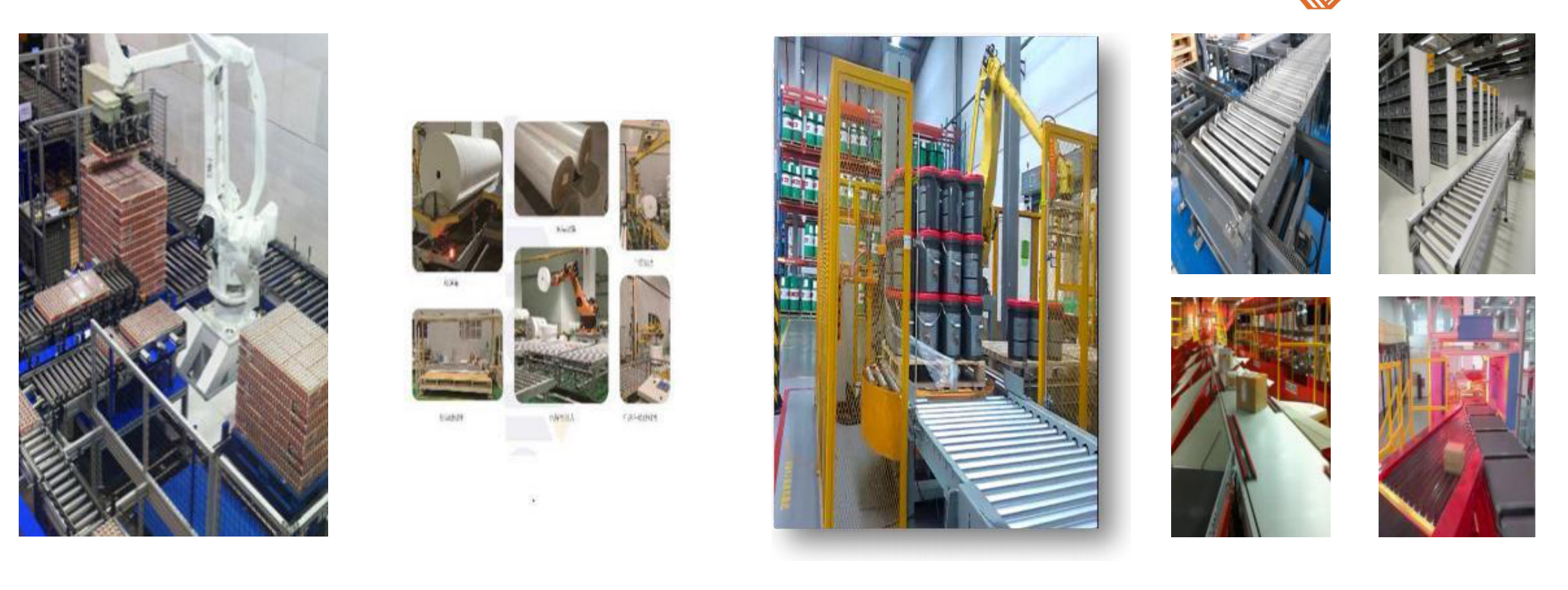
Roller conveyors — gravity or powered — are the workhorses for cases, boxes and pallet loads. Cases ride on rollers, can accumulate with the right drive (zero-pressure accumulation uses zones that stop independently), and transfer cleanly between sections. Powered roller conveyors handle the steady movement of sealed cases toward strapping and palletising, while heavy roller or chain conveyors move complete pallets. For a distribution centre or any line handling uniform cases, roller conveyors are the standard because they combine capacity, accumulation and durability at a sensible cost.
Slat and modular-plastic conveyors
Slat conveyors and modular-plastic-belt conveyors use interlocking slats or belt modules, giving a flat, robust, positively driven surface that can turn corners, carry heavy or hot products, and tolerate washdown and demanding environments. They are common in food and beverage plants, where the belt can be cleaned, and in lines that need products held in fixed positions or moved through curves. Modular belts also handle side-flexing paths that a flat belt cannot, which helps in factories where the line must bend around columns or existing equipment.
Chain and special conveyors
Pallet loads and very heavy products move on chain conveyors, turntables and transfer cars; specialised handling — such as the coil and roll handling in our wrapping range — uses saddles, V-blocks and powered rollers matched to cylindrical loads. The choice always follows the load: a conveyor that is right for a 300 g flow-wrapped pack is not right for a 1,000 kg pallet, and specifying the wrong type is the most predictable source of premature wear.
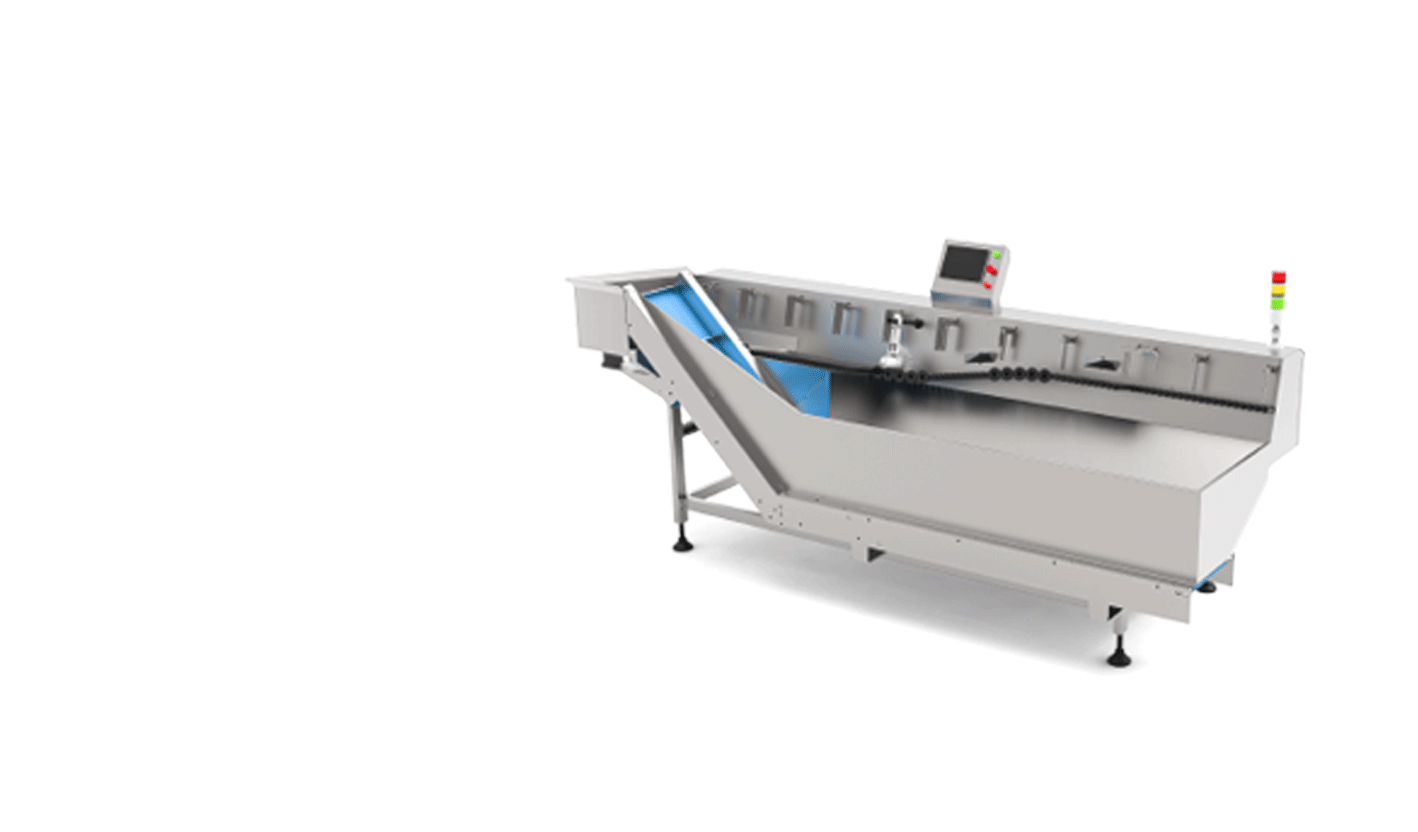
Aligning, feeding and singulating product
Getting product onto a conveyor is one problem; presenting it to a machine in the correct orientation and pitch is another. Products arrive from upstream processes in rows, batches or random order, and the handling system must turn, merge, space and align them before they reach a wrapper, packer or cartoner. The WX160 random product aligning feeder is built for exactly this: it receives products in a random stream and arranges them at the spacing and orientation the downstream machine requires, removing the operator who would otherwise place them by hand. For irregular or delicate products, this kind of feeding station can be as important to the line’s output as the machine it supplies.
Several handling operations recur across projects. Merging brings two lines into one — for example, two wrappers feeding a single cartoner. Dividing splits one line into two packing stations. Turning rotates cases or products so labels or seams face the right way. Singulating separates a clump into individual items at a set pitch. Each is a small piece of automation, but when any one is missing, an operator appears at that point, and the line’s throughput becomes bounded by manual handling. Deciding early which of these operations to automate — based on the labour cost and the required speed — is part of sizing the whole line rather than just the machines.
Integrated logistics systems and automated cells
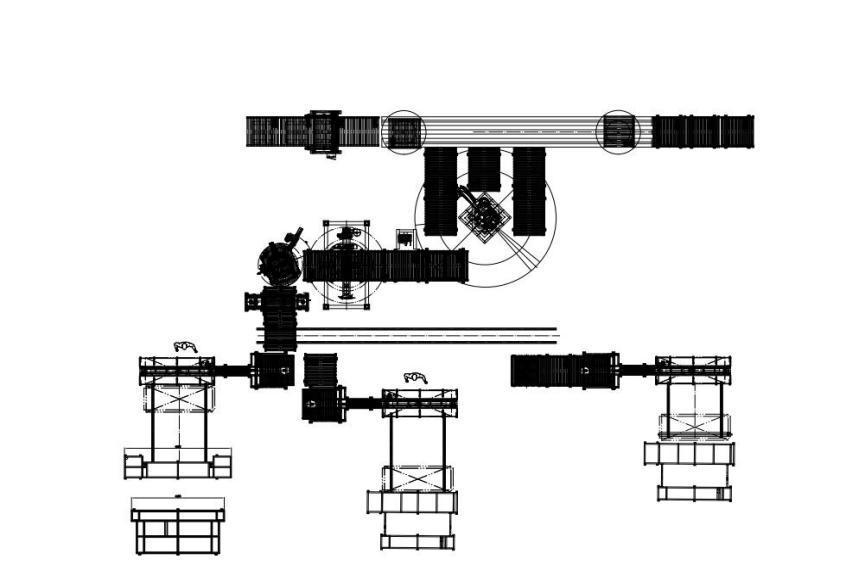
For many projects the conveyors and handling equipment are supplied as an integrated system rather than a collection of sections. The automated production line logistics system combines the conveyors, transfers, accumulation and control needed to move product through a complete line, with the zones and signals already matched to the machines. Similarly, the warehouse automated packaging system extends handling into the distribution flow, and the nonwoven conveying and packaging system shows how a handling system is tailored to a specific product that is soft, light and difficult to control on a generic conveyor.
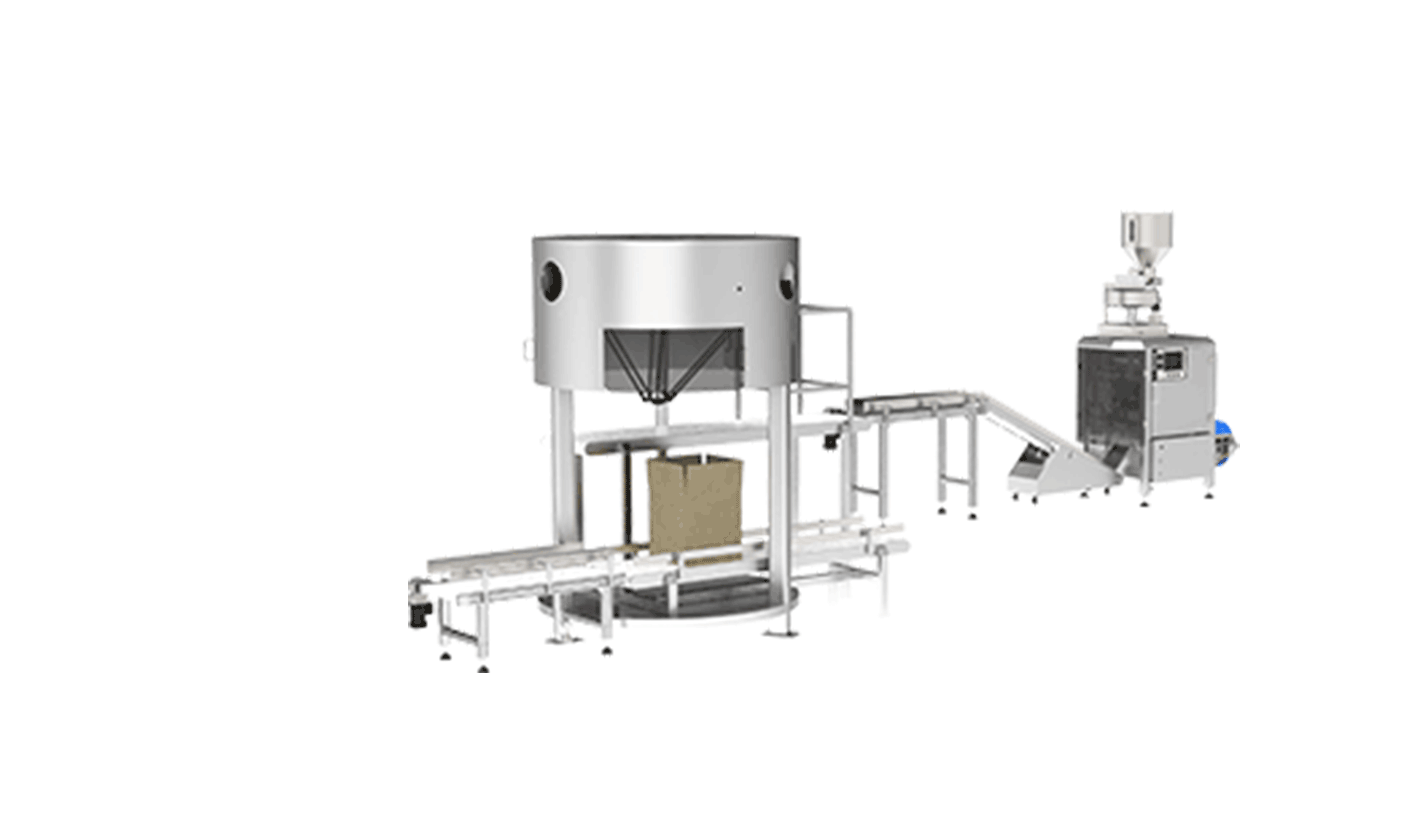
Integrated handling cells increasingly use robots for the steps that were manual — picking products from a belt, placing them into cases, or transferring between conveyors. The vertical packaging case packing solution combines a spider robot over a case with the conveyors that feed both, so products move from the belt into the box without being handled. Where a product is difficult for a conveyor to orient or a step varies between batches, a robot provides flexibility that fixed handling cannot, and it shares the same control system as the conveyors around it.
Speeds, transfers and the matching problem
A conveyor that moves product at the wrong speed causes faults that are easy to misdiagnose as machine problems. Product must enter a wrapper or packer at the machine’s pitch; if the conveyor runs too fast, products bunch; too slow, the machine waits. At transfers between conveyors — especially between a belt and rollers, or across a corner — small or unstable products can catch, tip or fall, which is why transfer plates, nose-over sections and matched belt speeds are specified rather than improvised. Heights must line up so cases hand off without a step that tips them, and curves must be sized to the product so boxes do not jam against the outer rail.
The control system holds this together. In a modern line, photo-eyes and zone sensors detect product position, variable-speed drives match conveyor speed to the machine, and handshake signals tell each section when to release. Zero-pressure accumulation, indexing to a packer, and merging two lanes are all control problems as much as mechanical ones. Specifying the conveyors with their control architecture from the start — rather than adding sensors and wiring after the sections are installed — is the difference between a line that runs and one that is continually adjusted.
Environment, sanitation and durability
Conveyors run through the same environments as the machines and must be specified accordingly. In food plants, modular-plastic belts, stainless frames and accessible surfaces support cleaning and inspection; in dusty mills, sealed bearings and drives resist fine powder; in cold stores and freezers, belts and drives must tolerate low temperature and condensation; in washdown cells, the same protection principles we cover in our guide to cold and wet end-of-line environments apply to every conveyor section. A conveyor that is under-specified for the environment is a recurring maintenance cost — belts that track poorly, bearings that fail, drives that trip — long before the machines around it show wear.
Common conveyor and handling mistakes
- No accumulation. Every pause at the palletiser or sealer stops the whole line instead of being buffered.
- Ordering machines before the layout. Transfer heights and paths are then forced around equipment that cannot move.
- Using a belt where rollers accumulate better. Cases drag and jam instead of zoning cleanly.
- Ignoring the feeding station. A fast machine is hand-loaded and runs at the operator’s pace.
- Mismatched speeds at transfers. Products bunch, tip or wait rather than entering at pitch.
- Under-specifying for the environment. Washdown, dust and cold defeat standard conveyors predictably.
- Bolting on sensors later. Retrofitting control is more costly and less reliable than designing it in.
Frequently asked questions
How much conveyor accumulation do I need?
Enough to absorb the longest routine pause upstream of each machine — layer changes and pallet swaps at the palletiser, short cycles at the sealer, and bursts from the erector. Calculate from the machine’s pause duration and the line’s product rate rather than using a fixed length; when in doubt, extra accumulation is usually cheaper than the downtime it prevents.
Should conveyors be belt or roller for sealed cases?
Powered roller conveyors generally suit sealed cases because they accumulate well and transfer cleanly; belts suit primary packs, irregular products and inclines. Many lines use both — belts for loose product before packing, rollers for cases after sealing.
Can I automate product feeding on an existing line?
Yes, often. An aligning feeder or a robotic pick station can replace a manual handling point without replacing the machines, provided the conveyor layout and controls can accommodate it. A site review of the current speeds and transfer points determines what fits.
How are conveyors controlled alongside the machines?
Photo-eyes, zone sensors and variable-speed drives connect to the line’s control system, with handshake signals that release and hold product as each machine is ready. Zero-pressure accumulation, merging and indexing are all handled through these signals rather than by the operator.
Does a conveyor system need food-grade construction?
For unpacked or exposed food product, yes — modular-plastic belts, stainless or suitably finished frames and accessible surfaces for cleaning. For sealed cases downstream, industrial construction is often sufficient, which controls cost.
Conclusion
The conveyors and handling systems are where a packaging line’s real reliability is decided, because they move product and — more importantly — decouple the machines so that small stops stay small. Matching the conveyor type to the load, providing enough accumulation, automating the aligning and feeding points, and specifying speeds, transfers and controls as one integrated system turns a set of capable machines into a line that sustains its rated output. Specified early and protected against the actual environment, line logistics quietly carry the whole operation.
If you are planning a new end-of-line or want to remove the manual carrying and feeding points from an existing one, SunAura Packaging Machines can design the conveyors and handling system around your products, machines and throughput. Tell our applications team your product, layout and target rate, or explore the handling and logistics equipment in the products hub, including the SP260 secondary bundle packer and the full range of integrated packaging systems.

Kevin works on machine development for shrink bundling, shrink hoods and vacuum packaging. He tests film shrink ratios, tunnel heat zones, seal bar performance and chamber cycle times, and feeds that back into machine frame and conveyor design. He writes technical articles on shrink film selection, tunnel temperature balancing and vacuum packaging for industrial and food-adjacent secondary packs.
See Full Bio ›