

For a surprising number of mid-volume factories, the bottleneck is not the filler, the wrapper or the cartoner — it is the end of the line. Cases come off the packaging equipment faster than two or three operators can stack them onto pallets, and the whole line slows down to the pace of the palletising crew. Buying a new flow wrapper to raise output by 20% is wasted if the palletising station still caps you at 400 cases per hour. This selection guide explains how a mid-volume factory — typically running 500 to 2,000 cases per hour, one to three shifts — should choose an end-of-line palletizing system that matches its product, floor space and growth plans, without over-investing in a high-volume robotic cell it cannot keep fed. The wrong choice here is expensive in two directions: too little automation leaves a labour bottleneck, while too much automation leaves capital idle.
Why mid-volume is the hardest zone to specify
The extremes are easy. A low-volume packing operation under 400 cases per hour is usually better served by manual palletising; the capital of automation cannot be justified. A high-volume plant over 1,500 cases per hour, or running heavy or unstable loads, clearly needs a dedicated gantry or industrial six-axis robotic palletising cell with dedicated safety fencing. The mid-volume band in between is where buyers make costly mistakes: they either keep manual palletising until it dictates the line’s output ceiling, or they buy a heavyweight industrial cell that sits idle waiting for cases and costs more than the problem it solves. This guide is aimed squarely at that band, where a collaborative palletising robot or a compact gantry-style station is usually the most rational choice.
The four palletising architectures and where each fits
Manual palletising. Still the right answer below roughly 400 to 500 cases per hour, especially with very variable case sizes and short runs. It is flexible, cheap to install and needs no guarding. Its weaknesses are ergonomic injury risk, inconsistent layer patterns, and an output ceiling that rises only by adding people.
Collaborative (cobot) palletising station. A six-axis collaborative robot on a fixed pedestal, usually integrated with a simple layer-stacking programme, a vacuum or gripper tool, and a pallet-location fixture. Cobot cells do not require full safety fencing if the payload and speed stay within safe working limits, which saves floor space and installation time. They are ideal for 400 to roughly 1,200 cases per hour with regular case geometry. The WP-40 collaborative palletising robot and the smaller WP-20 collaborative palletising robot represent this architecture: modest footprint, quick deployment, and straightforward pattern teaching.
Compact gantry-style layer palletiser. A gantry or Cartesian gantry stacks full layers picked up from a layer-former table. These are faster and handle heavier case weights, but need more floor space and a layer-accumulation conveyor. They suit the upper end of mid-volume, roughly 800 to 1,500 cases per hour.
Industrial six-axis robotic cell. The high-volume answer, with large reach, high speed and dedicated guarding. It is over-specified for most mid-volume buyers unless the load is heavy, the rate is at the top of the band, or future growth is certain. Buying one “just in case” often leaves it under-utilised.
The six numbers that determine the architecture
Specify by data, not by wishful thinking. Collect these before you request quotes.
1. Real cases per hour. Use the line’s actual sustained output, not its nameplate. A palletiser that is matched to the wrapper’s catalog speed but not its real first-pass rate will starve or overflow. Our guide to calculating real throughput rather than catalog rated speed applies just as firmly here.
2. Case dimensions, weight and format. Length, width and the heaviest single case set the gripper size and the required payload. Flimsy or empty cases need gentle handling; heavy cases need a heavier robot and a stiffer gripper.
3. Pallet pattern and layer count. The layer pattern determines how many cases the cell must place per layer and whether a layer former is needed. Simple square stacking needs less complex tooling than interlocking or mixed-SKU patterns.
4. Pallet footprint and stacking height. Standard GMA or EUR pallets and a 1,600 to 1,800 mm stacking height define the robot’s required reach. Reach is a hard specification; a robot that cannot comfortably place the top layer or reach the pallet far edge is not a bargain.
5. Floor space and ceiling height. Cobot cells need the smallest footprint; gantry and industrial cells need accumulation, pallet entry and exit aisles. Measure the real available bay, including door and column positions. Avoid the layout traps described in our note on packaging line layout mistakes that cause factory failures.
6. Number of shifts and growth. A single-shift operation can tolerate slower manual intervention at breaks; a three-shift line needs automatic pallet entry and exit, empty-pallet supply and full load discharge so the cell never waits for an operator.
Integration is where mid-volume projects succeed or fail
The palletising robot itself is rarely the risky part. The surrounding material flow is. You need an infeed conveyor that presents cases in a predictable orientation, a way to accumulate a short buffer so the robot can keep working during a brief stoppage upstream, empty-pallet supply, and a discharge route for finished loads. For mid-volume lines, a compact solution that conveys cases directly to a cobot on a fixed pedestal — without a full layer-accumulation system — is often the sweet spot: it is simple to install, easy to understand, and keeps the capital budget honest.
Do not forget handover safety. Even a collaborative robot needs a defined work envelope, e-stops at the load and unload points, and clear signage. Integrating the cell with the existing packaging line’s control system — so that a stopped line pauses the robot gracefully and a full load triggers discharge — is worth paying for explicitly in the quote.
Load securing: the second half of end-of-line
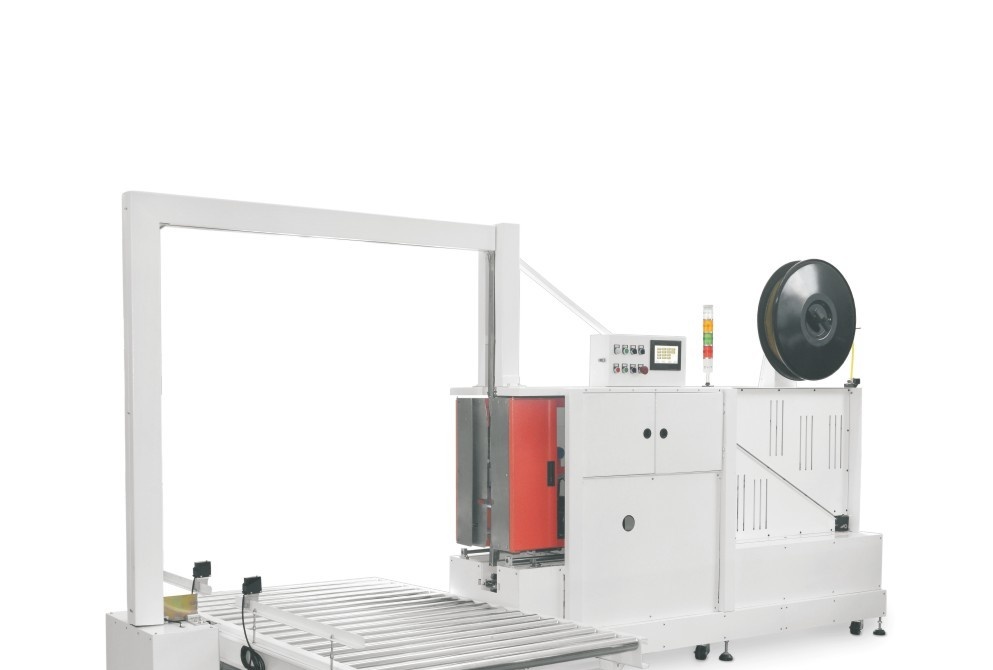
A perfectly stacked pallet is still a logistics problem unless the load is secured for transit. Most mid-volume plants pair palletising with either stretch wrapping or strapping, and increasingly both. A rotary-arm pallet wrapping machine such as the FG2000B applies stretch film around the load from a fixed ring or rotary arm, which is fast and consistent. For loads that also need vertical restraint, an integrated wrapping and strapping combination like the AO77B/FG2000B pallet wrapping and strapping system applies both film and strap in one station. Buyers often underestimate the cost of transit damage caused by inconsistent load securing; our comparison of pallet wrapper versus manual wrapping total cost shows how quickly consistent wrapping pays back through reduced returns and claims.
Cost and payback for mid-volume palletising
A collaborative palletising station costs a fraction of a full industrial robotic cell and can be installed in days rather than weeks. Payback is driven by replacing manual stacking labour, eliminating ergonomic-related absenteeism, and — usually the biggest factor — raising the line’s sustainable output to match the upstream packaging equipment. A line that was previously throttled to 70% of wrapper speed because of palletising congestion can often run at 90 to 95% once a robot handles the cases. When you weigh that recovered output against the capital and maintenance cost, a cobot station commonly pays back within eighteen to thirty months. The full picture, including energy, consumables and maintenance, should be judged against the total cost of ownership of automatic packaging lines, not the purchase price alone. Ask suppliers for a target uptime figure and how it is measured; a well-integrated mid-volume cell should sustain 90% or better availability once operators are trained, and anything materially lower usually points to a bottleneck in the surrounding conveyors or hand-off rather than the robot itself, which is worth challenging before you sign the order.
The selection checklist
Before comparing quotes, confirm you have answers to all of the following: real sustained cases per hour; case dimensions, weight and fragility; pallet type and stacking height; required layer pattern; available floor space and reach; whether automatic empty-pallet supply and load discharge are needed; how the cell hands off to stretch wrapping or strapping; how it integrates with the upstream line controls; expected changeovers between products; and the maintenance skill level on site. Suppliers who respond to this level of detail with a tailored configuration — rather than a generic price list — are the ones likely to deliver a cell that performs on day one. Also ask for a spare-parts recommendation: the wearing items on a palletising cell — gripper pads, conveyor belts, vacuum filters and safety relays — should be listed with lead times so a worn component never becomes an unplanned eight-hour stoppage.
Gripper and end-of-arm tooling: choose it for the case, not the robot
The robot arm grabs the headlines; the gripper decides whether the cell actually works. Three common end-of-arm tools suit mid-volume palletising. A vacuum gripper lifts by suction pads and suits rigid cartons and shrink-wrapped bundles with a flat, dust-free top; it is fast and flexible but struggles with porous, flexible or dusty cases where vacuum cannot hold. A fork or slip-sheet gripper slides under the case and suits products that cannot tolerate top pressure, such as open trays or delicate bakery packs. A clamp or side-grip tool grasps the case between two paddles and suits cases that are unstable or overfilled and would crush under vacuum. Many mid-volume cells are specified with a single generic vacuum tool that is then unsuitable for half the customer’s SKUs, causing dropped cases and lost time. Confirm the gripper against every case format you run, and budget for a tool change or a tool that can switch between SKUs without manual retuning.
Common mid-volume palletising mistakes
Three errors recur. The first is matching the cell to the wrapper’s nameplate speed rather than its real first-pass rate, which either starves an expensive robot or overflows it. The second is forgetting the empty-pallet and full-load hand-off: a brilliant robot that waits for a forklift to bring pallets or clear full loads is barely better than manual stacking. The third is ignoring future SKU changeover; a cell that stacks one pattern beautifully but cannot switch to a second pattern without an engineer visit quickly becomes a liability on a multi-product line. Reserving teach-pendant pattern memory, quick gripper changes and recipe recall in the original purchase is far cheaper than retrofitting them later.
How SunAura Packaging Machines approaches mid-volume palletising
SunAura Packaging Machines supplies collaborative palletising robots, compact gantry stations, pallet wrappers and integrated wrapping-and-strapping systems to mid-volume food, beverage and consumer-goods factories. Our engineering team starts from the real case rate and the real product geometry, recommends the smallest architecture that clears the bottleneck, and then designs the infeed, accumulation and load-securing hand-off so the whole end-of-line moves in rhythm. We prefer to deploy a cobot today and reserve the interface for a faster cell tomorrow, rather than forcing a buyer into a heavyweight investment before the volume justifies it.
If you would like a mid-volume end-of-line configuration matched to your cases, pallets and line speed, contact the SunAura Packaging Machines engineering team with your case dimensions, target cases per hour and current bottleneck, and we will propose a staged palletising and load-securing layout.
Bottom line
Selecting an end-of-line palletising system is a matching exercise: match the robot’s speed, payload and reach to your real case rate, case geometry and pallet height, and match the surrounding conveyors, pallet supply and load securing to the way your line actually runs. For mid-volume factories, a collaborative palletising station with integrated stretch wrapping or strapping is most often the rational middle path — fast enough to remove the output bottleneck, small enough to fit the existing floor, and modest enough to pay back quickly without locking you into over-sized automation. Get the six operating numbers, match the architecture to them, design the infeed and load-securing hand-off honestly, and the end of your line will stop dictating the output of the entire plant.

Michael designs automated palletizing stations and ties upstream case or bag flow to downstream stretch wrapping. His work spans conventional layer palletizers, robotic arm cells, conveyor routing, safety fencing and handover logic between machines. He writes about palletizer selection, load stability and how an end-of-line sequence should be balanced.
See Full Bio ›