

TL;DR. A Brazil-based consumer-goods exporter ordered a custom end-of-line packaging line from our Qingdao shop, and in November 2026 that line went through the final pre-shipment factory acceptance test (FAT) before crating and sea freight. The scope covered case loading and erection feed, a taped case sealing station, accumulation and buffering, stretch wrapping for a long ocean voyage, and robotic palletizing of the finished export loads. We ran the stations together on our test floor, recorded cycle and layer results, logged the defects that showed up, fixed them in the bay, and re-ran the affected sections before the customer signed off. This write-up walks through what the line looks like, how the FAT was planned, what we found and changed during the run-off, what the acceptance records cover, how a custom export line differs from a catalog machine, the questions a buyer should ask before signing off a test, and the support that stays on after the equipment leaves the shop. The figures below are planning bands and observations from this particular run-off, not quoted cycle guarantees for another plant; real performance follows your product, case geometry, pallet pattern and the reference installation running your own goods.
By Tom Xu, End-of-Line Integration and Commissioning Specialist. Tom has spent nine years laying out, wiring up and commissioning case sealing, strapping, stretch wrapping and palletizing cells for food, beverage, household chemical and distribution customers across Latin America, the Middle East, Southeast Asia and Africa, and has watched layer integrity, tape closure, wrap film hold-down and conveyor timing on more than 90 end-of-line stations before and after shipment.
The order and what an exporter at the end of the line actually needs
The customer is a Brazil-based exporter that packs a range of cartoned goods onto wooden pallets for domestic distribution and overseas freight. They did not come to us for a single standalone machine. They came because the packing end of their plant had reached the point where manual closing, hand stacking and loose loads were the bottleneck, and they needed a connected sequence that takes filled and closed cases from the packing area, sends them through sealing and wrapping, and stacks them into stable pallets ready for a truck or a container.
For an export shipment, the end of the line carries two jobs at once. The first is to finish the package: close the case cleanly so it does not open in transit, hold the load together so a truck or container move does not shift it, and build a pallet that keeps its shape through multiple handlings. The second is to make the whole sequence predictable: the infeed rate matches the packing side, the buffering absorbs short stops, the stations do not jam each other, and the finished pallets come out at a steady cadence rather than in bursts. A machine that runs fast in isolation but fights the next station on the line does not solve the buyer’s problem.
We see this on the floor when a plant buys one sealing machine and one wrapper separately, then discovers the conveyors do not line up, the speeds do not match, and nobody owns the handoff between the two. A custom integrated line avoids that by laying the stations out as one sequence before fabrication, sizing the conveyors and buffers to the real rate, and making the controls and guarding consistent across the cells. This Brazil order was scoped that way: the stations were specified, drawn and tested as one end-of-line package, not as a pile of independent machines bolted together after delivery.
What the customer specified before we cut steel
Before any frame was built, the specification had to pin down the facts that decide station sizing. These are the same questions that come up on every end-of-line order, regardless of destination.
The product facts: the case family that runs on the line, the case dimensions and the tightest/loosest case in the range, the gross weight per case, whether cases are square or rectangular, how full and firm the pack is, and whether any case sits off-square. The rate facts: cases per minute the packing side can deliver, pallets per hour required at the discharge, peak and average rates, and how much surge the line has to absorb when the upstream packing side pauses. The load facts: pallet type and footprint, pallet height when full, how many layers per pallet, layer pattern, whether slip sheets or top sheets are used, and how stable the load is when wrapped. The site facts: available floor length and width, ceiling height, floor level, how the line feeds in and discharges out, and where the guarding and access gates have to sit. The commercial facts: voltage and frequency at the plant destination, available controls and reporting, spare-parts expectations, and who will train the local operators.
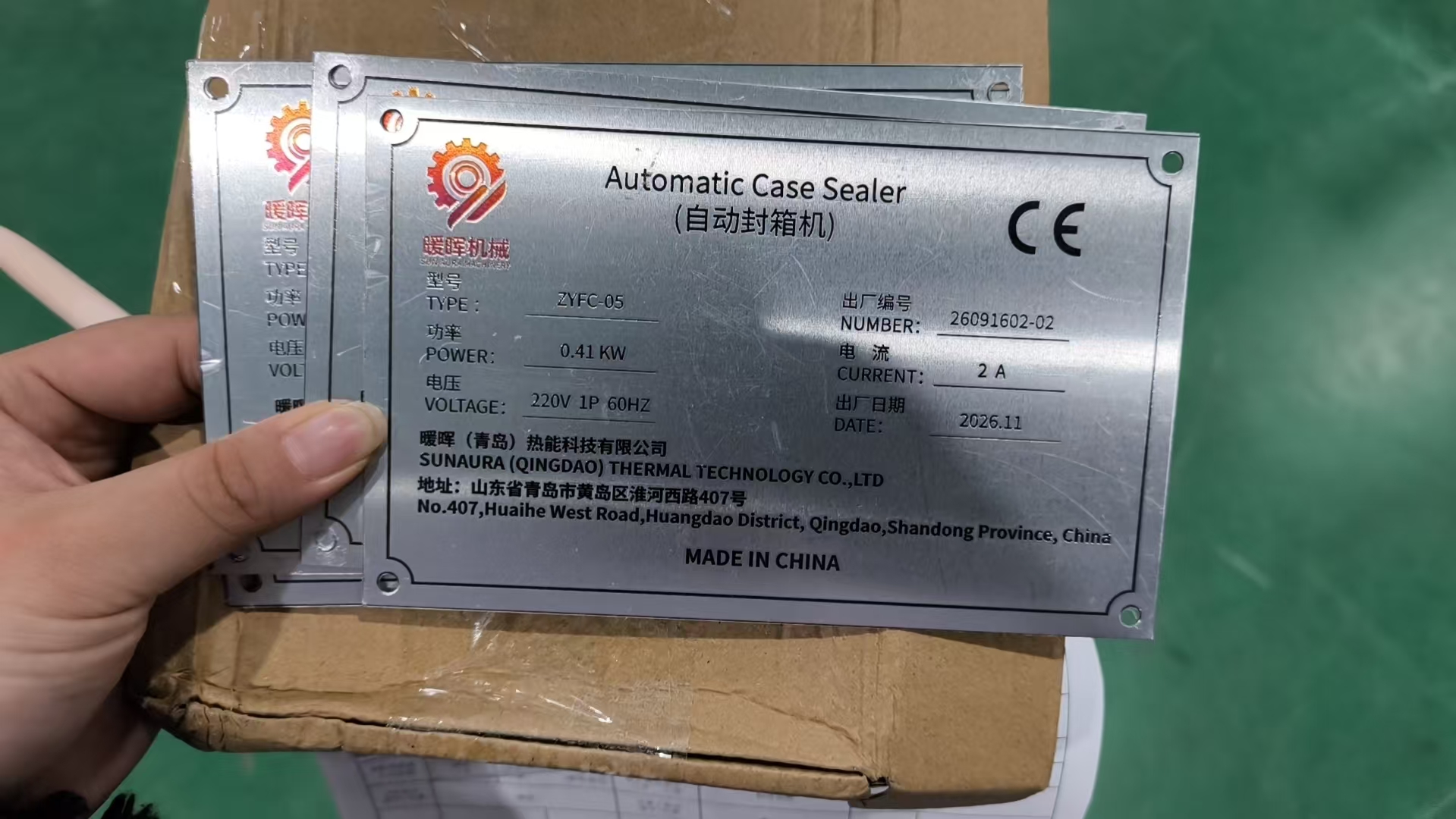
For this Brazil order the electrical scope was set to the local grid: the machines were wired for the 220 V / 60 Hz supply the plant runs on, and the case sealer rating plate reflects that single-phase 60 Hz build. Frequency matters more than buyers sometimes assume. A machine sized and tuned for a 50 Hz supply does not always behave the same on 60 Hz; conveyor speed, drive slip and cycle timing all shift, so the electrical rating has to match the destination country rather than default to the shop supply.
The line layout, station by station
The accepted layout runs left to right from the packing area to the stretch-wrapped pallet discharge. Cases enter on an accumulation conveyor that smooths short bursts from the packing side, move into the case sealing station where the top flaps are closed and taped, continue through a short buffer section, feed the stretch wrapping cell, and then go to the palletizing cell that builds the layer and discharges a finished wrapped pallet to an outfeed roller track.
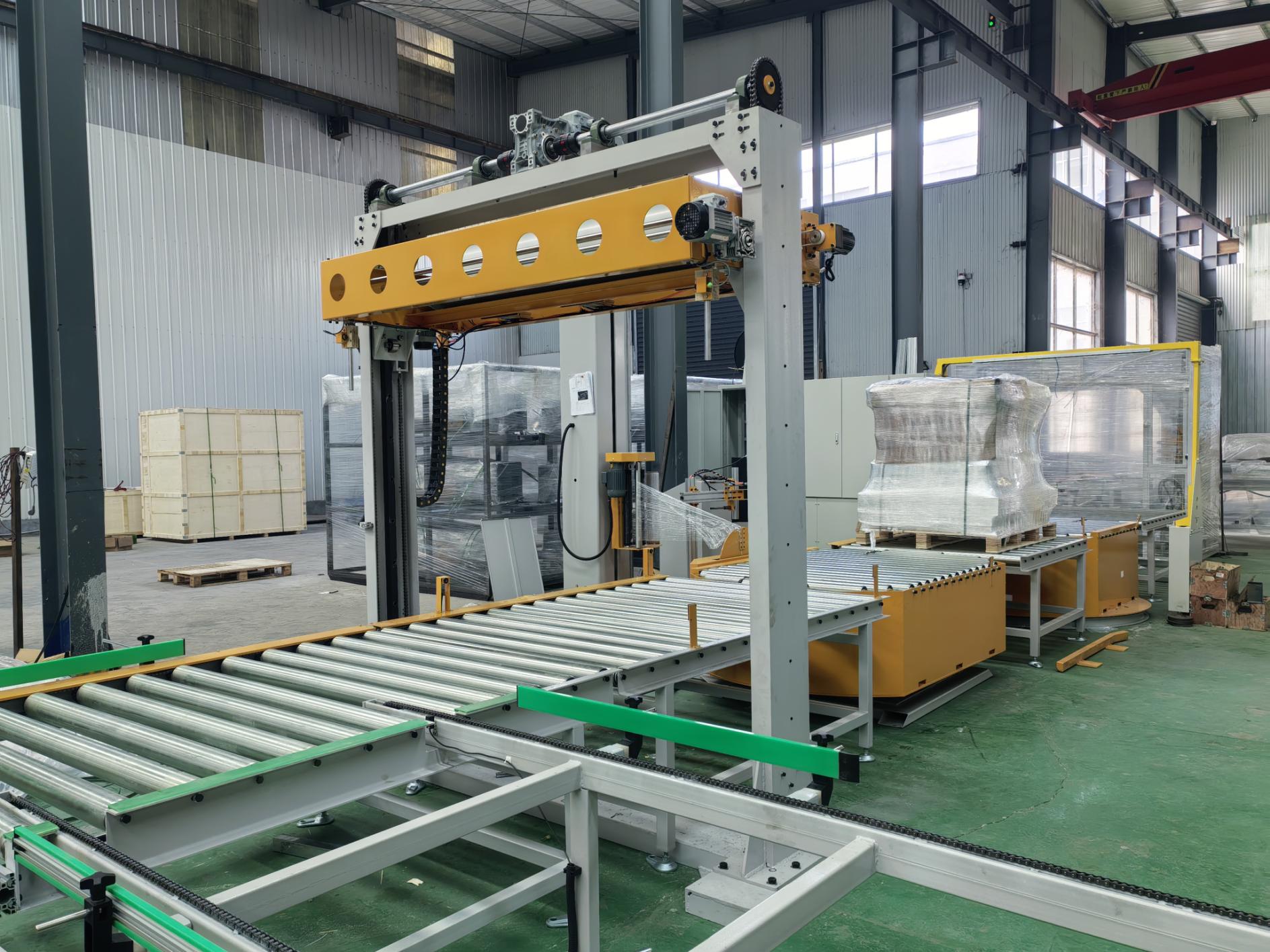
The stations sit on a common roller conveyor system so the case path stays level and consistent across cells. Where two cells meet, there is a short transfer section rather than a hard butt joint, which reduces case misalignment at the handoff. The guarding follows the work zone: fixed perimeter panels around the palletizing and wrap cells, access gates that stop the relevant cell when opened, and light curtains or interlocked barriers where an operator reaches into the work envelope. The safety layout is drawn to ISO-type machine safety practice, with guarding, emergency stops and interlocks reviewed before power-up.
Accumulation and infeed buffering
The first conveyor after the packing side is accumulation, not a single-speed feed line. Its job is to let cases pile up in a short buffer when the sealing or palletizing side pauses, and to release them smoothly when the line is ready again. Without this section, a one-minute stop at the wrapping cell backs cases straight into the packing area; with it, the packing side can keep moving for a short window while the downstream cell clears its queue. Buffer length is sized to the surge the plant reports, not to a generic standard. Too short and the accumulation does nothing; too long and the line burns floor space and money carrying conveyor that never fills.
Case loading and erection feed where the cases come onto the line
The cases on this line are fed closed or semi-erected from the packing side; the station that places product into the case sits upstream of our scope. At our end of the line, the cases enter the conveyor in a known orientation, and the sealing station reads the case height and flaps before closing them. Where a plant uses flat blanks and erects its own cases, an erector station would sit ahead of the sealer to open the blank, fold the bottom and feed a squared case onto the line. The feed setup for this order assumes cases arrive squared and oriented, which keeps the sealing station focused on flap closing and tape rather than correcting a misshapen blank.
Case sealing: the ZYFC-05 taped station
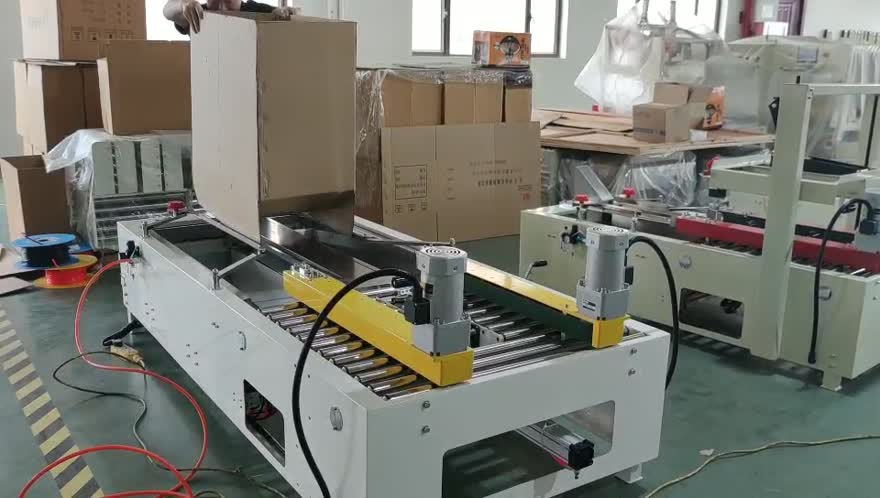
The sealing station on this line is a ZYFC-05 automatic case sealer with a tape closure head. Cases ride the roller infeed, the top flaps are folded down by the flap closing assembly, the tape head lays the strip over the top seam and pulls it down both sides, and the sealed case exits toward the buffer. Tape sealing is the closure chosen here because the cases run a regular RSC-style format, the flap geometry is consistent, and tape gives a fast, clean top seal that reads well on an export carton.
The sealer’s rating plate is the permanent record of what the machine was built to carry. On this unit the plate reads type ZYFC-05, power 0.41 kW, voltage 220 V single-phase 60 Hz, current 2 A, serial number 26091602-02, and build date 2026.11, with the CE marking and the maker details for SUNAURA (QINGDAO) THERMAL TECHNOLOGY CO., LTD, No.407, Huaihe West Road, Huangdao District, Qingdao, Shandong Province, China. The plate stays on the machine through shipment and service life so the plant, a technician and any future reseller can match the electrical rating and build identity to the unit.
On the sealer side, the acceptance checks cover flap squaring before the head, tape adhesive contact along the full seam, tape overlap at both ends of the case, cut length so the strip finishes flush rather than trailing or leaving a short tab, and whether the case exits straight rather than drifting to one rail. Tape choice and tape head setup are a separate topic; our buying guide on semi-automatic, inline and adaptive case sealers walks through when tape, hot-melt or cold glue suits different carton and closure jobs.
Why tape was the closure for this run
Tape sealing suits regular cases that repeat the same format, where the flap joint is flat and the case travels a short to medium distance. It runs fast, the head is simple to maintain, and a worn tape roll is a quick changeover on the floor. Where a case is heavy, irregular, or needs a tamper-evident or fully glued closure, a hot-melt or glue closure is often the better fit. On this line the carton range sat inside the tape-friendly band, so the sealer was specced with a tape head rather than a glue system.
Accumulation, buffering and the handoff to wrapping
After sealing, cases cross a short buffer section before the wrap cell. This section does two jobs. It spaces cases so the wrapping cell receives them at a steady pitch, and it gives the wrap station a small queue if the palletizing side holds a cycle. The conveyors here use driven or gravity rollers depending on the section, with guides that keep the case centered as it moves. The handoff between sealed cases and the wrap infeed is one of the spots we watch closely on any FAT: a case that arrives slightly cocked gets wrapped slightly cocked, and a slightly cocked case on a pallet is the start of an unstable load.
Stretch wrapping for a long ocean voyage
The wrap cell applies stretch film around the finished or building pallet load before it leaves the plant. Sea freight puts a load through vibration, stacking pressure, humidity changes and multiple re-handlings between the factory and the final warehouse, so the wrap has to hold the cases to the pallet and protect the layer during that movement rather than only look tidy in the yard. The wrapping run-off checks film stretch percentage, top and bottom web overlap, corner coverage, how tightly the film holds the top layer down, and whether the load shifts when the wrapper cycle ends.
Film type and gauge follow the load: lighter regular cartons wrap at one gauge and stretch level, heavy or sharp-edged loads need a heavier web and more corner protection. The wrapping station on this line was tuned for the customer’s carton weight and pallet height, with the wrap pattern set to cover the base, the sides and the top overhang. Film performance and packaging film market data are tracked by industry research sources such as Smithers’ packaging film market reports; plant buyers can use those reports to benchmark film categories rather than pricing a web in isolation.
Palletizing the finished export load
The palletizing cell takes wrapped or waiting cases and stacks them into the agreed layer pattern on the pallet. This order was built around an articulated robotic arm on a guarded pedestal, with a gripper suited to the carton geometry, serving an infeed conveyor and one or two pallet positions. The arm picks a case, positions it into the layer, returns for the next, and builds the stack to the agreed height before the finished pallet discharges to the outfeed track.
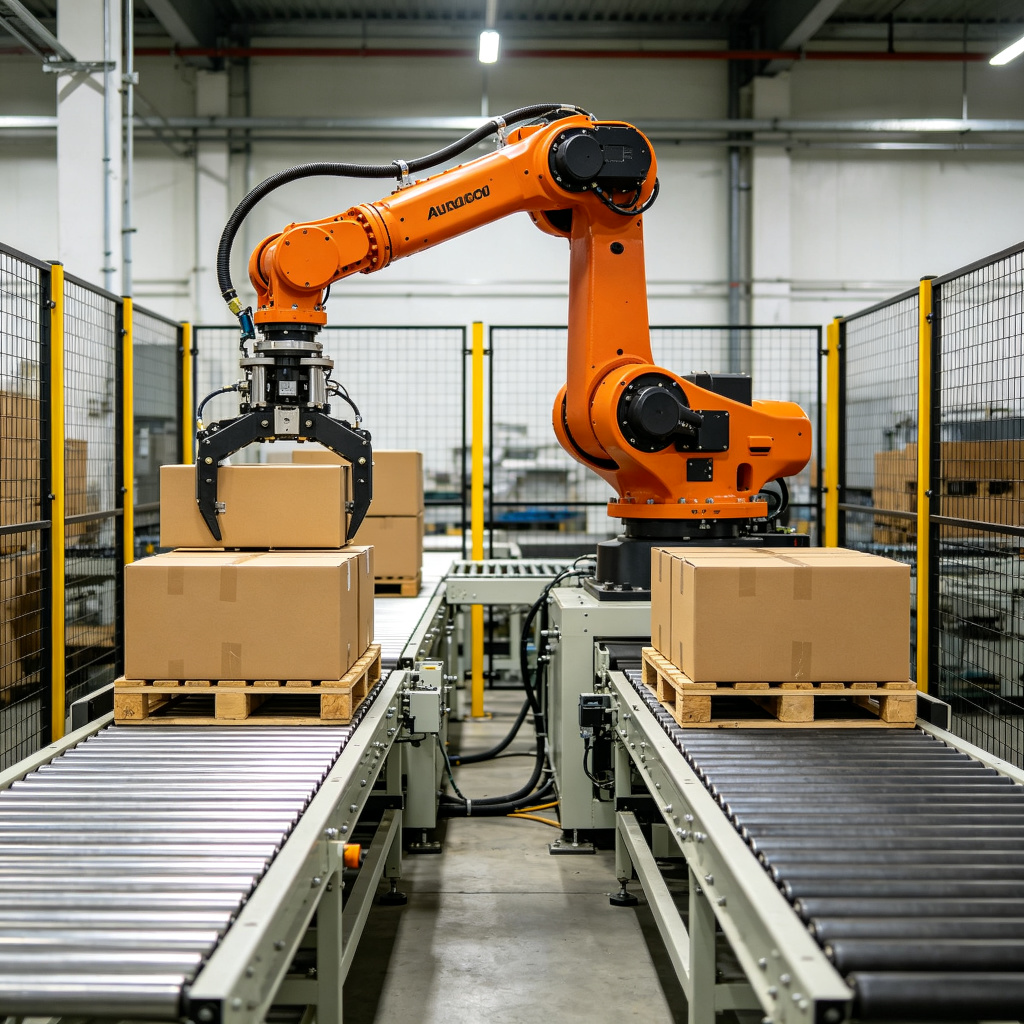
On the palletizing side, the acceptance checks cover layer pattern repeatability, case orientation within each layer, gap alignment between layers, pallet centering, whether the arm reaches every pallet position consistently, and how the cell handles an empty pallet or a slip-sheet if the pattern calls for one. The gripper pressure and pick point are tuned to the carton so the case is held firmly without crushing the flap or side. Industrial robot adoption and application trends are documented by sources such as Statista’s industrial robotics topic, which gives market context rather than a cycle guarantee for a specific cell.
Why a robot pedestal was chosen over a fixed-frame gantry here
For this line the product range was expected to widen a little over time, the customer wanted one cell that could serve a couple of feed positions, and the load was regular but not locked to a single rigid pattern. That points to an articulated arm rather than a fixed rail gantry: the wrist and gripper can orient a case, the pedestal can be laid out to reach more than one station, and pattern changes are made in the program rather than rebuilding a frame. Where a plant runs a narrow range of heavy regular cases at steady high volume, a gantry or conventional layer machine often holds the heavy layer more stiffly; the platform choice follows the load facts the specification set out earlier.
How the FAT week was planned on our test floor
The factory acceptance test is the last chance to run the whole line together before it leaves the shop. Once a machine is crated and on a container, changing a conveyor length, adjusting a guide or retuning a wrap pattern costs several times what it costs in the bay, and the plant is waiting on the other end. The FAT on this Brazil line was scheduled in three passes rather than one long run.
The first pass was a dry and single-station check. Each cell was powered and jogged on its own: conveyors moved in the right direction, drives reached the set speed, guards and interlocks tripped the relevant cell when opened, emergency stops cut power where they should, and the controls moved each actuator through its range without product. This pass catches wiring, orientation and safety issues before any case touches the line, when a problem is still easy to trace to one cell.
The second pass was a loaded station-by-station run. Cases of the customer’s representative dimensions and weights were fed through the sealing, wrapping and palletizing sections one at a time, then in short batches. We watched flap closure, tape seam, case exit straightness, wrap hold-down and layer placement on each station, and recorded where a case sat off-line or a layer sat off-center. This pass isolates a station fault from a handoff fault: if the sealer sends a straight case but the wrap infeed cockes it, the problem is the transfer section, not the sealer.
The third pass was the connected line run-off. All stations ran together on a continuous batch at the planned average rate, with short pauses and a surge introduced to test the accumulation and buffering. This is the pass that shows whether the sequence actually balances: whether the buffer fills and clears, whether the wrap cell keeps up, whether the palletizer discharges on cadence, and whether any station becomes the bottleneck that holds the rest back. The connected run also exercises the interlocks and stop/start sequence the plant operators will use day to day.
Throughout the week, results were logged against the acceptance criteria agreed in the specification: case dimensions and weights tested, cycle and cadence observed, layer pattern checked, safety devices tested, and any defect recorded with its station, symptom, cause and the action taken. A FAT that only watches the line run for an hour and calls it good does not give the plant much protection; the value is in the recorded checks and the re-run after each fix.
What we found and fixed during the run-off
Almost no custom line leaves the bay without a handful of adjustments. The goal of the FAT is to surface those adjustments on our floor, fix them there, and re-run the affected section rather than send the customer a list of things to correct after delivery. The table below lists the kinds of issues that came up on this run-off, the symptom we saw, the action taken in the bay, and how the re-run was checked. Specific numbers follow this product and this layout; treat them as examples of what a FAT should surface, not as guaranteed outcomes for another order.
| Station | Symptom observed | Action in the bay | Re-check result |
|---|---|---|---|
| Case sealer | Tape strip finished slightly short on one case size, leaving a small tab at the end of the seam | Adjusted tape cut length and head pressure for that case height; checked flap closure before the head | Re-ran the case size; seam closed flush at both ends, no trailing tab |
| Sealing to wrap transfer | A few cases entered the wrap infeed cocked after the buffer section | Centered the transfer guides and adjusted the short pitch section so cases arrive square to the wrap cell | Re-ran a batch; cases entered the wrap cell centered, no side drift |
| Stretch wrap | Top layer lifted slightly at the corners after the wrap cycle ended | Raised top web overlap and tuned film stretch so the top cases are held down through the cycle | Re-wrapped a pallet; corners stayed down, load held after the film released |
| Palletizing cell | One layer sat a few millimeters off-center on the pallet for the heavier case size | Corrected pick placement and layer offset in the program for that case geometry | Re-built the layer; cases aligned to the pallet edges within the agreed tolerance |
| Accumulation buffer | Buffer filled too quickly when the wrap cell paused, backing cases toward the packing side | Set release timing and conveyor speed so the buffer absorbs the short pause without reaching the packing feed | Introduced a controlled pause; buffer cleared without spilling cases upstream |
| Guarding and interlocks | One access gate stopped only its own cell; checked that the adjacent wrap cell held safely | Reviewed interlock wiring and confirmed each gate stops the work zone it guards | Opened each gate; relevant cell stopped, no unexpected motion in the guarded zone |
These are the ordinary adjustments a commissioning team expects: a guide that sits a hair off, a cut length that needs a case-specific tweak, a wrap tension that reads differently once real cases run through. The pattern worth noting is that most of them showed up at the handoff between stations, not inside a single machine. A sealer that closes a case perfectly can still feed a cocked case to the next cell if the transfer section is off, which is why the connected-line pass matters as much as the single-station pass.
Acceptance records and what the sign-off actually covers
The FAT sign-off is not a signature on a clean machine. It is a record of what was tested, against what criteria, with what result, and which open items remain before shipment. For this line the acceptance package covered the station-by-station checks, the connected run-off results, the safety device tests, the electrical rating match to the destination supply, the layer and pattern records, and the list of any items that will be completed after arrival.
The records the plant should expect on an export line include: the tested case range and weights, observed cycle and cadence at the planned rate, pallet pattern and layer count, wrap film setup and overlap settings, gripper pressure and pick settings, safety and guarding test results, serial and rating-plate details for each machine, spare-parts list, operating and maintenance manuals, electrical schematics and control documentation, and the commissioning contact who owns follow-up. A buyer running their own acceptance walk-through can use a structured FAT and SAT checklist for erecting, sealing, wrapping and palletizing cells to make sure nothing on that list is skipped on the floor.
It is worth separating FAT from SAT here. The factory acceptance test happens in our shop, on our floor, with our power and our test cases. The site acceptance test happens at the plant after installation, on the real production line, with the real product and the real upstream and downstream equipment. Some items can only be checked on site: how the line ties into the plant’s existing conveyor, how it runs against the actual packing rate, how operators interact with the controls in their own workflow, and whether the layout fits the plant’s aisles and access. The FAT clears what can be cleared in the bay; the SAT confirms the line performs where it will actually run.
How a custom export line differs from a catalog machine
A catalog machine is built to a fixed frame, a fixed conveyor length and a fixed speed band, sold off a standard configuration. A custom end-of-line line is laid out to the buyer’s product, rate, floor space and destination supply, and the stations, conveyors, buffers and guarding are sized to that scope. The differences show up in a few concrete places.
Conveyor length and layout follow the plant’s floor. The infeed, buffer, wrap and palletizing sections are arranged so the line fits the available footprint and feeds and discharges in the right direction, rather than forcing the plant to rearrange around a standard frame. Buffering is sized to the reported surge, not a generic length. The electrical build matches the destination grid: voltage, frequency, plug or terminal style and local standards are set to the country the machine ships to. The controls and reporting are matched to what the plant can maintain, and the guarding follows the actual work zone and access points.
The trade-off against a catalog machine is lead time and engineering depth. A custom line needs layout review, specification sign-off, fabrication, integration and the FAT sequence, which takes longer than ordering a standard unit off the shelf. The payback is that the line fits the real job: the conveyor reaches where it needs to, the buffer absorbs the real surge, the wrap holds the real load, and the palletizer builds the real pattern. Where a buyer’s product and rate sit inside a standard machine’s range, a catalog unit is often the faster and cheaper route; where the layout, product mix or destination supply falls outside that range, the custom scope earns its cost.
Upstream and downstream interface, and the data the line reports
An end-of-line line does not run in isolation. It receives cases from the packing side and discharges pallets to the warehouse or container area, and the handoffs at both ends have to be agreed before the line is built. Upstream, the question is how cases arrive: steady feed or burst, what orientation, what rate, and whether the packing side can pause when the end-of-line buffer is full. Downstream, the question is how finished pallets leave: by hand truck, forklift to a staging area, or onto a truck or container, and what clearance and access that discharge needs.
On the data side, a modern line can report run state, cycle counts, station alarms and production counts back to a plant system. How that data moves depends on the controls: basic signal outputs for status and alarms, or a network connection such as OPC UA-style communication to a WMS or MES for counts, rates and fault details. The choice follows what the plant actually uses on site; a line that sends detailed telemetry to a plant that has no system to read it adds cost without benefit. Our overview of connected end-of-line machines, OPC UA, WMS and MES integration covers how the interface is scoped without over-engineering the cell.
Budget bands and lead time for a custom end-of-line line
Buyers asking for a number on a custom line usually need a budget band more than a single price, because the final figure moves with stations, rate, automation level and guarding. A basic end-of-line section with manual or semi-automatic case handling, a standard sealer and a manual or simple wrapping setup sits at the lower budget band. A mid-range integrated line with accumulation, automatic sealing, stretch wrapping and a robotic or palletizing cell sits in the middle. A high-capacity line with multi-station serving, heavier payloads, advanced pattern control, connected reporting and full guarding sits at the upper band. These are planning ranges for discussion, not quotes; a firm number follows the specification, product samples and a layout review.
Lead time follows the same shape. A standard machine ships in weeks; a custom integrated line moves through layout confirmation, fabrication, integration and FAT, which spans a longer build window, with the FAT week as one of the final gates before crating. Buyers planning a launch date should pin the lead-time milestones early in the project rather than assuming a standard-machine delivery schedule applies. For a view on how equipment cost lines up against payback, the end-of-line packaging line cost and budget guide breaks down the budget bands by configuration, and the packaging line ROI and payback calculator shows how throughput and labor changes feed back into a payback period.
Five pitfalls buyers hit on export packaging lines
After watching these cells ship and run, the recurring mistakes on export orders tend to cluster in five areas, and most of them are easier to avoid before the FAT than after delivery.
1. Specifying the machine rate, not the line rate. A sealer can run a fast cycle in isolation but the line only moves as fast as the slowest connected station, and the buffer has to balance the rest. Buying to a single machine’s peak rate overstates what the end-of-line section actually delivers and undersizes the handoffs.
2. Ignoring the destination electrical supply. A machine tuned to one frequency or voltage does not transfer cleanly to another. Wiring the unit to the destination grid, rating the plate to match, and checking drive and conveyor behavior on the right supply are FAT items that should be confirmed before shipment, not diagnosed after arrival.
3. Under-sizing the accumulation buffer. Without enough buffer length and release timing, short pauses downstream back cases into the packing area and create jams at the handoff. Buffer sizing should follow the reported surge, with a margin for the occasional long pause rather than the average run.
4. Treating the wrap as a cosmetic step. Stretch wrap on an export load holds cases to the pallet through vibration, stacking and re-handling. Film gauge, stretch level, overlap and corner coverage have to be tuned to the real load; a light wrap that looks neat in the yard can fail on a long sea voyage.
5. Leaving the site interface until after arrival. Upstream feed, downstream discharge, floor clearance, power location and control connections should be agreed in the specification. Discovering on install day that the conveyor does not reach the plant’s packing side, or that the discharge path is blocked by a column, is the expensive kind of problem to fix on site.
After shipment: installation, SAT, training and spares
The FAT sign-off closes the shop-side acceptance, but the line has to perform at the plant after crating, ocean freight and installation. After arrival, the cells are uncrated, leveled, connected to the plant supply, and tied into the existing conveyor and discharge paths. The site acceptance pass then runs the line against the real product and the real upstream and downstream equipment, confirming cycle, pattern, wrap hold-down and operator handling on the production floor.
Training covers the operators who run the line day to day: how to feed cases, change over between case sizes, replace a tape roll or film roll, clear a jam safely, read the station alarms, and which checks to run at the start of a shift. Maintenance training covers the wear parts to inspect, the drives and bearings to keep clean, and the settings that should not be adjusted without the commissioning contact. Spare parts are listed in the acceptance package so the plant keeps the consumables and wear items that stop the line fastest if they run out.
Support after handover follows the warranty and service agreement: the commissioning contact who knows the line, the parts channel that stocks the wear items, and a channel for remote or on-site help when a station faults. For export customers, spare-parts availability and local response matter as much as the machine itself, because a line waiting on a single replaceable part sits down in production. Regional commissioning and spare-parts support for packaging lines across Latin America is something our service team plans with customers before the build, so the support path exists before the equipment reaches the plant.
Planning the export move before crating
Once the FAT sign-off is recorded, the line moves into the shipping preparation stage, and this stage has its own checklist separate from the machine test. The frames and conveyors are crated or skidded so the work surfaces, drives and tape heads are protected against stacking and moisture during ocean transit. Loose parts, spare parts and tooling are packed in marked cases that match the parts list, so the receiving team can identify what goes where when the installation starts.
Load planning matters for a line that ships in sections. Long conveyors, the palletizing pedestal and the wrap frame are packed to fit the container, with the heaviest pieces down low and the surfaces that carry guides or bearings protected from contact. The receiving side should know the crate sequence before the container arrives: which section comes off first, which skid carries the electrical panel, and which cases hold consumables and spare parts. That sequence keeps the installation from turning into a search through the container on the dock.
Documentation travels with the shipment in both paper and digital form. The packing list ties each crate to a machine or section, the manuals and schematics match the serial numbers on the rating plates, and the acceptance records from the FAT are included so the site team can see what was tested and what was adjusted in the bay. For a Brazil-bound order, the commercial and technical documents should align with what customs and the receiving plant expect, so clearance does not hold the line up after the vessel docks. We coordinate the document set with the customer before crating rather than assembling it at the last minute on the loading day.
There is also a timing point worth raising early in the project. Production launch dates usually sit downstream of installation, commissioning and operator training, not downstream of the ship date. A line that arrives on the first of the month still needs uncrating, leveling, connection to the plant supply, the SAT run, any final tuning, and a training pass before it runs production at target rate. Planning the launch around that on-site sequence, rather than around the container arrival, avoids the gap where the equipment has reached the plant but the line is not yet producing.
References and background sources
The market and standards context for this article draws on public industry research and standards bodies; machine-specific figures and observations come from this run-off on the test floor. Buyers can use the following sources to benchmark packaging machinery markets, film categories, robot adoption and machine safety practice against their own specification.
- PMMI market research on packaging and processing machinery — industry market data and sector context for packaging equipment.
- Smithers packaging film market reports — film category and performance background for stretch and shrink webs.
- Statista industrial robotics topic — industrial robot adoption and application trends.
- ISO 13849-1 safety-related parts of control systems — machine safety practice referenced when reviewing guarding and interlock design.

Tom programs and commissions the control layer that links separate machines into a coordinated end-of-line: PLC logic, sensor placement, conveyor synchronization, speed matching, HMI screens, alarms and safety interlocks. His articles explain control architecture, signal handover between machines and how automation affects line reliability.
See Full Bio ›