

Most end-of-line problems do not start at the case sealer or the case packer. They start at the pallet. A load that leaves the wrapper loose on one corner, film tails that drag on the floor, or a stack that leans three degrees by the time it reaches the dock will generate returns, rejected receipts and occasional safety incidents regardless of how well every upstream machine performed. Yet the pallet wrapper is frequently the last machine specified on a line and the one given the least engineering attention. Buyers tend to treat it as a commodity, compare only turntable diameter and price, and discover the mismatch months after commissioning.
There are three machine families that wrap pallets with stretch film, and they are not interchangeable: the turntable wrapper, which rotates the load while a film carriage travels up and down a mast; the rotary-arm wrapper, which keeps the load stationary while an arm carrying the film rotates around it; and the orbital or ring wrapper, in which a horizontal ring carrying the film passes around long or irregular products. A fourth, specialised group wraps cylindrical rolls and coils radially. Choosing among them is mostly a question of load stability, throughput, floor space and the shape of the product, not of which machine a salesperson happens to stock.
This guide walks through each family, the operating principle, where it earns its keep and where it fails, and the parameters you actually need to put on your specification sheet. It is written from the machines we commission on factory floors rather than the catalog ratings, because the gap between those two things is where most wrapping problems live.
Start with the load, not the machine
Before comparing machine types, write down the physical facts of the loads you wrap. A useful load profile includes the following.
- Footprint and height. Maximum and minimum length, width and height in millimetres, including any pallet overhang. A load that overhangs the pallet edges changes which turntable diameter is usable and how close the film can be applied at the corners.
- Load weight and centre of gravity. A 1,200 kg pallet of bottled product with a low centre of gravity behaves completely differently from a 250 kg pallet of empty, lightweight cartons that can topple under acceleration.
- Stability before wrapping. Is the product a solid, interlocked column that could almost be picked up without film? Or is it loose individual cartons, bags that bulge, or slick shrink-wrapped multipacks that slide against each other?
- Pallet type. Wood, plastic, pressboard or metal; two-way or four-way entry; and whether the bottom is flat enough to sit on a turntable without rocking.
- Throughput and pattern. Pallets per hour across a shift, peak versus average, and whether loads arrive in a steady stream or in batches that queue.
- Film and containment expectations. The containment force required, whether the receiver demands a specific wrap pattern or top-sheet, and any exposure to outdoor handling or sea containers.
Half the machines we are asked to reconfigure were bought against the average load but cannot handle the largest or most unstable one, which is the load that actually causes damage. Specify against your worst-case load, not your typical one.
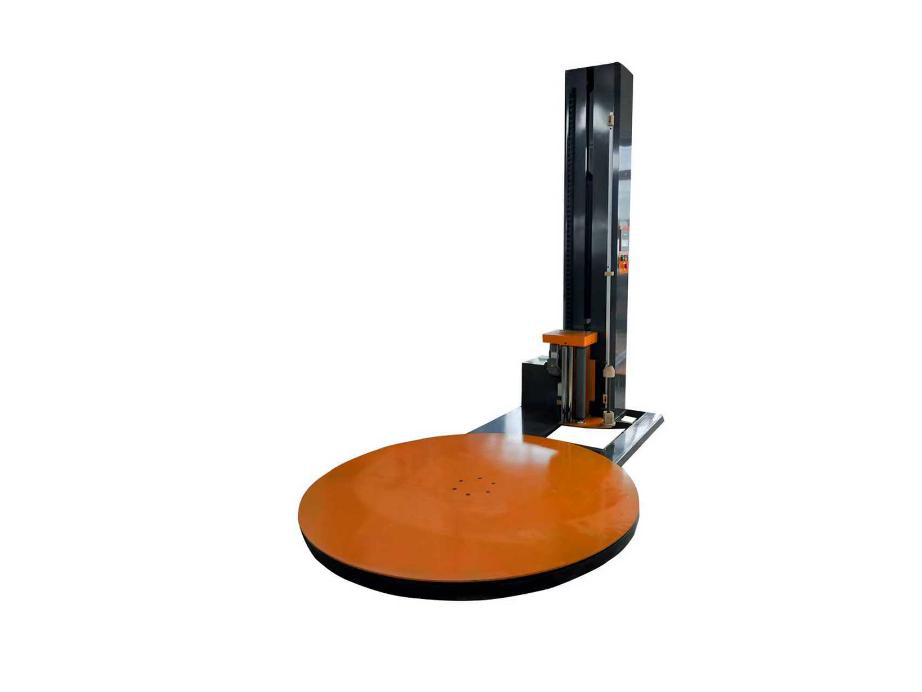
Turntable wrappers: the default, with clear limits
The turntable (or stretch) wrapper is the machine most buyers picture. The pallet sits on a rotating platform, usually 1,500 mm or 1,650 mm in diameter, and a film carriage moves up and down a fixed mast. At the bottom, the film is anchored to the pallet; as the table turns, the carriage climbs, wraps the body, and returns to add reinforcement at the top before the film is cut and the tail pressed down.
Where turntable wrappers work well
Turntable machines are the right default for stable, reasonably uniform loads that can tolerate rotation: sealed cases of dry goods, bags on pallets that are reasonably square, bundled products, and most general palletising at modest speeds. They are the least expensive family, the most compact in footprint for a standard pallet, and the simplest to operate and maintain. A well-adjusted machine with a powered pre-stretch carriage will consistently stretch cast film by 200 to 300 percent, which directly reduces film cost per pallet.
For standard loads in the range of roughly 20 to 40 pallets per hour, with no requirement to wrap on the fly, a turntable wrapper is normally the correct economic choice. Our standard turntable pallet wrapper covers exactly this band, with adjustable rotation speed, top and bottom wrap counts and a soft-start drive that avoids jerking lighter loads.
Where they fail
The limits come from the fact that the load itself must accelerate, rotate and stop. Very tall, top-heavy or unstable loads can topple or shift as the table starts and stops, particularly at the higher rotation speeds needed for throughput. Extremely heavy loads demand an oversized drive and table, and loads that overhang the platform can strike the mast or the frame. Light, fragile products can be pulled off-square by film tension during the first revolution.
Throughput is the other ceiling. A turntable machine wraps one stationary pallet at a time, and each cycle includes loading, a fixed number of revolutions, and unloading. Even fast cycles rarely exceed 40 to 50 pallets per hour in real operation, and most plants run well below the catalog figure because of the time spent positioning the pallet with a forklift or hand pallet jack.
For unstable loads that still need rotation, a turntable wrapper with a top platen holds the load down from above while it turns. This is the standard answer for light, fluffy or easily separated products such as empty containers, foam goods or bags that would otherwise lift under film tension. The platen adds cycle time and a height-adjustment step, but it turns many loads that are otherwise unwrappable on a turntable into stable pallets.
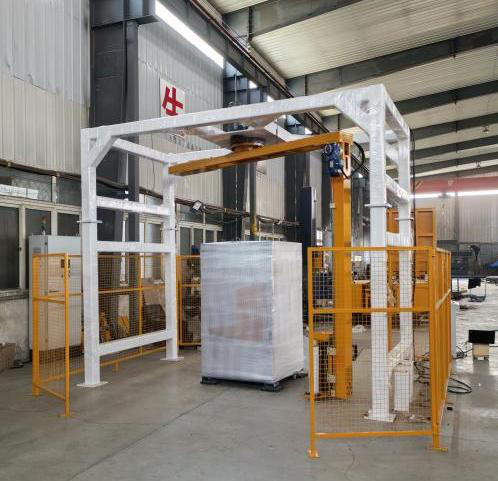
Rotary-arm wrappers: when the load must stay still
In a rotary-arm machine the pallet does not move. A rotating arm, mounted either on a column or on an overhead frame, carries the film carriage in a circle around the stationary load. Because nothing accelerates the product, there is no risk of toppling at start-up and no requirement for the load to be self-supporting under rotation.
Where rotary arms win
Rotary-arm wrappers are the correct choice for three situations. The first is very light or unstable loads that cannot safely rotate: tall bags, lightweight foam, stacked empty cartons, or products with a high centre of gravity. The second is very heavy loads, where rotating several tonnes repeatedly is impractical and hard on a turntable drive. The third is high throughput, because an overhead rotary-arm machine can be integrated in line with a palletising cell and chain conveyor, wrapping pallets as they index without a forklift handoff. Inline rotary-arm systems commonly sustain 60 to 100+ pallets per hour, well above turntable cycles.
Keeping the load stationary also makes the wrap more repeatable. Film tension is applied against a load that is not moving relative to the floor, so containment force at the corners is more consistent cycle to cycle, which matters when a retailer audits load stability. Our high-speed inline rotary-arm wrapper is built for this integration, with arm speed and film delivery synchronised to conveyor indexing.
Where they lose
The trade-offs are footprint, structural requirements and cost. A freestanding rotary arm needs a frame large enough to clear the biggest pallet on the swing radius, and an overhead machine requires adequate ceiling height and a floor capable of taking the frame loads. Rotary-arm machines are mechanically more involved and cost more than a comparable turntable wrapper. They are also slower to justify at low volumes: if you wrap ten pallets a day, you are paying for capability you will not use.
One detail buyers miss is that a stationary load still needs the film sealed at the end of the cycle, and high-speed inline machines rely on automatic cut-and-wipe units rather than an operator to finish the tail. Confirm the machine includes automatic film tail treatment, or the throughput advantage disappears while someone finishes each pallet by hand.
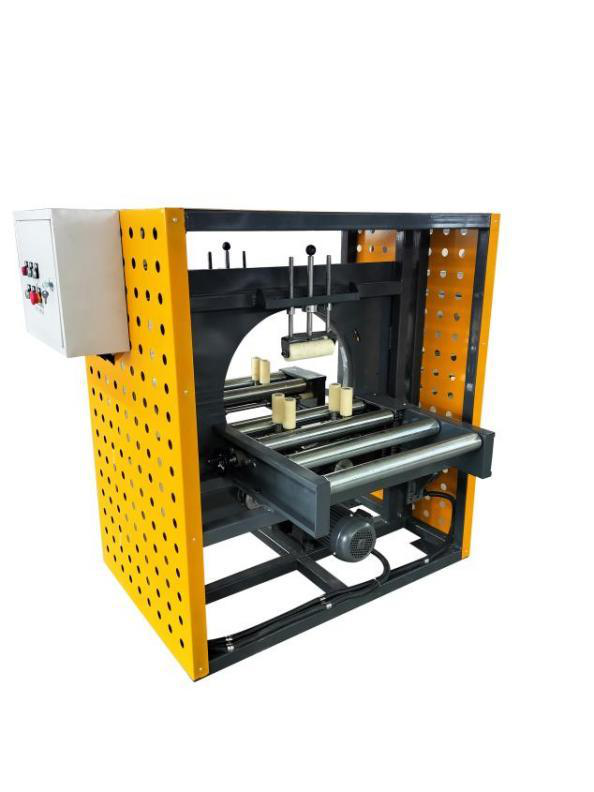
Orbital and ring wrappers: for long and awkward shapes
Pallets are not the only thing wrapped for transport, and a turntable or rotary-arm machine cannot wrap what does not fit on a pallet. Horizontal orbital wrappers drive a product lengthwise through a rotating ring that applies stretch or woven banding around it as it moves. The product travels on infeed and outfeed conveyors while the ring spins, producing a continuous spiral wrap along its length.
These machines handle timber and planks, plastic and metal profiles, pipe and tube, furniture and flat-pack panels, carpets and textiles, rolled insulation, doors, and assembled components that are too long or awkward to palletise conventionally. A compact horizontal orbital wrapper suits smaller workshops and shorter runs, while heavier profiles and steel sections call for a heavy horizontal orbital wrapper with a reinforced ring and stronger conveyor.
The key specification for orbital work is the relationship between conveyor speed and ring speed, which sets the overlap between successive wraps. Too little overlap leaves gaps and poor containment; too much wastes film. Ring diameter must clear the widest product, including any swing as irregular sections enter, and the conveyor must support long products without sag at the wrap point. Because the product moves continuously, orbital wrappers can be very productive, but they are purpose-built for a shape of product rather than a general pallet solution.
Radial wrappers for rolls and coils
Paper reels, fabric and nonwoven rolls, film rolls, tyres, wire and steel coils present a different problem again: they need wrapping around the cylindrical face, often through the eye as well, and they are easily damaged by conventional handling. A dedicated radial wrapper turns the roll on its axis and applies film around the circumference, sealing the roll against moisture and abrasion without flattening the ends. For paper, nonwoven and converter customers we specify a radial cylindrical roll wrapper; heavy steel coils and eye-through wrapping use the coil and ring machines rather than a pallet wrapper. Trying to wrap a reel upright on a turntable almost always produces a loose, poorly sealed roll and risks tipping.
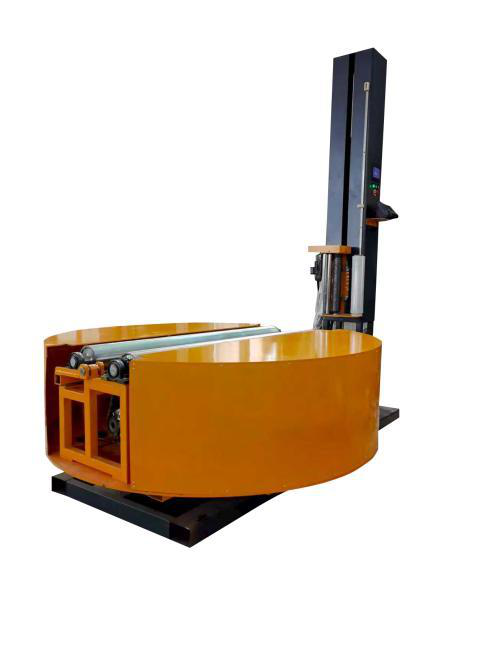
The parameters that actually determine performance
Whichever family you choose, the following parameters separate a machine that contains the load from one that merely spins film around it. Put numbers against each on your specification sheet.
Pre-stretch method and ratio
Pre-stretch elongates the film before it touches the load, exploiting the elastic memory of stretch film to pull tight and reducing the amount of film used. Mechanical (powered) pre-stretch, where two rollers turn at different speeds to elongate the film by a fixed percentage, is substantially more economical and repeatable than friction or “powered” systems that rely on load tension to stretch. Ratios of 200 to 300 percent are common for good cast film; the exact figure should be matched to the film grade. A machine without powered pre-stretch is the single most common reason film cost per pallet stays high.
Containment force, not just film tension
What keeps a load together is containment force, the cumulative holding pressure built up over multiple wraps, rather than the tension of a single band. It is governed by film tension, the number of revolutions and the pre-stretch ratio. Specify reinforcement wraps at the bottom (where the load meets the pallet) and at the top, and resist the temptation to reduce revolutions to save film, because the corners and the top few layers carry most of the stabilising load.
Drive and speed control
Variable-frequency drives with soft start and stop protect unstable loads on turntable machines and let you trade a little speed for stability on awkward pallets. On rotary-arm and ring machines, look for synchronised speed control between the rotating element, the film carriage and the conveyor so that overlap and tension stay constant as throughput changes.
Automation and integration
Decide whether the wrapper is a standalone workstation fed by forklift or an inline machine fed by chain conveyor from the palletiser. Inline integration needs powered roller or chain conveyors, pallet presence sensing, automatic film clamp/cut/wipe, and handshake logic with the upstream palletising cell. It costs more but removes the forklift handling that dominates real cycle time. If loads vary in height, an automatic height-sensing photocell avoids setting the wrap height manually each cycle.
Film: the variable nobody specs
A wrapper and its film are a system, and a perfectly good machine will underperform with the wrong film. Cast machine film is quieter, clearer and unwinds smoothly, and suits most high-speed pre-stretch work; blown film is tougher and more puncture-resistant for irregular, sharp loads but noisier and generally pricier. Gauge (or the modern equivalent, net-wrap performance) should be chosen against load weight and the number of sharp corners, not simply minimised to cut cost. Thin film that breaks on corners creates more waste and rework than a slightly heavier grade that runs cleanly.
If you want to quantify the saving rather than assume it, our calculation method for stretch film cost per pallet works through pre-stretch ratio, wrap count and film price to give a cost per load you can compare against manual handling. The same article explains why the cheapest film is rarely the cheapest pallet once breakage and re-wraps are counted. For plants still wrapping by hand, the direct comparison in pallet wrapper vs manual wrapping sets out the labour and film trade-off with real cycle figures.
Common commissioning problems and their fixes
A short list of the issues we correct most often, and their usual cause, is useful during your own acceptance checks.
- Loose bottom wraps. Too few base revolutions, or the film starts too high. Add bottom wraps and confirm the first band binds the load to the pallet deck.
- Film breaking at corners. Tension too high for the film gauge, or sharp case edges. Reduce tension, check pre-stretch rollers, or move to a tougher blown film.
- Drifting or leaning loads on a turntable. Aggressive start/stop on an unstable load. Lower rotation speed, enable soft start, or add a top platen; if it still leans, the load belongs on a rotary arm.
- Tails dragging on the floor. The cut tail is not wiped onto the load, or the film ends low. Confirm the cut-and-wipe function and the final wrap height.
- Crushed top layers. A top platen set with too much downward pressure, or film tension pulling upward. Reduce platen pressure and lower tension on the top wraps.
- Inconsistent wrap from operator to operator. Manual wrap-count and height settings. Use saved recipes per load type and automatic height sensing.
A decision path you can use
If the engineering detail is more than you need for a first pass, the following path gives the right family in most cases.
- Is the product long, profiled or otherwise not a pallet? Choose a horizontal orbital wrapper, or a radial roll wrapper for reels and coils.
- Is it a pallet that is stable enough to rotate and under roughly 40 pallets per hour? A turntable wrapper is the economic default; add a top platen if the load is light or loose.
- Is the load very light, very heavy, unstable, or above roughly 50 to 60 pallets per hour? Specify a rotary-arm wrapper, inline if the throughput justifies conveyor integration.
- Does the receiver require specific containment, a top sheet, or weather protection for sea freight? Add the top-sheet and extra reinforcement wraps to whichever family the load profile selected, and confirm the machine can apply them automatically.
The cheapest machine that contains your worst-case load at the throughput you actually run is the correct machine, even when it is not the cheapest on the quote. A wrapper that lets one pallet in a hundred lean or split costs more in a single claim than the difference between machine families.
Putting it into a specification
When you are ready to specify, gather the load profile, the worst-case dimensions and weight, the pallets-per-hour figure at peak, the film grade you run or intend to run, and the layout where the machine will sit, including ceiling height and conveyor direction. With those inputs the machine family and the required pre-stretch, containment and automation options fall out quickly. You can browse the full range in the packaging machinery catalogue, and for loads that do not match any standard model, we routinely build modified and purpose-built wrappers and integrated end-of-line cells through the custom packaging machine service. A short conversation about the load profile will usually settle the specification faster than comparing datasheets, because the right answer is driven by the pallet, not the price tag.
By the SunAura Packaging Machines applications engineering team in Qingdao. We build and commission turntable, rotary-arm, orbital and radial wrapping equipment for export markets, and we specify machines against the load profile rather than the average pallet.

Michael designs automated palletizing stations and ties upstream case or bag flow to downstream stretch wrapping. His work spans conventional layer palletizers, robotic arm cells, conveyor routing, safety fencing and handover logic between machines. He writes about palletizer selection, load stability and how an end-of-line sequence should be balanced.
See Full Bio ›