

Turning a load that weighs more than a forklift can safely swing is a daily event in metalworking plants, and it is usually done badly. Coils arrive on the flat and must stand for the uncoiler; moulds are machined in one orientation and stored or mounted in another; pallets under finished goods have to be exchanged without setting the load down; fabrications are welded horizontally and installed vertically. Where plants rely on chains, slings and an improvised forklift manoeuvre, the operation is slow, uncontrolled and a standing crush risk, and it depends entirely on whoever happens to be driving. A purpose-built upender or tilter removes the improvisation, and this guide explains how to size one, choose the drive and clamping, calculate the cycle and integrate it safely.
SunAura Packaging Machines supplies a standardised range of 90-degree upenders and 180-degree tilters from three to fifty tonnes; the launch announcement covered the machines themselves, while this article works through the engineering decisions a buyer makes when specifying them for coils, moulds, dies and heavy pallets.
First, define the load correctly
Every upender is sized from the load, and the first mistake is describing an average rather than the worst case. The specification inputs are the heaviest single load to be turned including its pallet or fixture, the largest envelope in each dimension, whether the load is cylindrical or flat, how its centre of gravity sits relative to the rotation axis, and how it will be placed and removed — forklift, crane or conveyor. A coil specification needs the outside diameter, inside diameter, width and weight; a mould needs its closed dimensions and weight; a pallet load needs the footprint, height and whether it is stable when tilted.
The centre of gravity matters because it changes the torque the drive must produce: a tall, offset load exerts far more turning moment at mid-rotation than a compact cube of the same weight, and the frame and drive are sized for that moment rather than the static weight. SunAura Packaging Machines works from photographs or drawings of the actual loads and sizes conservatively against the heaviest case, which is why the RFQ asks for the maximum rather than a typical load.
The verified machine range, in numbers
| Machine | Angle | Capacity | Cycle (one way) | Drive / clamping |
|---|---|---|---|---|
| Mechanical 90° upender | 0–90°, stop anywhere | up to 50 t | 30–50 s | Mechanical, VFD soft start/stop |
| Hydraulic 90° upender | 0–90°, stop anywhere | up to 50 t | 30–50 s | Hydraulic, smooth rotation |
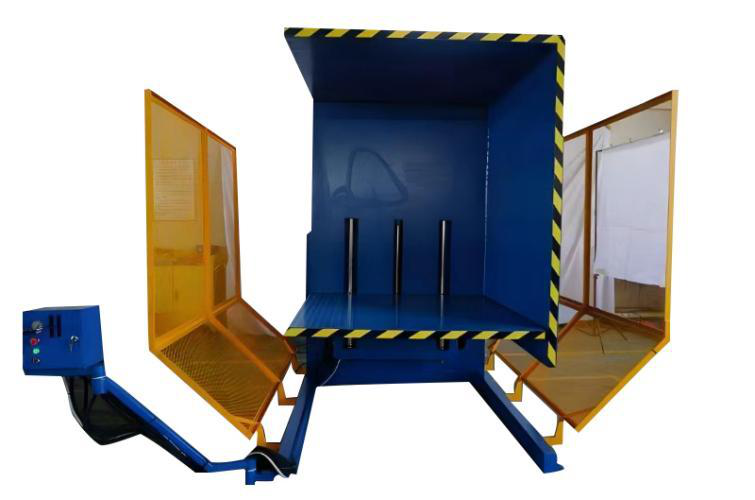
| Mechanical 180° tilter | 0–180°, stop anywhere | up to 10 t | 60–120 s | Mechanical, pneumatic/hydraulic clamp |
| Enclosed 180° tilter | 0–180° | up to 3 t | 60–120 s | Fully guarded, interlocked doors |
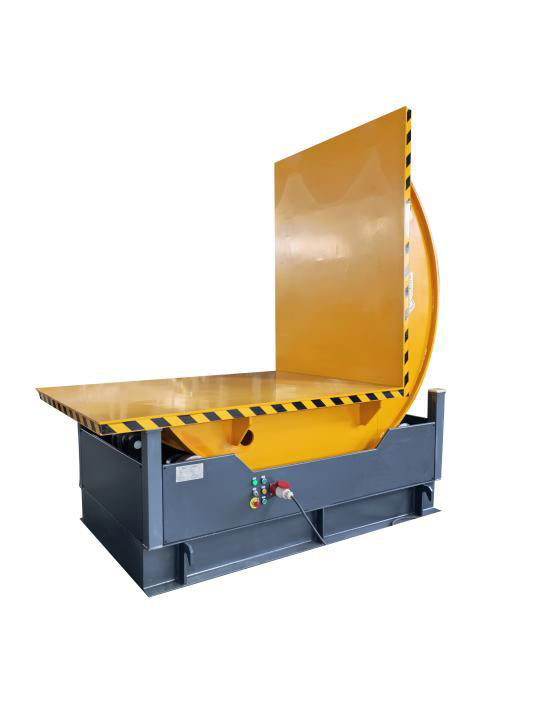
Standard 90° machines accept tilt envelopes of 500–2000 mm on each side and cylindrical loads of 500–2000 mm diameter with web width within 2000 mm, with installed power from 1 to 22 kW depending on load; non-standard envelopes are engineered to the customer’s drawings.
Mechanical versus hydraulic drive
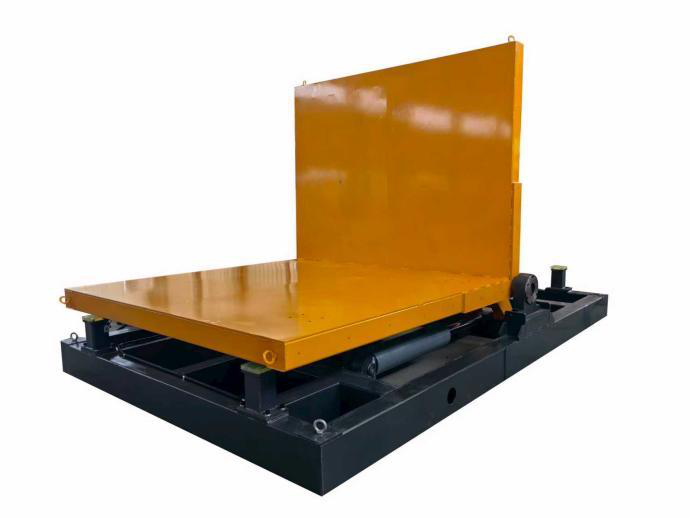
Both drives reach fifty tonnes and both stop at any angle, so the choice is not about capacity. Mechanical upenders use a VFD-driven drivetrain with soft start and soft stop, which protects the load and the gears from shock, and they suit defined, repetitive cycles in production environments where maintenance already works with electrical drives. Hydraulic upenders rotate smoothly under high torque and cushion the turn, and they suit the heaviest loads and plants already running hydraulic power units and hydraulic maintenance. The decision rests on the cycle profile and the maintenance department’s existing capability: a hydraulic machine in a plant with no hydraulic experience is serviced reluctantly, while a mechanical machine in a hydraulic workshop loses the smoothness that drove the choice.
Clamping: the part that must not be guessed
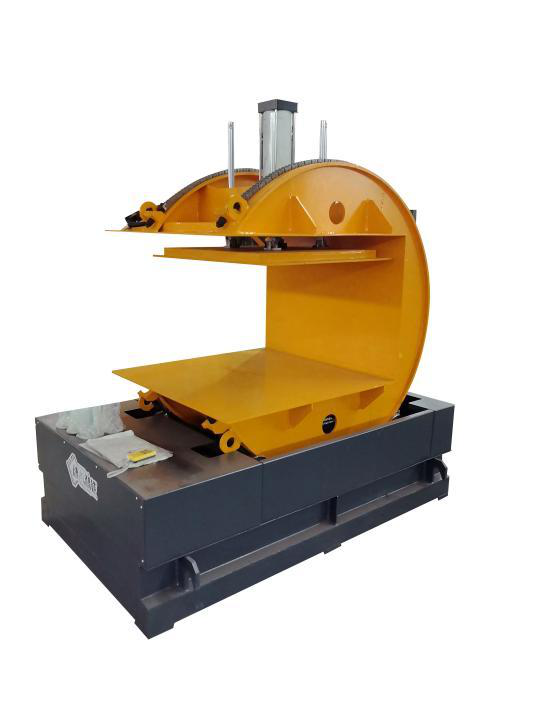
Rotation is only safe if the load cannot move, and clamping is the component most often customised. Coils sit in saddles and are retained against the platen; flat loads are clamped between tables or held by pneumatic or hydraulic arms; pallet loads may be turned with the pallet, with the clamp gripping the assembly positively before the platform moves. The 180° tilters use pneumatic or hydraulic clamping precisely because a load inverted at the top of the cycle is held by nothing else, and the clamp force and sequence are interlocked with rotation so a cycle cannot start until the load is secured. Plants turning mixed loads specify adjustable clamping and recipe-stored positions, while dedicated lines use fixed fixtures that are faster to load.
Calculating the real cycle and throughput
The published cycle — 30–50 seconds one way for 90° machines, 60–120 seconds for 180° — covers rotation only, and the practical throughput includes loading, clamping, the turn, release and removal. A coil turned in forty seconds but loaded and removed by forklift over another two minutes gives a cycle closer to three minutes per load, and planning should use that complete figure rather than the rotation time. The machine is rarely the bottleneck: the forklift or crane that places the load is, and high-volume plants therefore integrate the upender into a conveyorised flow where loads index in and out without a dedicated truck. As with all packaging and handling equipment, the line should be planned on achievable cycles rather than best-case figures, the method in SunAura Packaging Machines’ guide to real throughput.
Safety: why the operator stands clear
The entire justification for a purpose-built upender is the safety difference versus rigging, and the design follows a short set of principles. The load is positively clamped before rotation; the operator runs the cycle wirelessly from outside the working area, which removes the habit of guiding a swinging load by hand; emergency stops are fitted at the frame and controls; soft start and stop prevent the load swinging at the ends of the turn; and the fully enclosed 180° machine adds interlocked doors so a cycle cannot run with a door open. These devices are verified at commissioning and tested on a maintenance schedule, because a bypassed interlock returns the operation to the condition the machine was bought to eliminate. The guarding logic matches the washdown and heavy-duty guidance in SunAura Packaging Machines’ wider end-of-line selection work.
Standalone versus inline integration
Upenders are installed in two arrangements, and the choice follows the volume. Standalone cells in warehouses and die shops serve a single machine, with loads brought by forklift and the frame occupying a small dedicated area; this suits jobbing plants and mixed production. Inline machines at metal service centres and stamping plants sit within roller conveyors or coil cars, turning loads as one station in a continuous flow and feeding the uncoiler or slitter automatically. SunAura Packaging Machines integrates both with the conveyors, coil handling and end-of-line equipment it supplies, following the layout principles in its guide to conveyors and product handling, and the PLC and HMI exchange signals with the surrounding line so rotation only runs when the upstream and downstream stations are ready.
A worked example: a steel service centre
The sizing is clearest with a concrete case. A service centre slitting hot-rolled steel receives coils up to twenty-five tonnes, outside diameter 1900 mm, width up to 1600 mm, arriving eye-horizontal and feeding an uncoiler eye-vertical. The worst-case coil sits slightly offset on the saddle, moving its centre of gravity away from the rotation axis at mid-turn, and the drive is sized for that moment rather than the coil simply resting flat. A hydraulic 90° upender is chosen for smooth high-torque rotation, the platen and saddle are built to the actual coil diameters, and the cycle runs roughly forty seconds rotation — but the complete cycle, including the coil car placing the load, clamping, turning and releasing into the uncoiler, is planned at several minutes because the coil car serves other stations. The machine is integrated inline with roller conveyors and coil cars rather than as a standalone frame, and the PLC interlocks rotation with the car’s position.
A die shop with the same budget would specify differently: a standalone mechanical 90° or 180° machine, adjustable clamping for mixed mould sizes, wireless control and forklift loading, because its loads vary daily and never arrive on a conveyor. Same weight class, completely different configuration.
Common specification errors
The failures SunAura Packaging Machines sees in enquiries follow a short pattern. Buyers size to the average load and then turn a heavier one, overloading the frame and drivetrain; they ignore the centre of gravity and specify by static weight alone, under-sizing the torque at mid-rotation; they assume a clamp from a previous machine suits a new load shape, which is how loads shift during inversion; they plan throughput on the rotation time rather than the complete loading and removal cycle; and they order a machine without confirming how it will be loaded, leaving no room for the forklift or crane. Each is fixed in the specification stage and expensive after manufacture, which is why SunAura Packaging Machines requests drawings and works the layout before quoting a frame.
Foundations, site and maintenance
A fifty-tonne machine turning a fifty-tonne load needs a floor that carries it, and foundation loading is checked against the building’s slab rather than assumed from the machine’s footprint. The frame is anchored to a flat, level slab, with room around it for the loading equipment and, on inline machines, the conveyors and coil cars. Maintenance is straightforward: the mechanical drivetrains are inspected and lubricated on a schedule, the VFD and PLC cabinets kept clean and ventilated, the hydraulic systems checked for condition and leaks where fitted, and the clamping surfaces maintained so the load cannot slip. The safety devices — emergency stops, interlocks, wireless controls — are tested routinely, because their correct function is what keeps the operator clear. As with other heavy equipment, a short documented routine and a small stock of the practical wear parts prevent the failures that cost a shift, following SunAura Packaging Machines’ guidance on parts management.
Why plants replace improvised methods
Plants usually buy an upender after an incident rather than before one: a coil swung on slings, a mould nudged with forklift forks, a pallet turned with the load sliding. The machine’s value is then straightforward. It removes the uncontrolled swing and the habit of guiding loads by hand, turns every load in the same repeatable cycle, records the operation through the controls and keeps the operator outside the working area. It also protects the product itself, since a coil or mould that slips during an improvised turn is damaged before it reaches the machine it was bought for, and the cost of one such incident approaches the machine’s price. For plants handling these loads daily, the question is rarely whether the machine is justified but why the improvised method was tolerated as long as it was.
Frequently asked questions
What capacity should I specify?
Your heaviest actual load including pallet or fixture, with the frame and drive sized for the centre-of-gravity moment at mid-rotation, not the average load.
Mechanical or hydraulic drive?
Both reach fifty tonnes; choose mechanical for defined repetitive cycles and hydraulic for smooth high-torque turning, guided by your maintenance experience.
How many loads per hour can I turn?
Rotation takes 30–120 seconds depending on model, but the complete cycle includes forklift loading and removal, which usually sets the practical rate at one to several loads per minute-equivalent; inline arrangements run far faster.
Can non-standard loads be handled?
Yes. Frames, clamping, voltage and orientation are engineered to your drawings, with adjustable clamps and recipes for mixed production.
Conclusion
A purpose-built upender replaces an improvised, dangerous forklift turn with a repeatable cycle: the load is defined and clamped, the mechanical or hydraulic drive rotates it through ninety or one hundred eighty degrees with soft start and stop, and the operator runs the machine wirelessly from clear of the working area. Specified from the heaviest load and its centre of gravity, with the right clamping, a realistic cycle and either standalone or inline integration, these machines protect both people and product in coil, mould, die and pallet handling, and they are built to verified capacities rather than catalogue claims.
If you need to turn heavy loads, contact SunAura Packaging Machines’ applications engineers with your load dimensions, weights and orientation, or review the four machines in the products hub.

Sarah evaluates packaging consumables against machine capability: film gauge and prestretch, PP versus PET and steel strapping, core width, tension settings and corner board use. Her articles connect film and band choice to machine settings, freight damage rates and total cost per pallet, rather than recommending the cheapest consumable on paper.
See Full Bio ›