

“Servo” is the most over-used word on a flow pack machine specification sheet. Buyers hear it, assume it means modern, precise and fast, and stop asking questions. Meanwhile suppliers compete on the number of servo motors rather than on how those motors are configured, tuned and controlled. The result is a market full of machines that look identical on paper but behave very differently on the line. In this article, the engineering team at SunAura Packaging Machines clears up the eight most common misunderstandings about servo motor configuration on flow pack machines, and explains what a purchasing manager should actually compare when two quotes both say “full servo”.
First: what the servos on a flow pack machine actually do
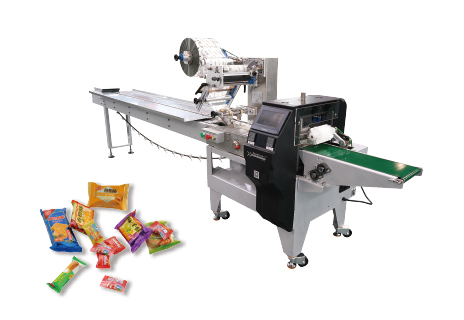
A horizontal flow wrapper performs a small number of critical motions. The film unwinds from a reel and is drawn forward; it passes through a former that wraps it around the product; longitudinal sealing wheels fuse the fin seal; a rotating or reciprocating cross-seal jaw cuts and seals the ends; and the finished pack is discharged. On a traditional mechanical wrapper, one main motor drives all of these through a gearbox, line shaft, chains and camboxes, and changeovers require manual adjustment of cams and gears. On a servo wrapper, each major motion has its own motor — typically the film-feed/pull-wrap rollers, the longitudinal seal rollers and the cross-seal jaw — coordinated by an electronic cam inside the controller. Some machines add a fourth and fifth servo for the infeed lug chain, the product tracking (colour-mark) correction and the discharge.
Understanding which motion each servo controls is the precondition for judging a configuration. Once you know that, most of the common misunderstandings become obvious.
Misunderstanding 1: “More servos means a better machine”
Sales literature loves a high servo count: “five-axis servo”, “seven-axis full servo”. Buyers read more axes as more capability. In reality, the number of servos is a description of which motions are independently driven, not a quality score. A three-servo wrapper (film feed, long seal, cross seal) is the sweet spot for a wide range of products. A five- or seven-servo wrapper adds independent control of infeed lugs, product positioning and reciprocating motion, which is genuinely valuable at high speed or with delicate, irregular products — but it is wasted cost if your product is a regular biscuit running at 60 packs per minute.
Worse, an extra servo for a motion that was perfectly fine mechanically adds another point of failure, another cable, another encoder and another parameter to tune. The right number of servos is the smallest set that independently controls the motions that actually vary across your product range. Compare the function each servo serves, not the count. The same principle applies when buyers weigh automation generally; our piece on the return on investment of servo-driven packaging machines shows where additional axes pay back and where they do not.
Misunderstanding 2: “Servo automatically means smoother and quieter”
Servos deliver precise, programmable motion, but the smoothness of the finished pack depends on the mechanics riding on top of the servo: the rigidity of the frame, the quality of the gearboxes, the sealing-jaw balance, and — critically — the electronic cam profile tuning. A well-tuned three-servo wrapper runs quieter and produces neater packs than a badly tuned seven-servo machine where the electronic cams fight each other. Servos remove the hardware limits on motion; they do not remove the need for engineering judgement in the trajectory, acceleration rates and seal dwell times.
This is why commissioning and after-sales tuning matter. A machine shipped with generic motion profiles may vibrate, mark film or mis-seal at your product’s speed even though every servo specification on the quote was met. Ask the supplier whether the motion profiles are tuned per product recipe at factory acceptance, and whether changes can be made remotely.
Misunderstanding 3: The catalog “up to” speed is what you will get
This is the single most expensive misunderstanding. A flow wrapper quoted at “up to 200 packs per minute” measures that speed under ideal conditions: a single rigid product, perfect registration, no stoppages, fresh film, and an operator who never touches the line. With real products, real film variation and real changeovers, the first-pass rate is far lower — typically 55 to 75% of catalog peak. Servo control helps here, because electronic registration and product tracking recover some of the losses, but it does not make the catalog number real.
We have written extensively on this in our guide to calculating the real throughput of automatic packaging equipment rather than using catalog rated speed. The practical lesson for servo configuration: choose a wrapper whose rated speed is comfortably above your real target, because the servo axes lose very little headroom when you run at a sensible speed, and you will need that margin for stops, splices and changeovers.
Misunderstanding 4: “All servos are the same; the brand is just marketing”
The brand and class of servo matter, but not for the reason most buyers think. It is not that a premium servo motor makes better seals. It is that the servo system — motor, drive, encoder and controller firmware — determines repeatability, energy behaviour and, above all, the availability of replacement parts and technical support over the machine’s twenty-year life. A wrapper built on a fragmented, unsupported servo platform can become unrepairable in ten years when the drive electronics are discontinued.
When you compare quotes, ask which servo brands are used for each axis and confirm that the supplier holds or can source replacement drives and motors locally or quickly by air. A machine built on widely available servo platforms is cheaper to maintain, regardless of whether the motor itself is the highest-end option on the market. This is also why spare-parts planning matters; our article on packaging machine spare-parts management to reduce unplanned downtime describes how to tie servo and control purchases to a workable parts strategy.
Misunderstanding 5: “Electronic cams remove all mechanical setup”
Servo machines replace mechanical cams with software cam profiles, which is a genuine leap in changeover flexibility. But they do not eliminate mechanical setup entirely. The film former, the guide rails, the fold geometry, the jaw-to-former alignment and the seal-temperature tuning are still physical adjustments that change with product and film. What servos do is make the timing and phase relationship between motions repeatable and recallable by recipe — so that when you return to a product, the timing is already set, but you still mount the correct former and set the seal temperature.
Buyers who expect a “push one button and it’s done” experience are disappointed by the first changeover. The right expectation is: the motion timing is saved, the mechanical form and heat are set once per tooling and then checked. Realise this and you will budget the right operator time and the right tooling set.
Misunderstanding 6: “Bigger servos are safer; it’s better to over-specify”
There is a small but real cost to over-sizing a servo. Oversized motors draw more no-load current, respond more sluggishly, and can actually make high-frequency seal motion less crisp because the inertia mismatch between motor and load grows. Servo systems are most efficient and most responsive when motor inertia is matched to the load inertia within a sensible ratio. An experienced controls engineer sizes each axis for the actual torque and inertia of the motion it drives — the cross-seal jaw needs fast, controlled acceleration; the film pull needs steady, low-tension torque. Over-specifying every axis does not buy reliability; it buys energy waste and poorer tuning.
Misunderstanding 7: Electronic registration means film quality no longer matters
A servo flow wrapper with optical or printed-mark registration continuously corrects the film phase so that the seal lands on the intended position even as film stretches and drifts. This is genuinely useful, and it tempts buyers to assume that cheaper, inconsistent film can be used without consequence. It cannot. Electronic registration corrects phase error — where the seal cuts relative to the printed mark — but it cannot correct film that stretches unevenly across its width, film that carries variable ink drag, or film whose thickness is outside the sealing temperature window. A poorly controlled servo will chase a drifting mark, producing jittery pack lengths and over-heated seals as the jaw hunts. The registration loop is a compensator, not a fix for bad raw material. Buyers should still specify film to the supplier’s recommended tolerance and treat the mark quality as a gating requirement, particularly for laminated films used in cosmetics and frozen foods.
Misunderstanding 8: The servo platform is maintenance-free
Servos have no brushes and few wearing parts, which leads buyers to believe they are zero-maintenance. In practice, the encoder feedback path, the cooling fans on the drives, the gearbox lubrication on the output stages, and the seals where the motor meets the hostile heat environment of the sealing jaws all need attention. The cross-seal jaw servo in particular works near heated tooling, and cable carriers flex millions of cycles; the flexible cables and encoder wires in the moving axis are among the first components to fail in a neglected machine. A realistic preventive schedule — inspecting cable carriers, checking drive error logs, verifying encoder calibration and re-greasing gearboxes at the manufacturer’s intervals — prevents the unplanned stoppages that servo machines are otherwise expected to avoid. This is exactly the maintenance discipline covered in our note on preventive maintenance for high-speed packaging equipment.
What a sensible servo configuration looks like
For the majority of mid-speed food, bakery and cosmetic flow-pack applications, SunAura Packaging Machines recommends a well-tuned three- to five-axis servo architecture. The SZ-350 three-servo flow wrapper covers the common case of medium-width products with moderate changeovers. For higher speed or products requiring precise reciprocating cut motion, the SW-60E full-servo reciprocating wrapper adds independently controlled reciprocating jaws that handle products requiring a longer seal dwell. For the fastest multi-SKU environments, the SZ-580 five-servo flow wrapper layers on product tracking and infeed coordination. The point is that the architecture is matched to product and speed, not chosen for the most impressive spec sheet. If you are still deciding which class of machine fits your product, our guide to selecting a horizontal flow wrapper for food and cosmetic products walks through the product-to-machine matching that should precede the servo debate.
Questions to put in writing on every servo quote
To cut through the marketing, ask each supplier the same set of questions and compare the answers side by side:
- How many independent servo axes are there, and which specific motion does each one control?
- What servo motor and drive brands are used, and what is the documented lead time for replacement?
- What is the first-pass speed with your actual product and film, rather than the catalog peak?
- Are electronic cam profiles tuned at factory acceptance for your product recipes, and can they be adjusted remotely?
- What mechanical changeover adjustments remain, and how long does a full changeover take with a stored recipe?
- What warranty applies to the servo drives, and what consumable or wearing parts are expected per year?
How SunAura Packaging Machines specifies servo flow pack machines
At SunAura Packaging Machines, we quote servo configuration by product and operating pattern rather than by a one-size spec. We ask for product dimensions, film specification, target real packs per hour, changeover frequency and product delicacy, and then recommend the smallest servo architecture that comfortably covers that envelope — while keeping the control hardware capable of adding an axis later if volumes grow. Every machine is run with the customer’s product at factory acceptance before shipment, and the motion profiles are documented and stored so that commissioning on site is a confirmation exercise rather than a tuning exercise.
If you would like a configuration comparison between a three-servo, five-servo and reciprocating servo wrapper for your product range, contact the SunAura Packaging Machines engineering team with your product drawings, film spec and hourly target. We will tell you honestly which servo count you actually need.
Bottom line
Servo motor configuration on flow pack machines is an engineering decision, not a tick-box marketing claim. More axes are not automatically better, catalog speeds are not real speeds, and electronic cams do not eliminate mechanical setup. Compare the function of each axis, the support behind the servo platform, the tuned first-pass speed with your product, and the realistic changeover time. Done that way, the servo wrapper you buy will perform on the day it is commissioned — not only on the day it is quoted.

David leads our case sealing and cartoning engineering team. Over 14 years he has specified, installed and commissioned hundreds of random-size case sealers, top- and side-loading cartoners, and automatic case packers for food, household and industrial product lines. He writes buying guides and troubleshooting articles around seal quality, tape and hot-melt glue selection, and carton throughput limits.
See Full Bio ›