

For many small and mid-sized food, bakery, confectionery, cosmetics and contract-packing operations, the question is not whether to buy packaging machinery at all. It is whether the capital budget is better spent on a fully automatic turnkey line, a patchwork of hand-fed machines, or a carefully balanced semi-automatic packaging solution. The wrong choice shows up eighteen months later as either an under-used automated line that never reached rated speed, or a labor bottleneck that capped output just as demand grew. This guide walks purchasing managers, plant engineers and production supervisors through the decision process SunAura Packaging Machines uses when quoting semi-automatic equipment for factories running between roughly 500 and 8,000 finished packs per hour.
What “semi-automatic” actually means on the shop floor
In marketing brochures, “semi-automatic” is a loose term. In practice it describes a machine that automates the high-value, repeatable motion — film feeding, sealing, cutting, case erecting, tape application or strapping — while a human operator handles the variable part: product loading, collation, size changeover and inspection. A horizontal flow wrapper is semi-automatic when a operator places product onto an infeed belt by hand and the machine automatically forms, seals and cuts the pack. A case sealer is semi-automatic when the operator folds the flaps and the machine folds the top flaps and applies tape. A strapping station is semi-automatic when the operator positions the bundle and the machine tensiones, seals and cuts the strap.
This division of labour is the whole economic argument for the category. Machines do the precise, fatiguing, repetitive jobs; people do the jobs that require judgement. As long as the manual step does not become the bottleneck, the semi-automatic route captures most of the quality, consistency and waste-reduction benefits of automation at a fraction of the capital outlay and with a much smaller footprint. When the manual step becomes the bottleneck — for example when one operator cannot load fast enough to feed a wrapper capable of 120 pieces per minute — you have under-invested, and the gap must be closed either with a collation/denester infeed or by moving up to an automatic infeed.
When semi-automatic beats fully automatic
Fully automatic lines earn their keep when three conditions are simultaneously true: single-SKU or very low changeover frequency, stable, high and predictable volume, and a product geometry that a mechanical feeder can reliably present. The same conditions make semi-automatic the wrong tool at very high volume. The reverse is also true: a fully automatic line is a poor investment when any one of those conditions fails.
Semi-automatic packaging is usually the right answer for a small-to-medium factory that exhibits one or more of the following characteristics:
- Many SKUs, frequent changeovers. A craft bakery running ten bread varieties, a contract packer running short promotional runs, or a cosmetics lab launching a new shade every month pays for automatic infeeds it only uses a few days per quarter. Hand-fed flow wrappers and semi-automatic cartoners change over in minutes rather than hours.
- Output between roughly 1,000 and 8,000 packs per hour. Below this band, even a semi-automatic line may be over-specified and simple hand wrapping is adequate. Above it, the labour cost of manual loading begins to erase the capital saving and the output ceiling becomes a sales constraint.
- Uncertain or seasonal demand. If you are growing into a new channel and cannot yet commit to a volume forecast, a semi-automatic machine buys you the option to scale later with an automatic infeed rather than forcing a single irreversible bet.
- Limited floor space and low headroom. A turnkey automatic line with accumulation, robotics and conveyors often needs 20 to 40 metres of linear floor. A semi-automatic flow wrapper and case sealer can fit on a single bench bay.
- Workforce where flexible labour is cheaper than automation. In regions where skilled packing labour is available at a predictable hourly cost, the break-even point shifts toward manual loading, provided quality and speed remain acceptable.
The decision framework: four numbers that settle the debate
Rather than arguing from gut feel, reduce the choice to four operating numbers and solve the arithmetic.
1. Net required packs per hour. Start from the sales forecast and the production calendar, then divide by effective working hours after changeovers, breaks and scheduled downtime. Do not quote your target against a wrapper’s catalog “up to” speed. A realistic first-pass rate for a hand-fed flow wrapper is between 55% and 75% of catalog peak once loading rhythm, misfeeds and splices are counted. This is the same discipline we describe in our companion piece on calculating real throughput of automatic packaging equipment rather than catalog rated speed.
2. Changeover frequency. Count how often the line must switch product size, film or carton. Each changeover on a semi-automatic line costs fifteen to forty minutes; on a fully automatic servo line it can cost one to three hours unless recipes are stored and automated. If you change over more than twice a day, the labour saving of automation is largely consumed by lost changeover time.
3. Labour cost per operating hour. Add wage, loadings and supervision, then multiply by the number of operators a given configuration requires. A hand-fed wrapper typically needs one loader and one pack-off operator. An automatic infeed can remove the loader but adds amortised capital, maintenance and a more skilled technician. Compare the two running-cost streams over five years.
4. Five-year cost of ownership, not sticker price. Include energy, film waste on startup, spare parts, consumables, maintenance labour and training. This is why we recommend buyers read our guide to the total cost of ownership of automatic packaging lines before finalising a budget; the sticker-price gap between manual, semi-automatic and automatic shrinks or even reverses over five years when waste and downtime are costed honestly.
A typical semi-automatic equipment mix for a mid-sized plant
SunAura Packaging Machines commonly supplies three building blocks that combine into a complete semi-automatic end-of-line without committing to full automation.
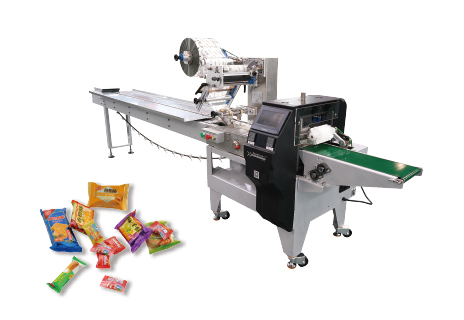
Hand-fed horizontal flow wrapper. Models such as the SZ-280 horizontal flow wrapper are sized for medium-width products and short runs. The operator places items on the infeed, the former tube is set for the film width, and machine speed is matched to loading rhythm. These machines are popular with bakeries and confectioners because they handle pillow packs, have short changeovers and leave room to add an automatic collation infeed later as volumes grow.
Semi-automatic case sealer. Once packs are bagged, they must go into shipping cases. The FA-500 semi-automatic case sealer lets the operator fold the bottom and top flaps and then runs the case through self-adhesive tape heads. It removes the single most frustrating, inconsistent manual task — hand-taping cases at variable tension — while keeping the machine itself inexpensive and easy to relocate between lines.
Semi-automatic or automatic strapping. For palletised loads, a semi-automatic strapping machine tensiones and seals polyester or polypropylene strap consistently, which matters far more than most purchasers realise: hand-tensioned straps routinely lose 30 to 50% of their retained tension, leading to pallet shift in transit. Buyers comparing this step should also review our analysis of pallet wrapper versus manual wrapping total cost, because stretch wrapping and strapping solve different parts of load containment.
These three blocks interoperate with ordinary roller or belt conveyors, so the layout can be reconfigured as the factory grows. The next step up — an automatic infeed on the wrapper, an automatic case erector, and a collaborative palletiser — can be bolted on module by module rather than forcing a single large capital event.
Floor space, utilities and layout: the overlooked half of the spec
Small plants rarely have the luxury of a greenfield layout. Before ordering, measure the bay, the door widths, the floor load, the electrical supply and the compressed-air service. Semi-automatic flow wrappers typically need a single-phase or three-phase supply at 220V/380V and a modest 6 to 8 bar compressed-air connection for the sealing and cutting actuators. Case sealers and strappers need even less. What catches buyers out is accumulation space: you need somewhere to place finished packs before cartoning, and somewhere to collect cases before palletising. Without a small buffer, the operators of adjacent stations are forced to work to the slowest station’s rhythm.
Layout mistakes are the single most common cause of “the machine doesn’t keep up” complaints that are actually material-flow problems. We cover this in depth in our technical note on packaging line layout mistakes that cause factory failures; the short version is that you should sketch the flow on the floor with tape before you commit to the purchase order, and leave at least 800 mm of clearance on every side for reels, cleaning and maintenance.
Cost expectations and payback for semi-automatic equipment
A realistic budget for a hand-fed horizontal flow wrapper in standard configuration, including one forming set and a basic printer interface, is a fraction of the equivalent fully automatic servo wrapper. A semi-automatic case sealer and a bench strapper add further modest amounts. The appeal is not the absolute price — it is the ratio of automation benefit to capital outlay, and the fact that almost every component can be retained when you later upgrade.
Payback is usually dominated by three savings. First, reduced film and packaging-material waste: a powered, repeatable seal-and-cut cycle consistently beats hand wrapping on film over-usage, often 5 to 12% material saving. Second, reduced rework and returns from inconsistent seals. Third, the reallocation of operator time from tiring, repetitive motion to inspection and collation. When you put numbers to these, a semi-automatic line commonly pays back in twelve to twenty-four months for a plant running two shifts. The SW60X/SW80X flow wrapper family illustrates the upgrade path: buyers who start with a hand-fed configuration can later move to a servo model with automatic infeed without abandoning the former and sealing architecture.
The RFQ: what a serious buyer should ask
A vague enquiry (“how much for a packaging machine?”) gets a vague, inflated quote. A precise enquiry gets a price you can trust. Before you approach a supplier, complete the checklist we publish in our RFQ checklist for sourcing automatic packaging machinery. At minimum you need to provide: product dimensions and weight, pack style and film specification, required packs per hour including a future-proof margin, number of SKUs and changeover frequency, available floor space and utilities, target markets (which drives CE, food-contact and documentation requirements), and your maintenance capability on site.
When comparing two quotes on an equal footing, ask each supplier the same five questions: what is the demonstrated speed with your product at a realistic loading rhythm; what is included in the changeover time; what is the spare-parts lead time for wear items such as sealing jaws, belts and tape heads; what training and remote-diagnosis support is included; and what happens when you later want to add an automatic infeed. The supplier’s willingness to answer these in writing is itself a qualification signal.
How SunAura Packaging Machines approaches semi-automatic projects
SunAura Packaging Machines supplies flow wrappers, cartoners, case sealers, strappers and end-of-line palletising equipment to small and mid-sized factories on every continent. Our default approach for a first-time buyer is to specify the smallest semi-automatic configuration that clears the present bottleneck, while wiring in the infeed, control and conveyor interfaces needed to add automation later. We would rather sell you a machine you grow into over three years than a line you under-use for one.
Every quotation includes the product drawings, electrical schematic, recommended spares list and a realistic first-pass yield target based on comparable installations. Because equipment from a manufacturer is only as good as the support behind it, we also provide documented remote-diagnosis access, training materials and a structured parts programme; you can read more about this on our after-sales support page. If you would like us to scope a semi-automatic layout for your specific products and volumes, contact the SunAura Packaging Machines engineering team with your product dimensions, current hourly output and number of SKUs, and we will return a configuration with a phased upgrade path.
Bottom line
For a small-to-medium factory, semi-automatic packaging is neither a compromise nor a step down from “real” automation. It is a deliberate economic decision that matches the machine to the variability in the product, the volume and the changeover schedule. Model the four numbers — net required packs per hour, changeover frequency, labour cost per hour, and five-year total cost — and the right specification usually becomes obvious. Buy the automation that today’s volume justifies, keep the upgrade path open, and you will avoid the two classic mistakes: over-buying an automatic line you cannot keep fed, and under-buying manual labour you cannot afford to keep.

Michael designs automated palletizing stations and ties upstream case or bag flow to downstream stretch wrapping. His work spans conventional layer palletizers, robotic arm cells, conveyor routing, safety fencing and handover logic between machines. He writes about palletizer selection, load stability and how an end-of-line sequence should be balanced.
See Full Bio ›