

Strapping machines are the quiet workhorses of end-of-line packaging. They secure cartons, bundle products, and unitize pallet loads with PP or PET strap — but choose the wrong one, and you’ll deal with inconsistent tension, jammed strap, frayed seals, and cartons arriving damaged at the customer’s dock.
This 2026 buying guide walks you through every decision: semi-auto vs. fully automatic, PP vs. PET strap, arch size, speed ratings, price ranges, and the exact questions to ask suppliers. Whether you’re strapping 50 cartons a day or 5,000, this guide gives you the framework to pick the right machine.
1. Strapping Machine Types: Pick by Your Volume
Strapping machines fall into three automation tiers. Your daily carton count and labor budget determine which tier is right.
| Machine Type | Best For | Speed | Price (FOB China) |
|---|---|---|---|
| Semi-Automatic Tabletop | Workshops, low volume, <500 straps/day | 1–1.5 sec/cycle (operator-fed) | $1,500–$4,000 |
| Automatic Arch Machine | Mid-volume lines, 500–3,000 straps/day | 1.5–3 straps/sec (30–65 SPM) | $5,000–$18,000 |
| Fully Auto Side-Seal / Inline | High-speed integrated lines, 3,000+/day | Up to 65+ straps/min | $15,000–$45,000+ |
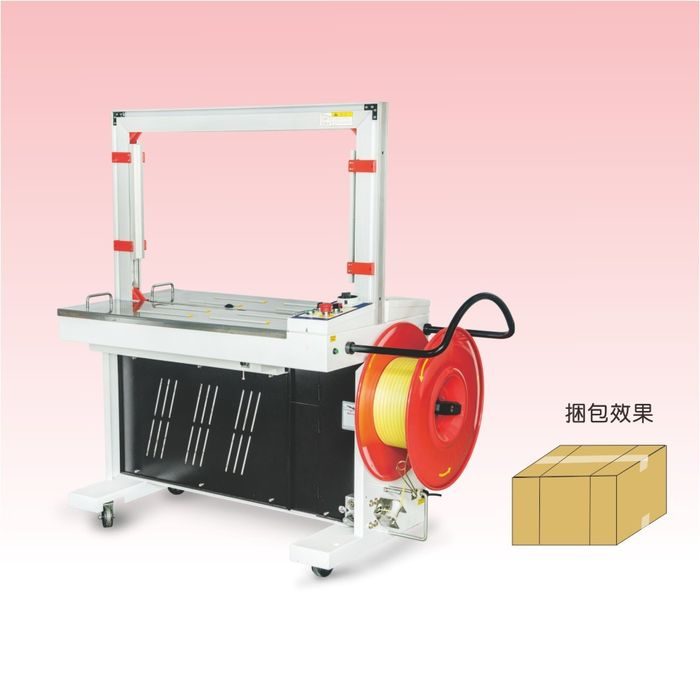
Semi-Automatic: The Budget Starter
An operator places the carton on the table, feeds the strap through the arch, and presses a pedal. The machine tensions, seals, and cuts automatically. This is the lowest-cost entry point, but it depends entirely on operator speed and consistency.
Watch out for: These machines struggle with heavy or bulky loads. The operator must lift and position each carton, which adds fatigue and slows throughput over a full shift.
Automatic Arch: The Line Workhorse
Cartons enter the arch automatically via conveyor. A photoeye detects the box, the strap feeds around the arch, tensions, seals, and cuts — all without operator intervention. These integrate directly with case sealers, carton erectors, and conveyors.
Side-Seal / Inline: Maximum Speed
Side-seal machines mount the sealing head on the side of the arch, making them ideal for wet, dusty, or oily environments where traditional top-seal heads would jam. They’re also the choice for high-speed integrated lines running 40+ straps per minute.
2. PP vs. PET Strap: Which Material?
The strap material you choose affects tension strength, elongation, noise, and cost. Here’s the straight comparison:
PP Strap (Polypropylene)
Best for: Light-to-medium cartons, bundling, printed packaging
Width: 5–15 mm (most common: 12 mm)
Break strength: 40–200 kg
Price: $1.5–$2.5/kg
Pros: Low cost, quiet, printable, easy to seal
Cons: Loses tension over time (especially in heat), not for heavy loads or long-distance shipping
PET Strap (Polyester)
Best for: Heavy pallets, bricks, lumber, metal, long-haul shipping
Width: 9–19 mm (most common: 12–16 mm)
Break strength: 200–500+ kg
Price: $2.5–$4/kg
Pros: High tension retention, steel replacement, UV-resistant, eco-friendly
Cons: Louder operation, requires compatible sealing head, higher material cost
Critical Note: Not all strapping machines handle both PP and PET. Many entry-level machines are PP-only. If you might switch to PET for heavy loads later, buy a machine with a PET-compatible sealing head from day one — retrofitting is rarely cost-effective.
3. Critical Specs to Evaluate
| Specification | What to Ask | Why It Matters |
|---|---|---|
| Arch Size (W×H) | mm / inches | Must fit your largest carton with 50mm clearance on each side |
| Strap Width Range | mm (e.g., 9–12 mm) | Determines which strap sizes you can run; narrower = less material cost |
| Tension Range | kg / N adjustable | Too tight crushes cartons; too loose = load shifts. Digital tension control is worth the premium |
| Seal Type | Friction weld / hot knife | Friction weld handles PET and thick strap; hot knife is simpler for PP-only |
| Strap Reel Capacity | Max reel OD / core size | Larger reels = fewer changeovers = more uptime |
4. Price Ranges & Total Cost of Ownership
| Configuration | Typical Use Case | Price (FOB China) |
|---|---|---|
| Semi-auto tabletop strapper | Small workshop, <500 straps/day | $1,500 – $4,000 |
| Automatic arch strapper (standard) | Mid-volume production line | $5,000 – $12,000 |
| High-speed automatic arch (40+ SPM) | Fast cartoning line integration | $12,000 – $22,000 |
| Side-seal inline strapping system | Wet/dusty environment, high speed | $18,000 – $45,000+ |
| Pallet strapping machine (vertical) | Pallet load unitizing | $8,000 – $30,000+ |
Operating cost reminder: Strap material is your recurring expense. A line running 2,000 straps/day at 12mm PP strap uses roughly 60–80 kg of strap per week. At $2/kg, that’s $5,000–$8,000 per year in strap alone. Cheap machines that waste strap (poor feeding, high trim scrap) can cost you more in material than the machine saved upfront.
5. Case Study: E-Commerce Fulfillment Center
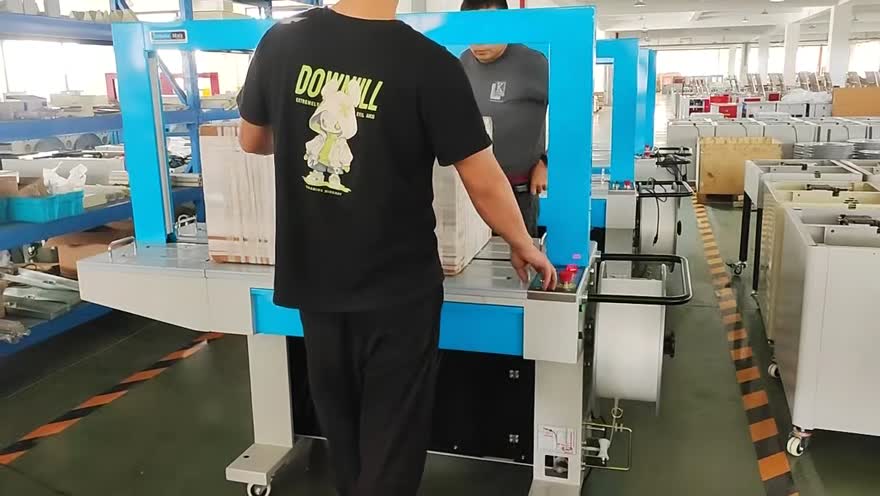
The challenge: A Chinese cross-border e-commerce fulfillment center was using two semi-automatic strapping stations, each staffed by one operator per shift. They were processing 1,800 cartons/day but dealing with inconsistent tension (some cartons arrived loose, others crushed), and labor costs were climbing as they expanded to a second shift.
The solution: SunAura supplied two automatic arch strapping machines integrated directly after the case sealers, with a merging conveyor and photoeye activation. The system runs at 45 straps/min with digital tension control (10–40 kg adjustable via HMI). PP strap at 12mm width, with automatic strap feed and self-threading.
The results:
- Operator count reduced from 4 (2 per shift × 2 shifts) to 0 dedicated strapping staff
- Strap waste dropped 18% due to consistent tension and reduced re-strapping
- Carton damage complaints dropped from 3.2% to 0.4%
- Payback period: 9 months on labor savings alone
6. Six Common Buying Mistakes
- Buying PP-only when you’ll need PET later. If your product weight is trending up or you ship long-haul, buy a PET-compatible head now.
- Arch size too small. Measure your largest carton, then add 50mm on each side. You’ll add SKUs later — leave headroom.
- Ignoring tension control. Fixed-tension machines crush light cartons and under-tension heavy ones. Digital adjustable tension is non-negotiable for mixed-SKU lines.
- Underestimating strap reel changeover time. On high-speed lines, a 5-minute reel change every 4 hours adds up. Buy the largest reel capacity your machine allows.
- Not checking sealing head access. Sealing jaws wear out and need cleaning. If you can’t reach them without tools, maintenance will be skipped.
- Forgetting noise. PET strap on automatic machines is loud (85+ dB). If operators work nearby, budget for noise enclosure or hearing protection.
Related Guides
- Shrink Wrapping Machine Buying Guide & Selection (2026) — pair strapping with shrink wrap for complete load containment
- Palletizer Buying Guide & Selection (2026) — what comes after strapping on your end-of-line
- How to Plan Your Packaging Line Layout — position the strapper correctly in your line
- Packaging Machine Preventive Maintenance Checklist — keep your strapper running
- End-of-Line Packaging Integration Guide — connect strapper to case sealer and palletizer
Frequently Asked Questions
How much does a strapping machine cost?
Semi-automatic tabletop strappers start at $1,500–$4,000. Automatic arch machines for production lines range from $5,000–$18,000. Fully integrated high-speed side-seal systems run $18,000–$45,000+. Most mid-sized operations should budget $6,000–$12,000 for a reliable automatic arch strapper FOB China.
PP or PET strap — which should I use?
Use PP strap for light-to-medium cartons (under 20 kg) and short-distance shipping. It’s cheaper, quieter, and works with most entry-level machines. Use PET strap for heavy loads (over 20 kg), pallet unitizing, long-haul shipping, or products that need tension retention over time. PET is stronger but costs more and requires a compatible sealing head.
How fast is an automatic strapping machine?
Standard automatic arch machines run 30–45 straps per minute. High-speed models reach 55–65 straps per minute. Actual throughput depends on carton size, conveyor speed, and how many straps per carton (typically 1–2). A line running 40 cartons/min with 1 strap each needs a machine rated for at least 45 SPM.
Can a strapping machine handle different carton sizes?
Yes, within the arch size limits. Automatic machines detect cartons via photoeye and adjust automatically. As long as each carton fits through the arch with clearance, the machine will strap it regardless of size. Just make sure the arch is large enough for your biggest SKU, and that tension is adjustable for different weights.
How do I maintain a strapping machine?
Daily: clear strap dust from the sealing head and arch track. Weekly: lubricate moving parts, check sealing jaw wear. Monthly: inspect strap feed path for burrs, test tension calibration. Sealing jaws are a wear item — budget replacement every 6–12 months depending on volume. Always use the strap width and quality specified by the manufacturer; off-spec strap causes jams and poor seals.

David leads our case sealing and cartoning engineering team. Over 14 years he has specified, installed and commissioned hundreds of random-size case sealers, top- and side-loading cartoners, and automatic case packers for food, household and industrial product lines. He writes buying guides and troubleshooting articles around seal quality, tape and hot-melt glue selection, and carton throughput limits.
See Full Bio ›