

If you are sourcing a shrink wrapping machine for the first time, the choice usually comes down to three machine families: the L-bar sealer, the continuous side sealer, and the sleeve wrapper. They look similar in a brochure but behave very differently on a production floor, and buying the wrong one is an expensive way to discover your real throughput. This guide explains how packaging engineers at SunAura Packaging Machines size these machines, what to put in your request for quotation, and which specifications actually matter.
What shrink wrapping actually does
Shrink wrapping encloses a product in a thermoplastic film — most often POF (polyolefin) for retail goods or PE (polyethylene) for heavier industrial packs — and passes it through a heat tunnel. Hot air causes the film to contract tightly around the product, producing a transparent, tamper-evident wrap that protects against dust, moisture and minor abrasion. Unlike stretch film, which is wrapped under tension and clings to itself, shrink film derives its holding force from heat recovery. The distinction matters because it determines the film, the tunnel and ultimately the machine configuration you should buy.
Buyers searching for terms such as “automatic shrink wrapping machine for sale”, “POF film packing machine” or “heat shrink packaging equipment supplier” are usually solving one of three problems: presentation for retail shelf packs, bundling of multiple items into a multipack, or protective unitisation of larger products. Each problem points to a different machine.
The three machine families compared
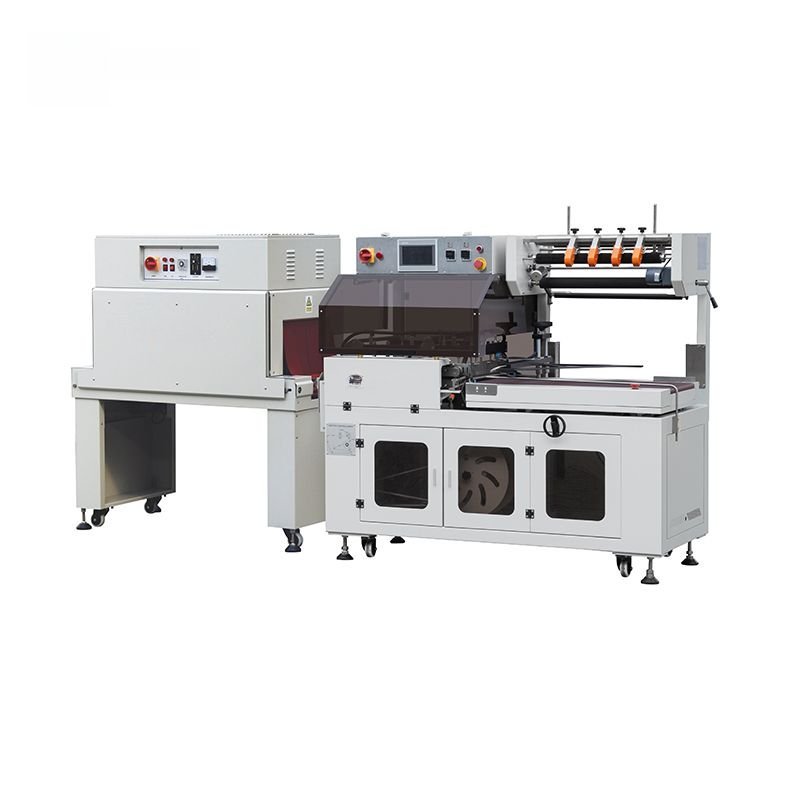
1. L-bar sealer — the batch and low-to-medium output workhorse
An L-bar sealer makes two perpendicular seals in a single closing action, forming the letter L. In manual or semi-automatic versions the operator places the product between the folded film and lowers the sealing arm; in fully automatic versions a conveyor feeds and indexes the product, the seal bar closes, and the pack travels into the tunnel. L-bar machines are compact, relatively quick to change over, and economical. They are the natural fit for contract packers, e-commerce fulfilment and smaller factories that run many different SKUs in modest batches.
The practical limit is speed. Because every pack requires the seal frame to open and close, output is intermittent and rarely exceeds roughly 20–30 packs per minute even on automatic models, and pack size is bounded by the seal-frame dimensions. If your product is large or your required output is continuous, an L-bar will become the bottleneck.
A typical starting point for automated retail packing is the fully automatic L-bar sealer shrink wrapping machine, which combines the sealing frame with an integrated heat tunnel in one footprint.
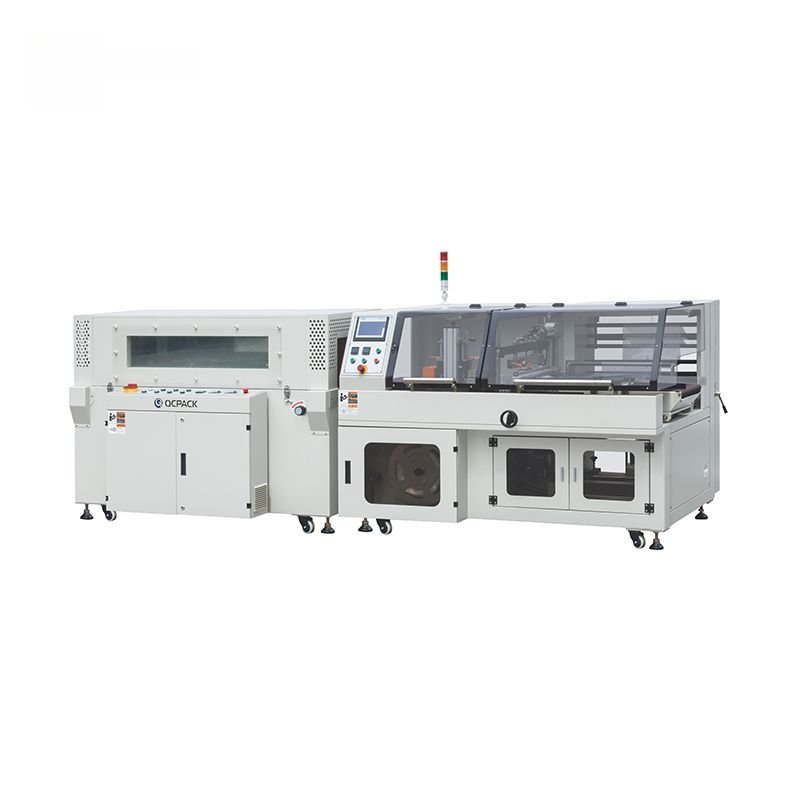
2. Continuous side sealer — for high-speed, long or variable-length products
A side sealer replaces the opening-and-closing frame with a moving, horizontal sealing mechanism that runs continuously while product flows through. There is no fixed frame length, so the same machine can wrap a short box and a long rolled product without a mechanical changeover. Side sealers are the choice when speed is sustained — 40 to well over 100 packs per minute depending on product and film — or when product length varies frequently.
You pay more, and the machine is longer, but the cost is usually justified within months when a side sealer removes a genuine throughput constraint. For continuous high-output lines, engineers often specify the automatic high-speed side seal shrink wrapping machine, and for long products such as pipes, profiles and boards the extended-frame side sealer for long products is the appropriate configuration.
3. Sleeve wrapper — for heavy, bulky or collated industrial packs
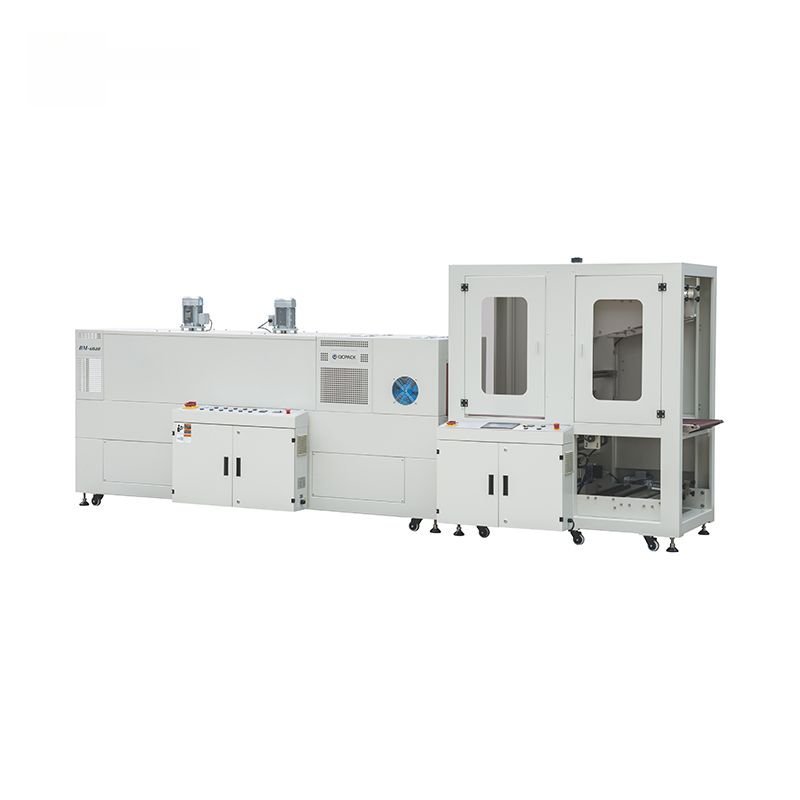
A sleeve (or band) wrapper does not enclose the product on all four sides before shrinking. Instead it dispenses a PE sleeve over and under the product, seals across the leading and trailing edges, and leaves the sides open; the tunnel then shrinks the band into a tight bundle. Sleeve wrappers are built for large cartons, trays, cans and bottles in multipacks, furniture, doors and stacked goods. They tolerate heavy, unstable loads that would defeat an L-bar and use cheaper PE film at high gauges.
If you are unitising trays of cans, bottled water, or stacked boxes, the automatic sleeve shrink wrapping machine is the correct family rather than a retail POF machine.
Side-by-side selection table
| Attribute | L-bar sealer | Side sealer | Sleeve wrapper |
|---|---|---|---|
| Typical speed | Intermittent, ~10–30 ppm | Continuous, ~40–100+ ppm | ~10–25 heavy ppm |
| Film | POF / PVC | POF, thin PE | PE (thicker) |
| Pack size | Limited by frame | Variable, incl. long | Large / bulky |
| Changeover | Fast | Fast for length changes | Moderate |
| Best fit | Retail, e-com, batch | High-speed, mixed lengths | Multipacks, heavy loads |
| Relative cost | Lower | Higher | Mid–high |
The specifications that actually determine suitability
- Real throughput, not catalog speed. Rated speed assumes a single ideal product at optimum conditions. Measure your required packs per minute including loading, rejects and changeover, then size the machine with headroom. We cover how to calculate genuine throughput in our technical library; browse more packaging machinery technical guides.
- Maximum and minimum pack dimensions. Give the supplier the full envelope of every SKU, not the average. Include the height, because tunnel clearance and frame height are fixed.
- Film type, gauge and centre-folded vs flat roll. POF gives clarity and a gloss finish for retail; PE gives strength and lower cost for heavy bundling. Confirm the sealer and tunnel are rated for the film and gauge you intend to run.
- Tunnel length and temperature control. A short tunnel underperforms on thick PE and high speeds. Look for independent top/bottom air and adjustable conveyor speed.
- Conveyor height and line integration. If the wrapper feeds an existing conveyor or a downstream case packing and palletizing line, matching heights and signals up front avoids rework.
- Electrical supply and compressed air. Larger tunnels draw significant power; confirm phase, voltage and kilowatt availability before ordering.
Common buying mistakes seen on real floors
The most frequent error is buying on peak catalog speed and discovering the line runs at half that once film, product and operator are factored in. The second is specifying a retail L-bar for a product that is simply too tall or too heavy, leading to weak seals and constant jams. The third is overlooking film cost: a cheap machine that only accepts a proprietary or narrow range of film can cost more over three years than the machine itself. Finally, many buyers treat the wrapper as an island and forget the infeed and outfeed; an automatic sealer upstream of a manual packing station is still limited by the manual station.
What to include in your RFQ
A good request for quotation shortens lead time and prevents mismatches. Send: product photos and dimensions for every SKU; target and peak packs per minute; preferred film and current film supplier; pack orientation and any labelling requirements; available power and floor space; whether integration with existing conveyors is needed; and your destination port and expected delivery window. With those inputs a competent supplier can recommend a family, model and tunnel in one iteration. You can send these details directly through the SunAura Packaging Machines engineering contact page.
Frequently asked questions
Can one machine wrap both small retail packs and long products?
A side sealer can, because it has no fixed frame length; an L-bar cannot. If your range genuinely spans short and long SKUs at speed, specify the side sealer.
POF or PE film — which should I choose?
POF for clear retail presentation on light-to-medium goods; PE for strength, economy and heavy multipacks. The machine and tunnel must be rated accordingly.
How much headroom should I add to my speed requirement?
As a rule, specify for your realistic peak plus 20–30% rather than the catalog maximum, so the machine is not running flat out all shift.
Are these machines available as semi-automatic versions?
Yes. If labour cost is low and output modest, a semi-automatic L-bar is a sensible lower-investment starting point and can be upgraded later.
Recommended machines for this application
- Automatic L-bar sealer with heat tunnel — retail and e-commerce batches.
- High-speed side seal shrink wrapper — continuous, mixed-length production.
- Automatic sleeve wrapper — heavy multipacks and tray collation.
Film economics: the cost buyers forget to model
Purchase price is only the beginning of the financial comparison. Over a five-year horizon, film and tunnel energy often exceed the difference between machine families, which is why experienced procurement teams model cost per finished pack rather than machine price alone. Centre-folded POF is priced by weight and width; running a film wider than necessary wastes material on every cycle, while a film too narrow forces a slower, more careful setup. A correctly sized sealer matches its web width to your largest pack so that film waste is minimised across the full SKU range. PE film for sleeve wrapping is cheaper per kilogram but heavier per pack, so freight and disposal should also be included when comparing a PE multipack against, say, a corrugated tray.
It is worth asking any supplier for the recommended film gauge for each product and calculating annual film consumption from your forecast packs. Two machines with similar prices can produce materially different operating costs if one requires a heavier gauge or a proprietary roll width. SunAura Packaging Machines designs its sealers and tunnels around commonly available film widths precisely to keep this downstream cost open and competitive.
Temperature, dwell time and seal quality
A clean shrink result depends on balancing three variables: sealing temperature, dwell (contact) time, and tunnel residence. The sealing frame must reach a temperature high enough to fuse the film without burning it, and the dwell time must be long enough for a consistent bead; the tunnel then supplies the residence time needed for full contraction. On thin POF at high speed the tunnel must deliver strong, even air over a sufficient length, otherwise the pack exits with “dog ears” — unsightly triangular film corners — or wrinkles that set as the film cools. Independent top and bottom airflow, adjustable tunnel speed and a cool-down zone at the exit are the features that separate a stable retail finish from a finicky one.
When commissioning, the correct procedure is to run the most demanding product first and tune temperature and belt speed on that pack; lighter products are then easier. If the line will run both POF and PE, confirm at the specification stage that the tunnel temperature range and air volume cover both, because the two films shrink at different conditions.
Layout, safety and operator workflow
A shrink line occupies more floor space than the sealer alone. Infeed accumulation, the tunnel, a cooling section and an outfeed table all need room, and operators require safe access to the film roll, the seal frame and the tunnel controls. The machine should be positioned so that film loading and pack removal do not require reaching over a hot tunnel, and guarding should prevent contact with the seal bar and tunnel entrance. On automatic models, interlocked guarding and emergency stops along the line are not optional; they also simplify internal safety sign-off. Planning these workflow details before installation avoids the common situation where a capable machine is installed in a layout that makes it awkward to run.
Finally, think about the line as a sequence rather than a single purchase. If packs will later be cartoned, bundled or palletized, the outfeed should be at a height and orientation that feed those steps directly. Discussing the full downstream path — including potential automatic L-bar sealing on lighter goods and heavier sleeve wrapping for multipacks — allows the conveyor and controls to be specified once.
Conclusion
The right shrink wrapper is defined less by the machine than by your products, your genuine peak output and your film. Start by classifying the load — small retail pack, high-speed variable-length pack, or heavy multipack — and the machine family largely selects itself. SunAura Packaging Machines manufactures all three families together with infeed, conveying and downstream case packing, which means the line can be specified and commissioned as one system rather than stitched together after purchase. Send your SKU dimensions and target packs per minute and our engineers will return a sized recommendation, not a generic catalog quote.

David leads our case sealing and cartoning engineering team. Over 14 years he has specified, installed and commissioned hundreds of random-size case sealers, top- and side-loading cartoners, and automatic case packers for food, household and industrial product lines. He writes buying guides and troubleshooting articles around seal quality, tape and hot-melt glue selection, and carton throughput limits.
See Full Bio ›