

End-of-Line Packaging Integration Guide: How to Connect Machines
How to properly connect case erectors, case sealers, palletizers and stretch wrappers into one synchronized end-of-line system — conveyor types, communication protocols, line balancing, and common integration mistakes that cost thousands.
- Line efficiency 85%+ target
- 3 common integration mistakes
- Conveyor + control + sensors
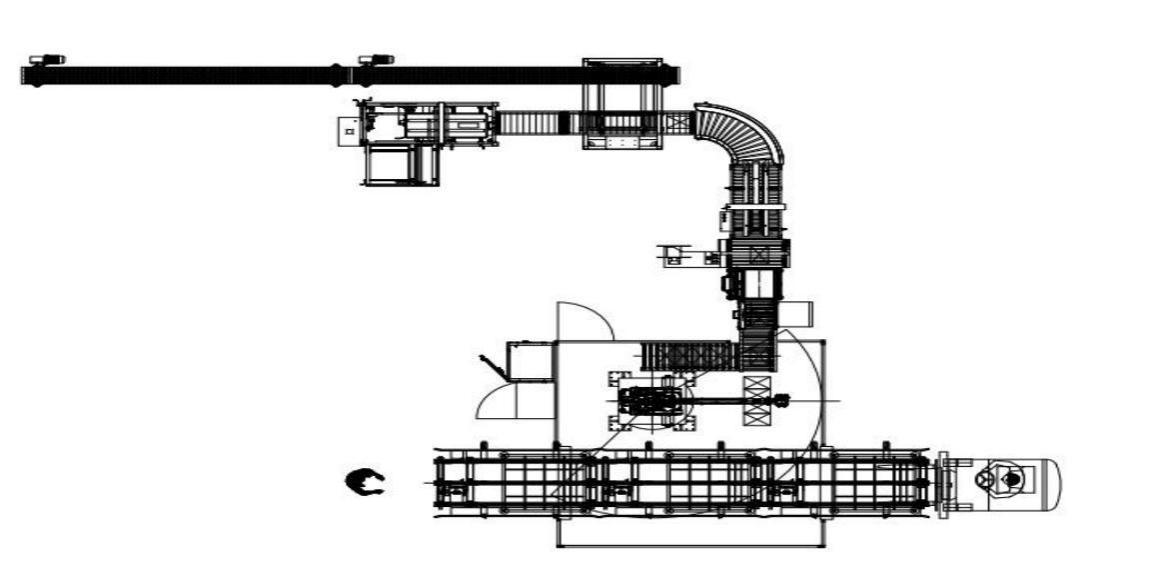
Why End-of-Line Integration Matters More Than the Machines Themselves
Buying individual packaging machines is easy. Making them work together as one synchronized line is hard. A perfectly good case erector feeding a poorly matched case sealer can kill 30% of your line output before you even start. Most packaging line problems aren’t broken machines — they’re bad integration.
Good integration means: products flow smoothly from one machine to the next, no jams, no backups, no operators standing around waiting. The line runs at the same pace as your upstream filling or packaging operation. This guide walks through everything you need to know to plan and execute a successful end-of-line integration.
The 5 Core Components of Any End-of-Line System
Case Erecting & Sealing
Case erector forms the boxes, case sealer folds flaps and seals with tape or glue. This is the starting point for almost every end-of-line.
Conveyor System
The nervous system of the line. Belt conveyor for general transport, roller conveyor for heavy cartons, accumulation conveyor for buffering between machines.
Case Packing & Loading
Manual packing, robotic case packer, or drop packer — depends on your product shape and speed. This is where products go from individual units into cases.
Palletizing
Stacking cases onto pallets. Semi-automatic pallet jack, gantry palletizer, or robotic palletizer — depends on throughput and floor space.
Stretch Wrapping & Exit
Stretch wrapper secures the pallet for transport. Turntable, rotary arm, or orbital wrapper — depends on pallet weight and product stability.
Conveyor Type Comparison
| Conveyor Type | Best For | Load Capacity | Typical Use |
|---|---|---|---|
| Belt Conveyor | Light to medium cartons | 10–50 kg/m | General product transport between machines |
| Roller Conveyor | Heavy rigid cartons | 50–200 kg/m | Case sealing, palletizing infeed |
| Accumulation Conveyor | Buffering between machines | 20–100 kg/m | Buffer when upstream runs faster than downstream |
| Modular Plastic Belt | Wide range of products | 20–80 kg/m | Turns, inclines, tricky product shapes |
| Chain Conveyor | Very heavy loads | 200+ kg/m | Pallet transport, heavy drums and buckets |
Line Balancing: The #1 Integration Priority
Line balancing means every machine in the line runs at roughly the same speed. If your case erector runs 30 cases/min but your case sealer only does 20 cases/min, the case erector will constantly jam up waiting. If your palletizer is faster than your case packer, the palletizer operator stands around doing nothing.
Rule of thumb: Design the line so the slowest machine is 90% of the target line speed. That gives you a 10% buffer for normal variation. Don’t buy machines that are 2× faster than you need — you’re just wasting money on idle capacity.
Example: If you need 20 cases/min output, buy a case erector that does 24/min, a case sealer that does 24/min, and a palletizer that handles 24/min. All machines run at 80–90% capacity, which is the sweet spot for reliability.
Machine Communication & Control
Stop / Go Sensors
Simple photo-eye sensors tell upstream machines to stop when downstream is backed up. This is the minimum viable integration.
PLC Line Controller
A central PLC coordinates all machines. It can track case counts, send alarms, and optimize line speed automatically.
Industry 4.0 / IIoT
Full data integration: OEE tracking, predictive maintenance alerts, production dashboards. Premium option for large operations.
Emergency Stop Circuit
Every machine has an e-stop, and they’re all wired together. Hit any e-stop and the whole line stops. This is non-negotiable for safety.
3 Costly Integration Mistakes to Avoid
Real-World Example: Beverage End-of-Line Upgrade
A craft beverage company had bought individual machines from 3 different suppliers and tried to bolt them together themselves. Result: line ran at 40% of target speed, constant jams, 3 operators needed just to keep it running.
What we did: Redesigned the conveyor layout, added accumulation buffer between case packer and palletizer, installed a central PLC with photo-eye sensors, and matched all machine heights. Total redesign and integration took 2 weeks of on-site work.
Result: Line efficiency jumped from 40% to 88%. Operators dropped from 3 to 1. They paid for the whole integration upgrade in 8 months from labor savings alone.
This is the typical ROI story for good end-of-line integration. The machines were never the problem — the integration was.
Your End-of-Line Integration Planning Checklist
Define Target Line Speed
How many cases per minute do you need? Be realistic — 80% of rated speed is a good design target.
Map Product Dimensions
What’s the smallest and largest case size? Heaviest case? Fragile products? This determines conveyor type and machine sizing.
Measure Your Floor Space
Draw your facility to scale. Leave room for conveyor bends, maintenance access, and future expansion.
Request a Single Line Quote
Get one supplier to design the whole line, not individual machines from different vendors. Integration is then their problem, not yours.
Do a Factory Acceptance Test
Before shipping, test the whole line at the supplier’s factory with your actual product. Fix problems before they arrive at your facility.
Frequently Asked Questions
A basic end-of-line system (case erector + sealer + conveyor + palletizer + stretch wrapper) starts at $50k–$80k. Fully automatic robotic lines with PLC control run $150k–$500k+. Integration engineering and commissioning typically adds 15–25% on top of machine costs.
For most operations, yes. Single-vendor integration means one company is responsible for the whole line working together. Multi-vendor lines create finger-pointing when something doesn’t work. Only go multi-vendor if you have a strong in-house engineering team.
Basic lines: 1–2 weeks on site. Complex robotic lines: 3–6 weeks including commissioning and operator training. Always add 10–20% buffer for unexpected issues.
Well-designed, well-integrated lines run at 80–90% OEE (overall equipment effectiveness). If you’re below 60%, there’s usually an integration problem, not a machine problem. Common causes: no accumulation buffer, wrong speed matching, poor sensor placement.
Absolutely. Most end-of-line upgrades are about adding conveyor, sensors, and a line controller — not replacing all the machines. We’ve upgraded lines that were 10 years old and improved efficiency by 30% with just integration work.
Get Your End-of-Line Line Design Today
Send us your case dimensions, target speed, and floor plan — we’ll send a complete line layout, machine list, and pricing within 48 hours, including conveyor routing and integration plan.

David leads our case sealing and cartoning engineering team. Over 14 years he has specified, installed and commissioned hundreds of random-size case sealers, top- and side-loading cartoners, and automatic case packers for food, household and industrial product lines. He writes buying guides and troubleshooting articles around seal quality, tape and hot-melt glue selection, and carton throughput limits.
See Full Bio ›