
Vacuum packaging machines extend shelf life, preserve product quality, and reduce spoilage — but only if you choose the right machine for your product, bag size, and throughput. Pick wrong, and you’ll deal with weak seals, residual air, batch contamination, and bags that leak on the shelf.
This 2026 buying guide covers chamber vs. external suction, single vs. double chamber, gas flushing, bag dimensions, vacuum levels, price ranges, and the exact spec questions to ask suppliers. Whether you’re packaging food, electronics, or industrial parts, this guide gives you the framework to choose with confidence.
1. Machine Types: Chamber vs. External Suction
Vacuum packaging machines split into two fundamental architectures. Your product type and throughput decide which is right.
| Type | Best For | Speed | Price (FOB China) |
|---|---|---|---|
| Single Chamber | Small shops, food producers, labs, low volume | 2–5 cycles/min | $2,000–$6,000 |
| Double Chamber | Mid-volume food processing, 5–15 cycles/min | 4–10 cycles/min | $5,000–$15,000 |
| External Suction (Nozzle) | Large bags, bulk packaging, liquids, non-chamber products | 1–3 bags/min | $1,500–$5,000 |
| Continuous Belt / Deep Draw | High-volume production line, meat, cheese, snacks | 10–30+ cycles/min | $20,000–$80,000+ |
| Thermoforming Rollstock | Very high-volume, custom packaging formats | 15–60 cycles/min | $50,000–$200,000+ |
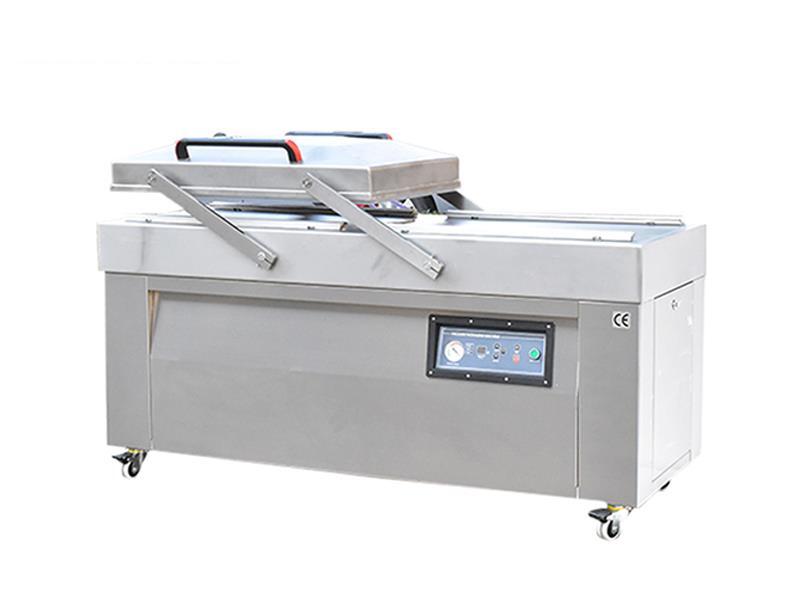
Single Chamber: The Entry Workhorse
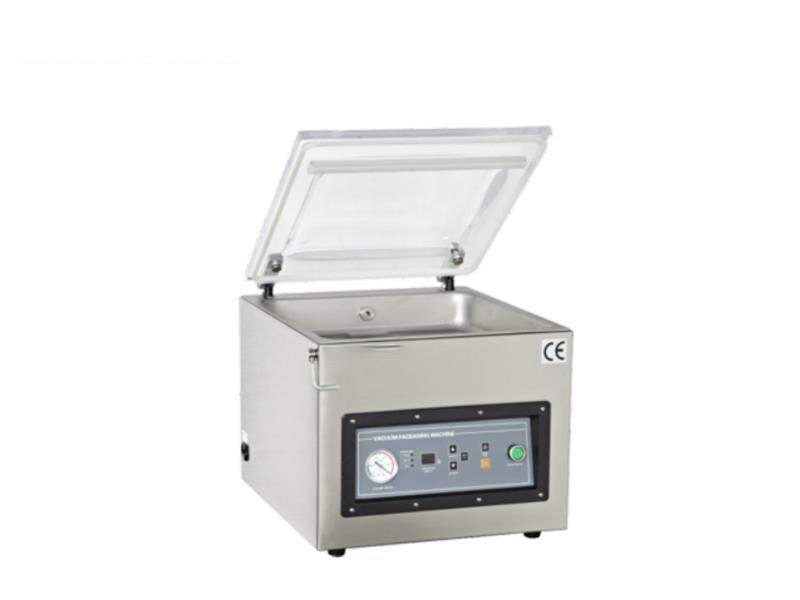
The operator places product bags inside the chamber, closes the lid, and the machine evacuates air, seals, and releases. Simple, reliable, and affordable. The DZ series (DZ400, DZ500, DZ600, DZ800) dominates this category, with chamber sizes ranging from 400mm to 800mm.
Double Chamber: Maximize Throughput
Double chamber machines (DZP series) have two chambers that alternate. While one chamber is running its vacuum cycle, the operator loads the other. This effectively doubles throughput compared to single chamber, making it the sweet spot for mid-volume food producers.
External Suction: When Chamber Won’t Fit
External suction machines (also called nozzle vacuum sealers) don’t use a chamber. A nozzle inserts into the bag and sucks out air externally. This is the only option for very large bags, bulk products, or liquids that can’t be tilted into a chamber. Vacuum levels are slightly lower than chamber machines.
2. Key Specifications to Evaluate
| Specification | What to Ask | Why It Matters |
|---|---|---|
| Chamber Size (W×D×H) | mm | Must fit your largest bag + product. Height clearance is often overlooked — bulky products need taller chambers. |
| Vacuum Pump Capacity | m³/h (e.g., 20 m³/h, 40 m³/h, 63 m³/h) | Pump speed determines cycle time. Undersized pumps = slow cycles = lower throughput. Chinese brands often use Luping or Busch pumps; Busch is the premium choice. |
| Ultimate Vacuum | mbar (e.g., 1 mbar, 0.5 mbar) | Lower mbar = better oxygen removal = longer shelf life. Most food applications need <2 mbar. |
| Seal Bar Length & Width | mm length, mm width | Seal width (8–10mm) determines seal strength. Double seal bars add reliability for heavy or liquid products. |
| Gas Flush (MAP) | Yes/No, gas type | Modified Atmosphere Packaging (MAP) flushes nitrogen or mixed gas after vacuum. Essential for fresh meat, cheese, and baked goods that need oxygen to stay appealing. |
3. Vacuum Pump: The Heart of the Machine
The vacuum pump is the single most critical component. A cheap pump will fail in 6–12 months; a quality pump runs 10+ years.
Domestic Chinese Pumps (Luping, Huayang)
Cost: $300–$800
Expected life: 2–5 years with regular maintenance
Best for: Budget operations, intermittent use, small bags
Caveat: Louder, requires more frequent oil changes, may not achieve ultimate vacuum consistently
Busch (Germany)
Cost: $1,500–$4,000
Expected life: 10–15 years
Best for: Continuous production, food-grade facilities, export markets
Caveat: Higher upfront cost, but lower total cost of ownership over 5 years
Pro Tip: Always ask which pump brand is installed. If the quote says “20m³/h rotary vane pump” without naming the brand, assume it’s a budget domestic pump. Upgrade to Busch for any machine running more than 4 hours/day. The $1,000–$2,000 pump upgrade pays for itself in reduced downtime.
4. Price Ranges
| Model / Configuration | Chamber Size | Price (FOB China) |
|---|---|---|
| DZ400 single chamber (20m³/h pump) | 400×400mm | $2,000 – $3,500 |
| DZ500 single chamber (20m³/h pump) | 500×500mm | $2,800 – $4,500 |
| DZ600 single chamber (40m³/h pump) | 600×600mm | $4,000 – $6,500 |
| DZP500 double chamber (40m³/h pump) | 2× 500×500mm | $6,000 – $10,000 |
| DZP800 double chamber (63m³/h, Busch) | 2× 800×600mm | $12,000 – $20,000 |
| External suction nozzle sealer | N/A (external) | $1,500 – $4,000 |
Optional add-ons: Gas flush/MAP system ($800–$2,500), stainless steel chamber (adds 15–20%), double seal bars ($300–$800), digital touchscreen HMI ($500–$1,500), oil mist filter ($200–$500 for food-grade facilities).
5. Case Study: Spice and Herb Producer
The challenge: A Turkish spice and herb producer was vacuum packing 200g bags of dried oregano, thyme, and paprika on an old single-chamber machine. They needed to double output for export markets, but the old machine was slow (3 cycles/min), had inconsistent seal quality, and the pump needed rebuilding every 8 months.
The solution: SunAura supplied a DZP500 double chamber machine with a 40m³/h Busch pump, double seal bars, and a gas flush option for delicate herbs. The VM500TE model with HMI recipe storage allows the operator to switch between 200g spice bags and 500g herb bags via saved recipes.
The results:
- Throughput increased from 3 cycles/min to 7 cycles/min (double chamber alternating)
- Seal rejection rate dropped from 4.2% to 0.3%
- Expected pump service interval extended from 8 months to 3+ years with Busch
- Shelf life of herbs extended from 6 months to 12+ months with gas flush
- Payback period: 8 months on labor and material savings
6. Seven Common Buying Mistakes
- Undersizing the chamber. Measure your largest bag, then add 50mm on each side. Bags need room to lay flat inside the chamber; a cramped chamber causes poor seals.
- Buying a cheap pump to save money. The pump is the #1 failure point. Budget for Busch or equivalent if running more than 4 hours/day.
- Ignoring seal bar width. 8mm seal bars are standard; 10mm double seal bars are worth the upgrade for liquid or heavy products.
- Forgetting gas flush when needed. If you package fresh meat, cheese, or baked goods, you need MAP. Adding it later is harder than ordering it upfront.
- Not considering bag height. Chamber height clearance is as important as width. Bulky products need a taller chamber.
- Overlooking maintenance access. The pump needs oil changes, filters, and occasional rebuilding. Make sure you can access service points without disassembly.
- Buying non-food-grade for food use. If you package food, the chamber and exterior must be stainless steel (304 minimum). Don’t buy painted steel to save 15%.
Related Guides
- Shrink Wrapping Machine Buying Guide & Selection (2026) — what follows vacuum packaging on the line
- Strapping Machine Buying Guide & Selection (2026) — secure cartons after vacuum bagging
- Palletizer Buying Guide & Selection (2026) — automate your end-of-line
- How to Plan Your Packaging Line Layout — position vacuum packaging correctly
- How to Choose a Packaging Machine Manufacturer — vet your supplier
Frequently Asked Questions
How much does a vacuum packaging machine cost?
Single chamber machines start at $2,000–$3,500 (DZ400). Double chamber machines range from $6,000–$20,000 depending on size and pump brand. External suction sealers are $1,500–$4,000. High-volume continuous belt or thermoforming machines run $20,000–$80,000+. Most small-to-mid food producers should budget $5,000–$12,000 for a double chamber with a quality pump.
What’s the difference between single and double chamber vacuum machines?
Single chamber machines have one vacuum chamber that alternates between loading and running. Double chamber machines have two chambers on a rotating table — while one is vacuuming, the operator loads the other. This roughly doubles throughput without adding a second machine. Double chamber is worth the investment if you run more than 2 hours/day.
How long does a vacuum packaging cycle take?
A typical cycle is 15–45 seconds, depending on chamber size, pump speed, and product. A DZ400 with a 20m³/h pump takes about 20–30 seconds per cycle. Larger chambers with bigger pumps can cycle in 15 seconds. Double chamber machines effectively halve the per-bag time by overlapping loading and vacuuming.
Can vacuum packaging machines handle liquids?
Yes, but with caveats. Chamber machines can handle liquids if the bags are positioned carefully and the product is not sloshing during evacuation. External suction machines are better for liquids because you can control the suction depth. For saucy or liquid-heavy products, look for machines with liquid-level detection and gentler vacuum curves. Always test with your actual product before purchase.
How do I maintain a vacuum packaging machine?
Change vacuum pump oil every 500–1000 operating hours (or every 3–6 months for daily use). Replace the oil mist filter every 3–6 months. Clean the seal bar and Teflon strip daily — residue buildup causes weak seals. Inspect the silicone gasket monthly and replace when it cracks. Busch pumps require specific Busch oil; don’t substitute generic oil.

Kevin works on machine development for shrink bundling, shrink hoods and vacuum packaging. He tests film shrink ratios, tunnel heat zones, seal bar performance and chamber cycle times, and feeds that back into machine frame and conveyor design. He writes technical articles on shrink film selection, tunnel temperature balancing and vacuum packaging for industrial and food-adjacent secondary packs.
See Full Bio ›