

TL;DR. As of 2026, a new robotic palletizer typically costs $90,000–$220,000 fully installed for a 4–6 axis arm with a box gripper; a conventional gantry or layered palletizer runs $150,000–$400,000; a collaborative (cobot) palletizer starts at $60,000–$120,000. Payback is usually 18–36 months on a two-shift operation replacing two manual palletizer operators. The biggest hidden costs are end-of-arm tooling changeovers, safety fencing, and integration with the upstream conveyor and stretch wrapper.
By Michael Zhang, Automation Engineer, End-of-Line Integration. Michael has commissioned more than 60 palletizing cells across food, beverage, building materials and e-commerce warehouses in China, Southeast Asia and North America over the last nine years, and has personally measured cycle times and uptime on ABB, FANUC, KUKA, Kawasaki and domestic Chinese arms.
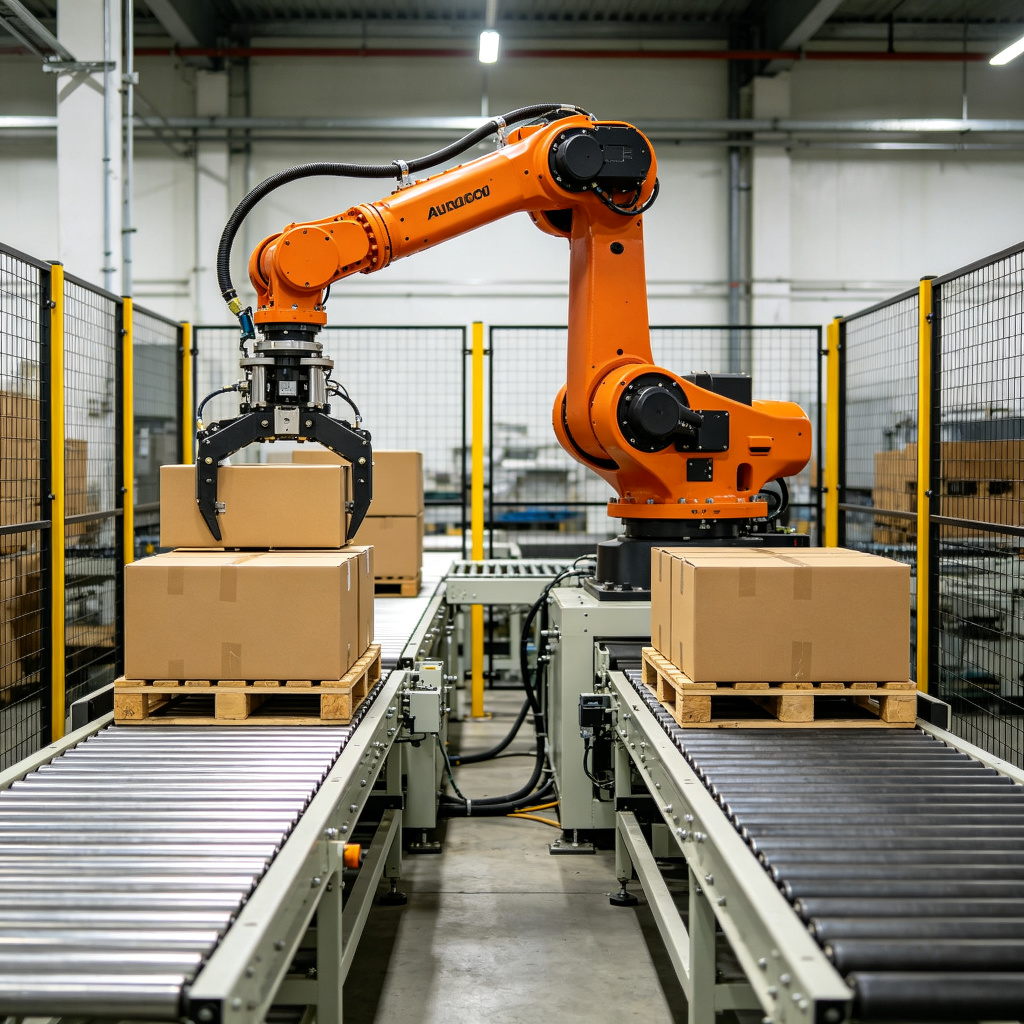
1. The question every operations director asks first
“How much does a palletizer cost?” sounds like a simple number. It is not. The answer depends on what you are palletizing (cases, bags, bales, drums, pails), how fast (six cases a minute or 60), how many SKUs per shift, whether you need to build mixed-SKU pallets, the ceiling height in your warehouse, the floor loading, whether you already have a conveyor, and whether the buyer wants a turnkey machine or just the arm.
PMMI’s 2025 Processing and Packaging Automation Outlook reports that the average North American end-of-line project in 2024 closed between $350,000 and $750,000 per cell when integration, guards, conveyor and commissioning are included — roughly 2.3× the sticker price of the robot arm itself. Buyers who budget only for the arm are the ones who call integrators back six months later asking why the project went 40% over budget. This guide breaks down every line item so you can build a realistic budget before you issue an RFQ.
2. Why palletizing is the most common automation purchase
Manual palletizing is one of the hardest jobs in a warehouse. A human operator lifting 15 kg cases for an eight-hour shift lifts roughly 28,800 kg over the course of a day. The OSHA ergonomic guidelines for manual handling recommend limiting repeated lifting above shoulder height and below knee height; by the end of a shift, manual palletizers are routinely stacking above 1.8 m and bending to pick cases off a floor-level conveyor. Injury rates in manual palletizing are among the highest in warehousing, and turnover on two-shift palletizer jobs typically runs 60–100% per year in the United States.
Statista data on industrial robotics shows that palletizing has been the fastest-growing robotic application since 2020, overtaking arc welding in unit sales in 2023. The International Federation of Robotics (IFR) World Robotics 2024 report records 619,000 new industrial robot installations globally in 2023, with palletizing and handling together accounting for 39% of units. Food and beverage, groceries, and building materials are the three largest verticals buying palletizers in 2026.
3. Four palletizer architectures, four price bands
Before you compare quotes, you have to know which architecture you are buying. The four families below are not interchangeable; picking the wrong one is the single most common reason a palletizer project fails the payback calculation.
| Type | Typical speed | Payload | Floor space | Installed price band | Best fit |
|---|---|---|---|---|---|
| Conventional / high-level layer palletizer | 40–80 cases/min | 2,000–3,000 kg per layer | 25–40 m² | $150,000–$400,000 | Dedicated high-speed lines, single-SKU, stable box geometry |
| Robotic arm palletizer (4–6 axis) | 10–25 cycles/min | 80–800 kg payload | 12–20 m² | $90,000–$220,000 | Mixed-SKU, 5–15 cases/min, most plant retrofits |
| Gantry / portal palletizer | 15–30 cycles/min | 200–1,000 kg | 8–15 m² (overhead) | $70,000–$180,000 | Low ceiling, high payload, simple square-travel paths |
| Collaborative (cobot) palletizer | 4–8 cycles/min | 10–70 kg payload | 3–6 m² (no fence) | $60,000–$120,000 | Low volume, frequent SKU changeover, small warehouses |
Price bands are typical 2026 ranges based on integrator quotes collected across projects in 2024–2025; premium brands (ABB, FANUC, KUKA) run 15–30% above the midpoint, and domestic Chinese arms (Estun, Siasun, Jaka) run 30–50% below. European-built conventional palletizers from companies featured in Packaging Digest’s palletizing coverage can exceed $500,000 installed.
3.1 Conventional high-level layer palletizers
A conventional palletizer accumulates a single layer of cases on a slip sheet, squaring it with plows, then pushes the complete layer onto the pallet with a layer plate. It is mechanically simple, runs 24/7 with almost no software, and can handle 50–80 cases per minute on a dedicated line. The trade-off is that it is huge (often 8 m × 4 m), it requires a mezzanine to feed cases at 2.5 m elevation, and changing layer patterns means mechanical change parts and 2–4 hours of downtime. These machines made sense when every line ran one SKU for months; in 2026, most greenfield installations choose robotics instead.
3.2 Robotic arm palletizers
A 4-axis or 6-axis industrial robot picks cases one at a time (or in 2- or 4-case groups) from a conveyor and places them on a pallet in a taught pattern. Programming is done on a teach pendant or, increasingly, offline with 3D simulation software. Modern cells can handle 5–15 cases per minute per arm and switch between 50+ SKU patterns with a barcode scan. This is the default choice for most plants building 300–1,500 cases per hour.
3.3 Gantry / portal palletizers
A gantry palletizer moves a gripper on linear rails above the pallet instead of an articulated arm. It is cheaper than an articulated arm for very heavy loads (300–1,000 kg per pick), it takes less floor space because the mechanism is overhead, and it has a smaller footprint in width. The downside is that it cannot reach around corners, it is slower on complex layer patterns, and the overhead steel structure requires roof clearance.
3.4 Collaborative (cobot) palletizers
A collaborative robot (typically a 15–25 kg payload arm from Universal Robots, Doosan, or Jaka) palletizes without safety fencing. It runs slower (4–8 cycles per minute), but it is cheap to deploy, moves with a pallet jack, and starts working the same day it arrives. Cobot palletizers are the right call for plants under 400 cases per hour that cannot justify a fenced industrial cell. Above 400 cases per hour, the cycle time gap makes an industrial arm cheaper per pallet.
4. The total installed cost: line items buyers forget
The arm is 40–55% of the project. The rest adds up. The table below shows a typical $150,000 robotic palletizer project in North America in 2026.
| Line item | Typical cost | Notes |
|---|---|---|
| Robot arm + controller + teach pendant | $40,000–$70,000 | 80–120 kg payload class, 4-axis |
| End-of-arm tool (vacuum or fork gripper) | $8,000–$25,000 | Multi-SKU vacuum gripper on the higher end |
| Input conveyor + case centering | $10,000–$20,000 | 2–3 m powered belt with side guides |
| Palet dispenser / auto pallet feed | $8,000–$18,000 | Manual forklift loading cheaper |
| Dual-station shuttle / pallet lift | $12,000–$30,000 | Needed to keep the arm running during pallet exchange |
| Safety fencing + light curtains + scanners | $10,000–$25,000 | ISO 13849-1 PLd / ISO 10218 compliance |
| Electrical, controls, HMI | $8,000–$18,000 | PLC, VFD, safety relay, 10″ HMI |
| Integration software + pattern building | $10,000–$30,000 | Offline programming, barcode lookup |
| Freight, install, commissioning | $10,000–$25,000 | 2 engineers × 5–10 days on site |
| Spare parts + training (first year) | $3,000–$8,000 | Vacuum pads, fuses, encoder cable |
| Typical installed total | $120,000–$270,000 | Matches the $90k–$220k mid-band for common cells |
The cheapest cells come in under $90,000 when the buyer already owns the conveyor, uses a manual pallet dispenser, and skips the dual-station shuttle. The most expensive cells run above $220,000 when the buyer wants integrated stretch wrapping, automatic labeling, mixed-SKU picking from a flow rack, or a 3D vision system for randomized depalletizing.
5. Payback: the math you should do before you call suppliers
Palletizer payback depends on labor rate, shifts, injury cost, and uptime. Use this formula as a starting point. Numbers below are illustrative based on a U.S. plant at $22/hour fully loaded wage, two shifts, 5,000 operating hours per year.
| Configuration | Operators replaced | Annual labor saved | Installed cost | Simple payback |
|---|---|---|---|---|
| Cobot, one shift | 0.5 FTE | $22,000–$28,000 | $75,000–$95,000 | 30–48 months |
| Cobot, two shifts | 1.5 FTE | $65,000–$80,000 | $75,000–$95,000 | 12–18 months |
| Industrial robotic, one shift | 1 FTE | $42,000–$55,000 | $140,000–$180,000 | 30–42 months |
| Industrial robotic, two shifts | 2 FTE | $85,000–$110,000 | $140,000–$180,000 | 15–22 months |
| Industrial robotic, three shifts | 3 FTE | $130,000–$165,000 | $150,000–$200,000 | 10–16 months |
| Conventional layer palletizer, high speed | 2–3 FTE + reduced damage | $120,000–$180,000 | $220,000–$380,000 | 18–30 months |
IFR industry surveys report that the median payback for a new robot installation in North America is 2.3 years, and in automation-heavy Germany it is under 2 years. Below 18 months you have an easy business case; above 36 months you should look for additional savings (damage reduction, quality inspection, labor shortage risk) before signing.
Do not forget to count secondary savings. Automated palletizers reduce pallet-to-pallet variability, which in turn reduces stretch film use by 8–15% and reduces load failures in transit. They also cut workers’ compensation claims; OSHA’s manual handling ergonomics guidance notes that overexertion in lifting is one of the largest categories of warehouse injury, and a single back injury claim typically costs $15,000–$40,000 in medical and indemnity.
6. Matching the machine to your load
The single most common mistake in palletizer procurement is picking an arm based on payload alone. A 120 kg payload arm is useless if it cannot reach your pallet height, if the gripper cannot handle your box geometry, or if the cycle time falls short of your upstream line.
6.1 Cases and trays
Corrugated RSC cases are the easiest load. A vacuum gripper with two to four pads handles most cases from 3 kg to 30 kg. If your cases are non-rectangular (trays with film wrap, open trays, shrink bundles), you need a fork or clamp gripper, not vacuum. If you palletize both cases and trays on the same cell, budget for a tool-change rack or a multi-function gripper.
6.2 Bags (open-mouth, valve, form-fill-seal)
Bags are soft, sagging, and slippery. A standard vacuum pad will crush the bag or fail to hold it. Bag palletizing requires a fork gripper with film or a clamp-style gripper that supports the bag from underneath. Speed is also lower — 6–10 bags per minute — because each bag must be centered and squared.
6.3 Drums, pails, buckets
Steel or plastic drums up to 230 kg need a mechanical gripper that captures the drum rim or the lid flange. Vacuum on a drum is unreliable because the top is often open or has a bung hole. Payload rating should include the gripper itself (typically 25–40 kg), so a 230 kg drum needs a 300 kg payload arm.
6.4 Mixed-SKU and e-commerce pallets
Mixed-SKU palletizing is the hardest application. The robot needs a barcode or vision system to identify each case, a software layer that decides the layer pattern in real time, and usually a 3D camera to detect case position on the conveyor. Budget an extra $30,000–$60,000 above a standard single-SKU cell for mixed-SKU software and vision. It is the fastest-growing palletizing segment in 2026, driven by e-commerce and grocery.
7. Site survey checklist: what integrators need before quoting
Suppliers cannot give you a firm price without these. Collect them in a single PDF before the first sales call.
- Case dimensions (L × W × H), weight, and a sample photograph of the case top and side.
- Maximum cases per minute from the upstream line, and the upstream conveyor height.
- Pallet type (GMA, EUR, CHEP, custom), pallet size, and maximum pallet weight.
- Required pallet stack height and finished pallet dimensions.
- Number of SKUs and layer patterns per shift. Is it one fixed pattern or random?
- Floor plan with dimensions, ceiling height, columns, and existing doors.
- Available electrical supply (480 V 3-phase? 220 V? 200 V?) and compressed air (bar, L/min).
- Integration requirements: upstream conveyor, stretch wrapper, pallet dispenser, MES/WMS connection.
- Safety requirements: fence or light curtain? Collaborative cell? Category 3 / PLd?
- Spare parts and service expectations: local engineer response time in hours.
Supply these ten items up front and the difference between quotes will shrink from 3× to 30%. Skip them and every supplier is pricing a different machine.
8. Supplier tiers: who actually builds what you buy
The palletizer market has three layers. Knowing which one you are talking to prevents you from paying integrator margins for a white-label machine, or paying factory-direct pricing without the integration support you actually need.
8.1 Tier 1 — Robot OEMs and global palletizer builders
ABB, FANUC, KUKA, Kawasaki, and conventional builders like Columbia, Alvey, and Honeywell Intelligrated sell engineered systems at the top of the price band. They offer 24/7 global service, proven software, and 10–15 year parts support. You pay 30–60% more, but you get a machine that runs 20 years.
8.2 Tier 2 — System integrators
Most independent integrators buy a robot arm from a Tier 1 OEM and build the cell around it: conveyor, gripper, guards, controls, HMI. This is where the majority of mid-market palletizers are bought. A good integrator has reference customers in your industry, responds in 24 hours, and provides a written SLA. Ask for three references within your industry, not just any three.
8.3 Tier 3 — Direct-from-China / offshore builders
Chinese and Korean builders (Estun, Siasun, Hyundai, Robostar, and numerous SunAura-class builders) supply arm-based cells at 40–60% below Tier 1 pricing. The trade-off is service: you will fly an engineer in for commissioning, and spare parts may take 2–4 weeks by sea. This tier makes sense when you have in-house controls engineers who can maintain the machine, or when the project is export to a market where the builder already has local support.
9. Common failures and how to avoid them
- Undersized gripper for the product. A vacuum gripper that holds a closed RSC case will drop an open tray or a shrink bundle. Get the gripper tested on your actual product before final PO.
- No dual-station shuttle. If the arm waits while a forklift removes a finished pallet and brings an empty one, you lose 15–25% uptime. A dual-station shuttle pays for itself in under a year on two-shift operation.
- Ignoring pallet quality. Warped GMA pallets with missing boards will jam any automatic pallet dispenser. Specify GMA Grade B or better, and budget a pallet condition check if your supplier sends low-grade pallets.
- Safety shortcuts. A fence without an interlocked gate, or a light curtain mounted too low, will fail a risk assessment and stop production until rectified. Insist on a documented risk assessment to ISO 12100 and ISO 10218-2.
- No offline programming. Teaching 30 layer patterns on the teach pendant on the production floor means 30 shifts of lost production. Buy offline programming software or a virtual commissioning service.
- Forgetting maintenance access. The arm itself needs no daily maintenance, but vacuum pumps, filters, and bearings on the conveyor do. Ask where the maintenance walkways are and how someone reaches the E-stop.
10. SunAura’s recommendation by scenario
If you run a single-SKU line at 1,000+ cases per hour in a food or beverage plant, a conventional layer palletizer or a high-speed 4-axis robotic cell with a multi-case gripper is the right call, and the payback lands at 18–24 months on two shifts. If you run 300–1,000 cases per hour with five to fifteen SKUs, a single-arm robotic palletizer on a dual-station shuttle is the sweet spot. If you are under 300 cases per hour and cannot fence off a cell, a collaborative palletizer at $60,000–$100,000 installed is the lowest-risk entry point. If you are building mixed-SKU e-commerce pallets, plan for the vision and software add-on — do not budget a standard cell and discover later that you need a 3D camera.
For a budget estimate on your own case sizes and throughput, send us your case dimensions and cases-per-minute target. We will send back a recommended architecture, a typical price band, and a payback worksheet within one business day.
11. Robot brands: what the premium buys you
If you have settled on an articulated-arm palletizer, the next decision is which arm to buy. The four major global brands dominate North American and European installations, while a second tier of Asian builders has become competitive on price over the last five years.
| Brand / model | Payload | Reach | Cycle (industry estimate) | Arm list price (2026) | Service network |
|---|---|---|---|---|---|
| FANUC M-410iC/110 | 110 kg | 2,200–4,300 mm variants | ~1,200 cycles/hr | $55,000–$75,000 | Global, strong in North America |
| ABB IRB 460 / 6700 | 110–150 kg | 2,400–2,900 mm | ~1,100 cycles/hr | $50,000–$80,000 | Global, strong in Europe |
| KUKA KR 70 PA / KR 180 PA | 70–180 kg | 2,400–3,200 mm | ~1,000 cycles/hr | $45,000–$70,000 | Strong in automotive, growing in packaging |
| Kawasaki CP180L | 180 kg | 3,200 mm | ~900 cycles/hr | $40,000–$60,000 | Good in Asia, smaller U.S. network |
| Estun / Siasun domestic 4-axis | 80–120 kg | 2,000–2,600 mm | ~800–1,000 cycles/hr | $20,000–$35,000 | Strong in China, growing export support |
| Universal Robots / Doosan cobot | 20–35 kg | 1,700–1,900 mm | ~300–480 cycles/hr | $25,000–$45,000 | Global, collaborative ecosystem |
The brand difference matters most in three areas: spare parts availability on your continent, the quality of offline programming software, and the local integrator’s depth of experience with that brand. A $20,000 Chinese arm that has to wait three weeks for a servo amplifier is not actually cheaper than a $55,000 FANUC arm with a 24-hour local parts depot. Ask every supplier how long a spare part takes to reach your plant and what the loaner policy is during a repair.
12. Integration with stretch wrapping and labeling
A palletizer that outputs a finished pallet is only half of the end-of-line. The downstream machine is almost always a stretch wrapper, and often a pallet label applicator. How those three machines talk to each other changes the project cost and uptime.
12.1 Standalone vs integrated
In a standalone cell, a forklift moves the finished pallet from the palletizer discharge to a stretch wrapper. This is the cheapest configuration, but it requires a forklift driver and creates a bottleneck if the wrapper is busy. In an integrated layout, the palletizer discharges directly onto a powered roller conveyor that feeds the stretch wrapper, which then feeds a pallet labeling station and a dispatch queue. An integrated layout adds $30,000–$80,000 in conveyor and controls but removes the forklift from the loop and raises uptime from ~80% to ~95%.
12.2 Palet dispensers and sheet placers
An automatic pallet dispenser stores 8–15 empty pallets and feeds one to the robot on demand. It costs $8,000–$18,000 and removes one manual task from the cell. A slip-sheet or tier-sheet placer adds another $10,000–$20,000 and is required when you stack product that needs interleaving between layers, such as bags or unstable shrink bundles.
12.3 Communication protocols
Modern cells communicate over EtherNet/IP, PROFINET, or EtherCAT. If your plant already runs a Rockwell PLC, ask for EtherNet/IP; if you run Siemens, ask for PROFINET. The cheapest cells ship with hardwired I/O only, which means every interlock is a wire and every pattern change is an electrician. Budget for a real industrial network and a clean HMI.
13. Safety standards you should insist on
Industrial robot safety is governed by international standards that any reputable integrator should already know. If a supplier cannot quote them, that is a red flag.
- ISO 10218-1 and 10218-2: the core safety standard for industrial robots and robot cells. It defines safeguarding, interlocks, collaborative operations, and risk assessment.
- ISO/TS 15066: the technical specification for collaborative robot operation, including speed and separation monitoring and power-and-force limiting.
- ISO 13849-1: the standard for safety-related control systems, defining performance levels (PLd is typical for palletizer fences).
- ISO 12100: the general machinery risk assessment methodology that should produce a written risk register for your cell.
Ask every integrator for the completed risk assessment and the PLd safety circuit diagram before installation. In North America, the cell must also meet OSHA’s general duty clause and any relevant state conveyor guard requirements. In the EU, the cell must carry CE marking under the Machinery Directive 2006/42/EC. Do not accept a verbal “it’s safe” — require the documentation.
14. New vs used: when a used palletizer makes sense
Used robotic cells appear on the market regularly as consumer-goods companies refresh their lines. A 5–7 year old FANUC or ABB cell with 20,000–40,000 hours on the clock typically sells for 40–60% of new price. The robot itself will run 80,000–100,000 hours before a major rebuild, so a well-maintained used arm has plenty of life left.
The catch is that the cell is only as good as its integration. Buy the used arm alone and you pay a system integrator the same engineering hours as new. Buy a complete used cell on a skid, with conveyor, gripper and guards, and you save real money — but only if the previous owner’s product geometry matches yours. Ask for a 4-hour live video walkthrough of the cell running, and budget $10,000–$20,000 for shipping, re-anchoring and a new gripper for your product.
15. Training and documentation buyers forget to budget
A palletizer is only as good as the operators who support it. Budget for two days of on-site training for two maintenance technicians and one line supervisor. The training should cover daily checks, vacuum pad replacement, safety gate testing, basic pattern edits on the HMI, and how to call for service. Ask the supplier to leave a printed operation manual, electrical drawing set, PLC backup on a USB stick, and a spare-parts list with part numbers. Cells that arrive with a 40-page manual translated from Chinese by Google Translate will cost you weeks of downtime later.
17. Worked payback example: a 600 cph food plant
To make the numbers concrete, walk through a typical 2026 decision. A mid-sized food co-packer in the Midwestern United States runs two shifts, palletizes 600 cases per hour of canned and bottled products, and currently employs two palletizer operators per shift at $22/hour fully loaded, with 32% benefits burden. Annual operating hours are 4,800 per shift, so 9,600 across two shifts.
Current annual labor cost is 4 operators × $22 × 1.32 burden × 1,920 hours per operator, or roughly $213,000. After installing a robotic cell, the plant needs one relief operator to oversee the cell, handle pallet dispensers and manage exceptions, so the net labor saving is 3 operators × $22 × 1.32 × 1,920 ≈ $168,000 per year. Stretch film savings from consistent pallet builds add about $12,000 per year, and reduced damage claims add another $8,000. Total annual benefit is roughly $188,000.
The installed robotic cell costs $165,000 including dual-station shuttle, vacuum gripper, guards and integration. The simple payback is 165,000 / 188,000 ≈ 10.5 months. Even after adding a 15% contingency for integration surprises, payback lands at 12 months. This is the profile that makes palletizer projects easy to approve.
Contrast that with a single-shift warehouse running 250 cases per hour. There, the robot replaces one operator on one shift, saving roughly $45,000 per year against a $90,000 cobot cell. Payback stretches to 24–30 months. The business case is still positive, but it depends on the labor shortage being real in that local market, and on the plant accepting that the cobot will run at 60% of its rated speed.
18. Power, air and environment: site readiness
A palletizer is not a plug-and-play machine. Before installation, confirm three site utilities.
Electrical. A typical 80–120 kg payload robot draws 5–10 kW at peak (the arm and controller together), plus 1–2 kW for conveyor and vacuum pump, plus 0.5 kW for controls and HMI. Plan for a dedicated 480 V 3-phase 30 A supply in North America, or 400 V 3-phase 16 A in Europe. The cell should have its own disconnect and its own E-stop chain tied to the plant safety system.
Compressed air. Pneumatic grippers, flap folders and safety gate locks use compressed air at 6–7 bar. Consumption is modest (100–300 L/min on demand) but the supply must be dry and filtered; water in airline corroded vacuum ejectors is the third most common service call on installed cells. Budget for an FRL unit on the cell’s air inlet.
Environment. Most industrial robots are rated IP54 for the wrist and IP20 for the controller. In a dusty, wet, washdown or freezer environment, you need IP65 wrist, stainless steel coverings, and a heated controller cabinet for freezer duty below 0°C. Freezer-rated cells add 20–30% to the price and require special lubricants. Food-grade washdown cells add stainless guarding and food-grade vacuum pads.
19. Warranty and service: what to negotiate
The default warranty on most robotic cells is 12 months parts only from ship date. For a $150,000+ machine, push for the following:
- 24 months from commissioning, not from ship date.
- Labor included for the first 12 months, with a 48-hour on-site response commitment.
- Wear items (vacuum pads, filters, belts) excluded from warranty, but priced transparently on a spares list.
- First-year preventive maintenance visit included at no charge.
- Software updates included for the first two years.
- A guaranteed uptime clause: if the cell is down more than 40 hours in a year for covered reasons, the warranty extends by the downtime.
These asks are standard for projects above $100,000. A supplier that refuses all of them is signaling they expect the machine to break often and do not want to stand behind it.
20. Questions to ask every supplier on the first call
- How many cells of this exact model have you installed in my industry in the last 24 months? Can I call two references?
- What is the sustained cycle time at 80% duty cycle with my actual case dimensions? Not the arm’s spec — the whole cell.
- What is included in your quote, and what is not? List the line items separately.
- How long is your lead time, and what slips the schedule?
- Who is the controls engineer who will commission my machine? How many years of experience?
- What is your local service response time in my country?
- What is the spare parts stock you keep locally? What is the longest-lead part?
- Do you provide offline programming? How many patterns are included in the base price?
- What happens at the end of the 12-month warranty? What is your annual service contract rate?
- Can I visit your factory or a reference installation before I sign?
Suppliers who answer these quickly and specifically are the ones likely to deliver on time. Suppliers who deflect or say “we will quote that later” will surprise you on every line item.
22. Typical project timeline from RFQ to running production
A palletizer project is not an overnight purchase. Budget realistic lead times before you tell the plant manager the machine will be online.
| Phase | Cobot cell | Robotic integrated cell | Conventional layer palletizer |
|---|---|---|---|
| Requirements gathering & site survey | 1–2 weeks | 2–3 weeks | 3–4 weeks |
| Quote engineering & client review | 1 week | 2–3 weeks | 3–4 weeks |
| Engineering design & offline programming | 2 weeks | 4–8 weeks | 8–12 weeks |
| Build & factory acceptance test (FAT) | 2–3 weeks | 6–10 weeks | 12–20 weeks |
| Shipping & customs | 1–2 weeks | 2–4 weeks | 3–6 weeks |
| Install & commissioning (SAT) | 2–3 days | 1–2 weeks | 2–3 weeks |
| Total | 8–12 weeks | 18–30 weeks | 30–50 weeks |
The FAT (factory acceptance test) is the most important gate. Insist on a 2–4 hour video call where the integrator runs your actual product (or representative samples) through the cell before shipment. Problems found at FAT are free; problems found at SAT cost a plane ticket, a week of lost production, and a negotiation over who pays.
23. Common budget mistakes that kill payback
- Buying the cheapest arm and then over-speccing the gripper. The gripper is where real reliability lives; vacuum pads that drop a case onto the floor cost more in an hour than the price difference between a $8,000 and a $15,000 gripper.
- Skipping the dual-station shuttle to save $18,000, then losing 20% uptime while forklifts swap pallets. The shuttle pays for itself in under 12 months on two shifts.
- Under-buying the safety package. A cell that fails a safety audit cannot run, and retrofitting guards after the fact costs twice as much as doing it right the first time.
- Forgetting floor prep. Anchoring a 2-ton robot to a cracked concrete slab requires underpinning; a level, smooth 150 mm reinforced slab is the spec. Plan concrete work 4–6 weeks before install.
- Under-training maintenance. A cell nobody knows how to debug becomes the plant’s bottleneck in year two. The two-day training budget is the cheapest insurance you will buy.
24. SunAura’s closing recommendation
If you take one number away from this guide, make it this: plan on roughly $150,000–$200,000 installed for a real two-shift robotic palletizer in 2026, and expect payback between 14 and 24 months. Anything quoted well below that band is either missing the integration line items, skipping the safety package, or shipping without a dual-station shuttle. Anything quoted well above that band is premium-brand margin you should be able to negotiate down. Use the site-survey checklist in Section 7 before you issue any RFQ, and require a live FAT on your product before the machine leaves the factory. Those two steps alone eliminate most of the cost overruns buyers experience.
The three decisions that most affect success are: matching the gripper to your actual product geometry, buying enough speed headroom for 30% volume growth, and choosing an integrator who has commissioned machines in your industry. Get those three right and the palletizer will run for ten years with predictable maintenance. Get them wrong and you will spend the next two years retrofitting the cell.
At SunAura, we build robotic and gantry palletizers for export markets, and we will send you a line-item budget based on your case dimensions and throughput within one business day. If you are still deciding between a cobot, a robotic arm and a conventional layer palletizer, send us your cases-per-minute, your number of SKUs and your ceiling height — we will tell you honestly which architecture makes sense, even if it is not the most expensive machine we sell.
25. Frequently asked questions

Michael designs automated palletizing stations and ties upstream case or bag flow to downstream stretch wrapping. His work spans conventional layer palletizers, robotic arm cells, conveyor routing, safety fencing and handover logic between machines. He writes about palletizer selection, load stability and how an end-of-line sequence should be balanced.
See Full Bio ›