

Long products are awkward for a packaging department in a way that boxes and pallets are not. Timber and lumber, aluminium and PVC profiles, steel and plastic pipes, rods and bars, furniture panels, doors and window frames come in lengths of two, three, six metres and more, and they cannot be rotated on a turntable or stacked onto a standard pallet the way cartons can. For decades these loads were wrapped by hand — workers walking film around a bundle, or turning it repeatedly — slowly, inconsistently and with a high risk of both damaged product and injury. Horizontal orbital stretch wrapping solves exactly this problem: the load travels straight through a rotating ring that carries the film, so long and bundled products are wrapped continuously without being turned. SunAura Packaging Machines supplies compact and heavy horizontal orbital wrappers, and this guide explains how the machines work, which products they suit and how to specify and run them.
If you pack long products and currently wrap by hand, or band bundles and ship them unwrapped, the sections below cover the equipment, the materials, the throughput you can expect and the protection orbital wrapping provides, together with the questions that decide whether a compact or heavy machine, standalone or inline, fits your operation.
What horizontal orbital wrapping is
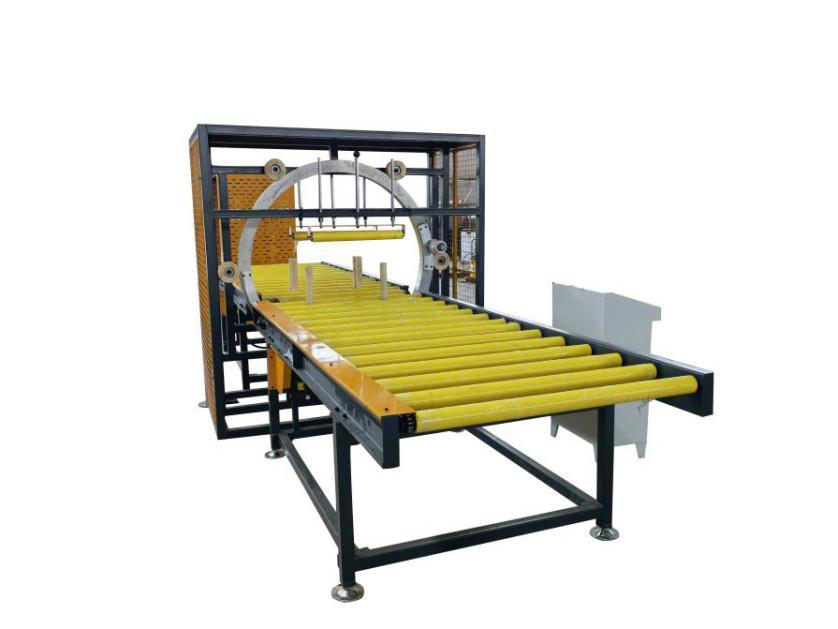
In a horizontal orbital wrapper, the product moves horizontally on a roller or belt conveyor while passing through a large rotating ring, and a roll of stretch film mounted on the ring orbits the load as it travels. The combination of the ring’s rotation and the load’s forward movement lays film in a spiral around the product, with the overlap between turns set by the conveyor speed relative to the ring. At the start and end of the bundle, the film overlaps heavily to close the wrap, and the ends can be left open for ventilation or closed for protection. The load never rotates and is never lifted, which is what makes the method suitable for long, heavy or irregular products that could not be turned safely.
Which products are wrapped this way
- Timber, lumber, planed wood, decking and fencing bundles
- Aluminium profiles and extrusions, PVC and plastic profiles
- Steel, copper and plastic pipes, tubes and conduit
- Rods, bars, rebar and linear metal stock
- Furniture, flat-pack panels, doors, window and door frames
- Rollers, shafts and long machined components
- Building materials — insulation, boards, trims and mouldings
- Bundled, strapped or multi-piece loads of any of the above
The common factor is length combined with a load that benefits from being held together and protected. For many of these products the wrap does two jobs at once: it binds the individual pieces into a bundle that can be handled as one unit, and it protects the surfaces from dust, moisture and abrasion through storage and transport. Anodised profiles, painted panels and finished furniture are exactly the products whose value is destroyed by a scratched surface, and orbital film protects them at low material cost.
How the machines are configured
Orbital wrappers are defined by the ring diameter — which must clear the bundle cross-section — and the conveyor length and capacity, which must support the product. Compact machines handle smaller bundles such as profile offcuts, furniture parts and light timber at moderate rates and suit plants with limited floor space; the compact horizontal orbital wrapper is built around a smaller ring with an integrated roller bed and can be run as a standalone cell. Heavy machines use a larger ring, a long roller conveyor and a stronger drive to wrap full-length timber, pipe and profile bundles continuously, as in the heavy horizontal orbital wrapper, and they are the machines used at building-products plants that wrap load after load through a shift.
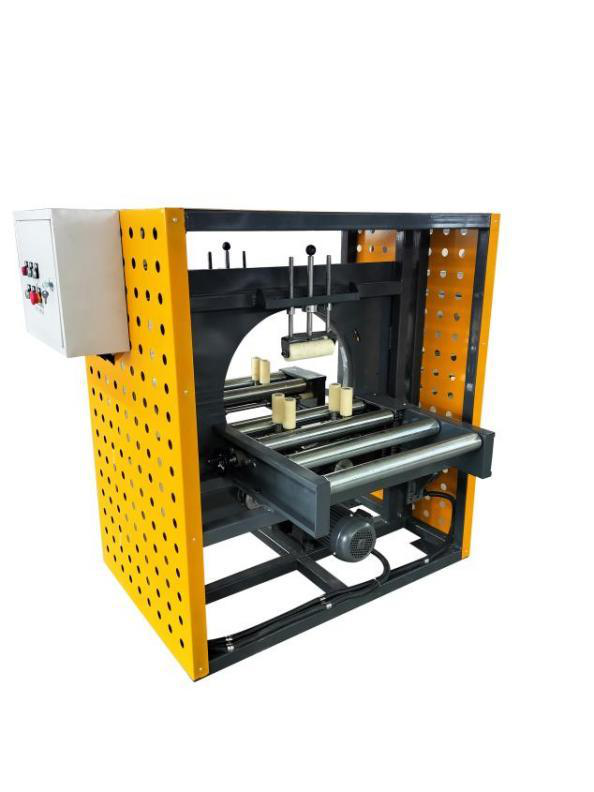
The conveyor is part of the specification rather than an accessory. Roller conveyors suit rigid bundles that carry themselves — timber, pipes, profiles — while belt or slat conveyors support softer or irregular products, and the infeed and outfeed lengths must be long enough that the product is supported throughout the ring. For very long loads the conveyor sections extend well beyond the machine, and the layout is planned around how bundles are presented by the production line and removed after wrapping.
Film, overlap and the protection it provides
Orbital wrapping uses stretch film applied under tension, and the containment comes from that tension rather than from the film’s thickness alone. The key settings are the stretch level, the overlap between spiral turns and whether the ends are closed. A typical protective wrap overlaps roughly half the film width so the load is double-covered, while a lighter binding wrap uses less overlap for products that only need to be held together. Increasing the overlap and closing the ends gives better dust and weather protection at the cost of film and a slightly slower pass, and the correct setting follows the route: product moving between adjacent factories can be lightly wrapped, while product going through open storage or sea freight needs closed, heavy coverage.
It is worth being precise about what the film does and does not do. Orbital stretch film binds and gives protection against dust, surface abrasion and light moisture, but it is not a vapour barrier and should not be specified as corrosion protection for bare metal going through long sea export, where the methods in SunAura Packaging Machines’ export packaging guidance apply. For products that genuinely need weatherproof wrapping, the film type and end closure are specified accordingly and confirmed against the route.
Standalone versus inline operation
Orbital wrappers are run in two arrangements, and the choice follows the production pattern. Standalone cells are fed by hand or forklift and suit batch production, mixed lengths and lower volumes; the operator places a bundle on the infeed, runs the wrap cycle and removes it, with the machine handling the film work that several people would otherwise do. Inline machines are connected to the production or bundling line so every bundle is wrapped as it is made, with conveyors feeding and removing loads continuously and the wrapper running at the line’s rate. Building-products and pipe plants with steady output run inline; joinery shops and mixed-product distributors run standalone, and the same machine can often start standalone and be integrated later as output grows.
Adding strapping for the heaviest loads
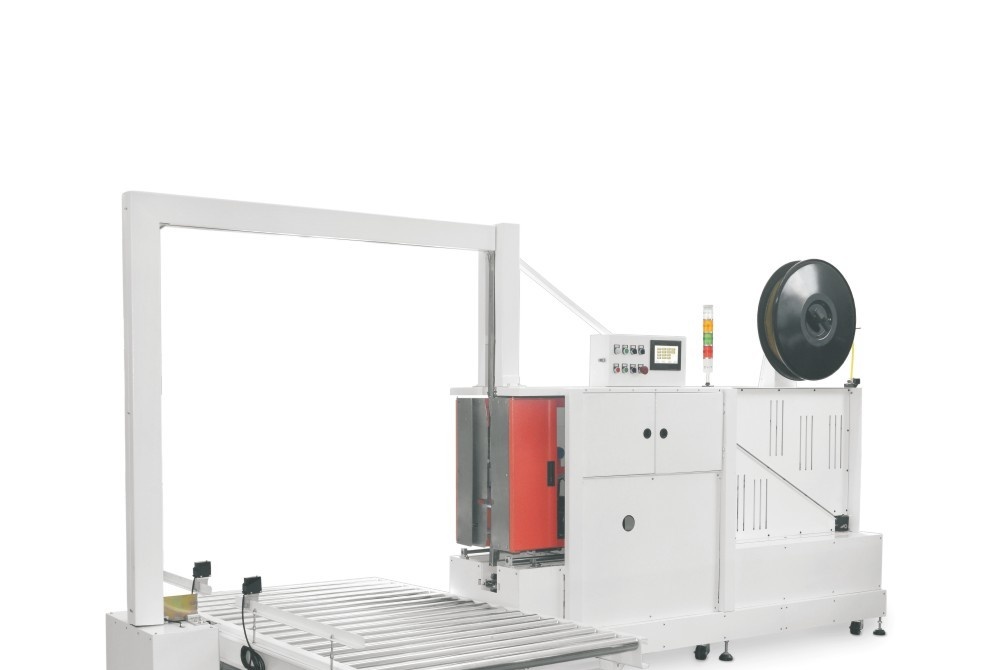
For bundles that must carry their weight when lifted — particularly timber and heavy profiles — film is often combined with strapping, because film binds surfaces while straps take the lifting load. Strapping can be applied before wrapping, with the film then protecting the strapped bundle, and machines in the class of the automatic strapping machine or a horizontal strapping station can be integrated alongside the wrapper. The combination is decided by how the bundle is handled: loads lifted by the individual pieces need positive strapping, while unit loads moved as one can rely on film. SunAura Packaging Machines confirms this against the customer’s actual lifting and storage during specification rather than applying a fixed rule.
Coiled and ring-shaped products: a related machine
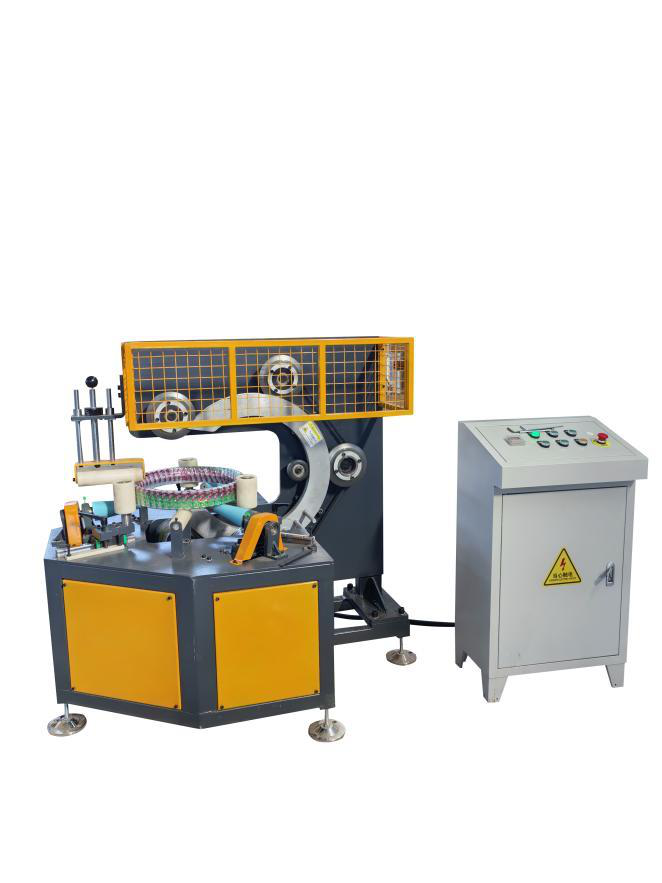
Not every non-pallet load is long, and coiled products — wire and cable coils, bearings, hose coils, rings — are wrapped on a horizontal coil wrapper, a smaller ring machine that orbits film around a coil presented on rollers. The horizontal coil wrapper works on the same orbital principle but is built around the coil’s shape rather than a long load, and plants that produce both linear and coiled products sometimes run both machine types. The distinction matters at enquiry: a long bundle and a coil are wrapped on different equipment even though the wrapping principle is shared.
Throughput, labour and the practical return
The return on an orbital wrapper is counted most directly in labour and damage. Hand wrapping a long bundle is slow — several workers, repeated walking around the load, film applied inconsistently — and it carries a real injury risk as bundles are turned and lifted. A wrapper applies a repeatable spiral in the time the bundle passes through, typically in seconds to under a minute depending on length and overlap, with one operator supervising rather than several people wrapping. On top of the labour, the consistent tension and full coverage sharply reduce the surface damage and loosened bundles that produce claims when long products reach site. For plants shipping finished, easily scratched surfaces, the damage reduction alone often justifies the machine before the labour is counted.
Safety and guarding on the wrapping station
A rotating ring is the one genuinely hazardous part of the machine, and orbital wrappers are guarded accordingly, with the ring enclosed and access protected so operators cannot reach a moving film carriage. The guarding and interlocks are verified at commissioning and should never be bypassed to clear film faster, and the emergency stops are checked on the same schedule as the rest of the line. Beyond the ring, the practical risks are in handling the bundles themselves — long loads swung by crane or forklift around the infeed — and these are managed with clear presentation areas and, on inline lines, conveyors that remove manual placement altogether. As with other end-of-line equipment, replacing hand wrapping removes the repeated turning and lifting that produced the plant’s strain and crush injuries, which is a safety gain counted alongside the labour saving.
Operators are trained to load film with the ring stopped and guarded, to recognise a torn web and to keep the conveyor area clear while bundles pass, and the maintenance team inspects the guarding, interlocks and emergency circuits as part of the routine service. For plants that previously wrapped by hand, the machine’s guarding also makes the process consistent in a way manual work never is, because the hazard is engineered out rather than left to how carefully each worker moves around a turning bundle.
Frequently asked questions
What size machine does my bundle need?
The ring must clear your largest bundle cross-section with margin, and the conveyor must support the full length and weight. Bundle dimensions and weights are the first details requested at enquiry.
Can the wrap protect products stored outdoors?
Heavy, closed-end wrapping gives dust and light-weather protection, but stretch film is not a vapour barrier; long outdoor storage or sea export needs the appropriate barrier materials and sealing.
Do I need strapping as well as film?
Bundles lifted by their pieces or carrying heavy weight generally need strapping for the lifting load, with film then binding and protecting; unit loads moved intact can often rely on film alone.
Can mixed lengths and small batches be wrapped?
Yes. A standalone cell with adjustable settings suits mixed lengths and batch work, while inline integration fits steady, uniform production.
How is film consumption controlled?
Stretch level and overlap set the film used per bundle, and stored settings per product keep consumption repeatable rather than varying by operator.
Conclusion
Horizontal orbital wrapping gives long and bundled products — timber, profiles, pipes, furniture, doors and building materials — a continuous, consistent wrap without turning the load, replacing slow hand wrapping with a ring-and-conveyor cycle that binds and protects in seconds. Specified by ring size, conveyor capacity, standalone or inline arrangement, and with strapping added where lifting loads demand it, the machines cut both labour and the surface damage that erodes the value of finished long products. Coiled products use the related coil wrapper, and export corrosion protection remains a separate barrier method.
If you produce or distribute long products and want to replace hand wrapping, contact SunAura Packaging Machines’ applications engineers with your bundle dimensions, lengths and throughput, or review the machines in the products hub, including the compact and heavy orbital wrappers and the full range of strapping and wrapping equipment. Our engineers will confirm the ring size, conveyor and film settings against your actual bundles and routes, and can review an existing wrapping station for improvement.

David leads our case sealing and cartoning engineering team. Over 14 years he has specified, installed and commissioned hundreds of random-size case sealers, top- and side-loading cartoners, and automatic case packers for food, household and industrial product lines. He writes buying guides and troubleshooting articles around seal quality, tape and hot-melt glue selection, and carton throughput limits.
See Full Bio ›