

Sustainable packaging is no longer a marketing option; it is a buyer requirement. Retailers, regulators, and consumers are pushing brands away from conventional polypropylene and PET films toward biodegradable, compostable, and paper-based alternatives. The problem that few brands anticipate is that a machine engineered for 30-micron OPP film often cannot run 20-micron PLA compostable film without leaks, wrinkles, and constant jams. If you plan to buy packaging machine capability for sustainable film in 2026, compatibility must be specified at purchase, not discovered on the factory floor. This guide from the engineering team at SunAura Packaging Machines explains which biodegradable films behave like which, what a compatible machine actually needs, and how to avoid the most expensive compatibility mistakes.
Why Biodegradable Film Behaves So Differently
Conventional flexible films (OPP, PET, LDPE, laminates) are engineered for toughness: they tolerate a wide sealing-temperature window, resist stretch under tension, and run predictably at high speed. Biodegradable films trade that toughness for compostability, and the trade-off shows up immediately on a packaging machine.
Narrow heat-seal window. PLA (polylactic acid) seals in a temperature band that can be as little as 8 to 12 degrees Celsius wide, versus 25 to 40 degrees for OPP. Run the jaws 10 degrees too hot and the film crystallizes, becomes brittle, and tears; 10 degrees too cold and the seal is weak and leaks. On a machine with crude on-off temperature control, this window is effectively unmanageable.
Lower tensile strength and higher stretch. Compostable films stretch and neck under tension. A film pull that was perfectly tuned for OPP will over-pull PLA, causing bag length drift and wrinkling on the fin seal.
Higher coefficient of friction and static. Many biodegradable films grip more on stainless rollers and build up static, which causes misfeeds, double-pulls, and dust attraction.
Lower melt point for shrink applications. Compostable shrink films shrink at lower temperatures and shrink tunnels calibrated for PETG will over-shrink or scorch them.
Compostability Certification: The Backdrop to Machine Choice
Before you tune a machine, make sure the film can actually carry the claim you intend. In Europe, industrial compostability is governed by EN 13432; in North America by ASTM D6400 and the BPI certification; home compostability has its own emerging standards (notably TÜV Austria’s OK compost HOME). A film that merely “biodegrades” in a landfill does not qualify, and neither does a laminate that mixes polymer and paper in a way that fails disintegration testing. This matters to machine compatibility because certified films tend to be the consistent, well-formulated grades; uncertified “eco” films vary batch to batch and are far harder to run.
Ask your film supplier for the certification certificate and the recommended processing window (seal temperature, dwell, tension, and reel width). Machine compatibility is really a contract between three parties — film producer, converter, and packaging machinery manufacturer — and the more of that data you hand to the equipment builder, the better the first FAT goes. A supplier that cannot give you a processing window cannot give you a reproducible pack.
Paper and Paper-Laminate Flow Wrap
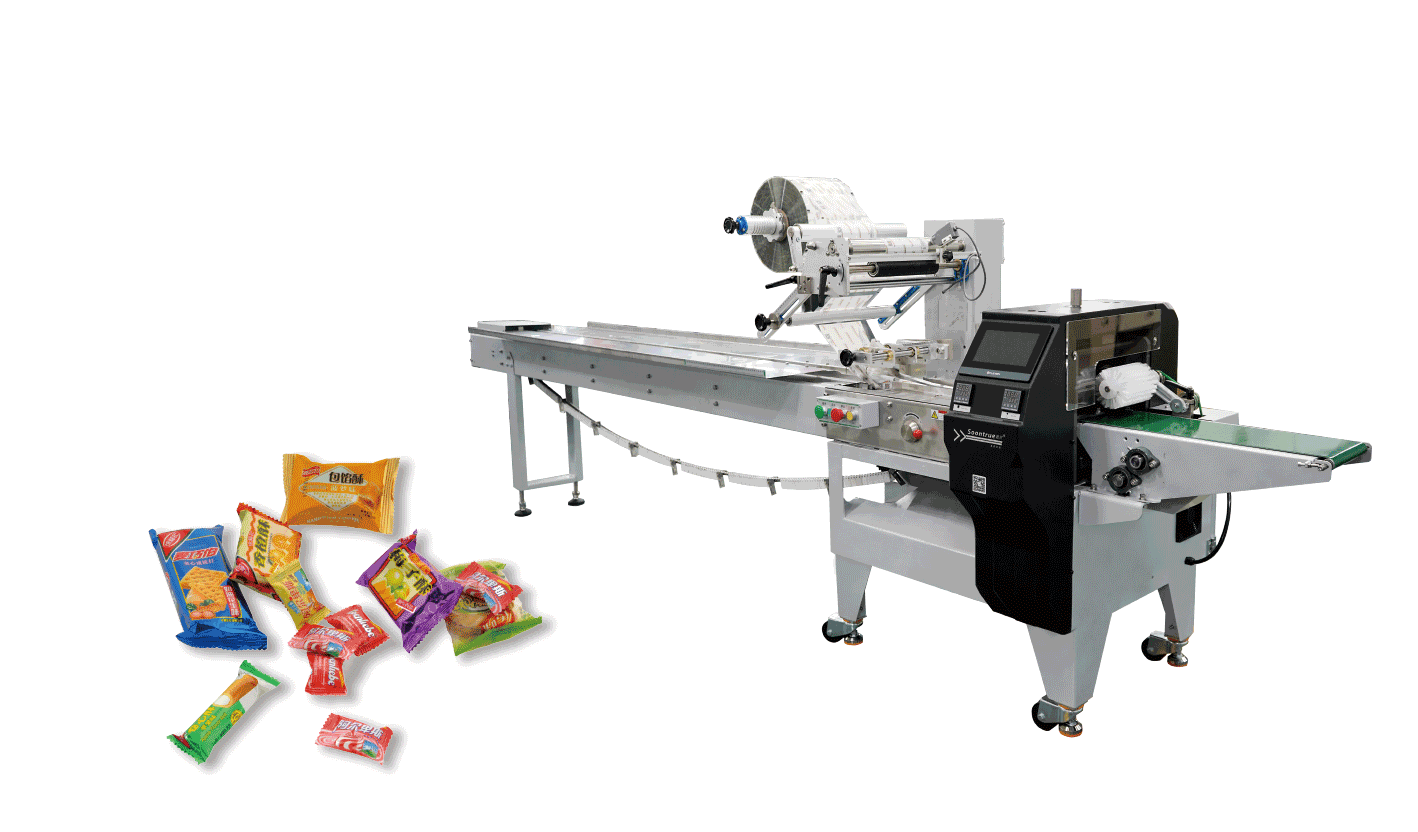
Paper-based flow wrap is the fastest-growing sustainable format in bakery and confectionery, and it stresses the machine in completely different ways than polymer film. Paper does not stretch, so bag-length control must be near-perfect with zero over-pull; it generates dust, which clogs pull belts and accumulates on guides; and it needs sharp, clean cross-cut knives rather than serrated crimp jaws. A machine intended for paper wrap needs dust extraction at the forming shoulder, food-grade timing belts that resist paper dust, and cross-cut knives ground for fibrous stock.
Paper also folds differently. The fin seal on paper-laminate is more of a crimp than a heat seal, and over-heating delaminates the thin heat-seal coating. Expect to run jaws 20 to 40 degrees cooler than on polymer, with a longer dwell. If you intend to alternate paper and polymer on the same wrapper, specify a quick-change jaw set and documented recipe recall so the changeover is a one-touch recipe, not a four-hour re-tune. Our three-servo flow wrapper platform is built around recipe recall for exactly this reason.
Running Both Conventional and Biodegradable Film on One Line
Most plants will not convert to 100 percent biodegradable film overnight. They will run a conventional OPP line for the price-sensitive SKUs and a compostable line for the premium, sustainability-branded SKUs, often on the same machine. That mixed-format reality raises the bar: the machine must hold two fully separate recipes, switch between them in minutes, and not contaminate one run’s parameters into the other.
Recipe recall is the feature that makes this work. A modern servo wrapper should store, say, 50 to 100 product recipes, each recalling film pull length, jaw temperatures, dwell, conveyor speed, and reject thresholds with a single HMI touch. Without recipe recall, every film switch becomes an engineering afternoon. With it, an operator can move from OPP to PLA in under ten minutes. This is also why cheap, non-servo machines age badly as sustainability accelerates: they cannot hold the parameters, so every new film is a fresh tuning project.
The Main Biodegradable and Compostable Film Families
| Film | Typical use | Key machine challenge |
|---|---|---|
| PLA (polylactic acid) | Flow wrap, overwrap | Narrow seal window, brittle when overheated |
| PBAT blends | VFFS bags, stretch | Stretches under tension, bag-length drift |
| PBS / PHA | Specialty compostable | Sensitive to heat and humidity |
| Paper / paper-laminate | Flow wrap, bakery | Cuts, dust, rigid fold issues |
| Compostable shrink | Shrink bundling | Lower shrink temp, tunnel recalibration |
The single most important question to ask your film supplier is not “is it compostable?” but “what is your recommended seal temperature, dwell time, and tension range?” Without those parameters, no machine can be tuned reliably.
What a Biodegradable-Film-Capable Machine Actually Needs
Precise, stable jaw temperature control. Closed-loop PID heating with individual zone control and fine resolution (±2°C) is the baseline. Cheap machines with simple relays cycle the elements in coarse 10-degree bands, which is unusable on PLA.
Servo-driven film pull and film feed. A servo film-draw with electronic tension control lets you dial in the exact pull length and torque, compensating for stretch. A mechanical gearbox and friction brake cannot. For deeper context, read our guide on servo motor configuration for flow packs.
Compliant fin-seal and end-seal jaw design. Jaws must be able to run at slower dwell if needed and use profiles suited to softer films. Serrated jaws that cut conventional film can perforate a thin compostable laminate.
Anti-static and low-friction guides. Brushed stainless or PTFE-coated guide surfaces reduce drag; anti-static bars prevent film clinging and double-pulls.
Adjustable forming box. Because biodegradable films are often thinner and stiffer, the forming shoulder must be adjustable so the film lays down without wrinkling. A fixed forming box tuned for 30-micron OPP will wrinkle 20-micron PLA.
Shrink and Overwrap Compatibility in 2026
Shrink wrapping is where biodegradable transitions fail most often. A conventional PETG shrink tunnel runs at 160 to 180°C to shrink a 15-micron film; a compostable shrink film may need 110 to 130°C and a longer, gentler dwell. A tunnel with coarse temperature control will either leave the film loose or burn through it. If you run both conventional and compostable shrink, look for a tunnel with fine zone control and a variable-speed conveyor so dwell time is programmable, not fixed.
Similarly, cellophane (overwrapping) machines running compostable overwrap need adjusted perforation and perforation-wheel tension, or the perforations tear into full cuts. Our notes on heat shrink packaging machine troubleshooting cover the tunnel-side symptoms you will see during the transition.
VFFS and Pouch Compatibility
Vertical form-fill-seal machines running PBAT compostable pouches face the same tension and seal-window issues, plus a forming-tube problem: compostable films often run cooler and stick to the forming tube. A compatible VFFS needs a coated or polished forming tube, cooled seal jaws, and a film pull that can be tuned to avoid necking. Our VFFS machine platform is specified with these adjustments for compostable stock.
How to Specify and Validate a Compatible Machine
Do not take a supplier’s word that a machine “runs biodegradable film.” Require a factory acceptance test (FAT) on your actual film and your actual product. Ask the supplier to run a 30-minute production trial, measure seal strength, bag-length consistency, and reject rate, and hand you the recorded parameters. A machine that only runs biodegradable film on the supplier’s best day with a technician present is not a machine that will run it on your night shift.
Build a validation table: target seal temperature range, actual seal strength in Newtons, bag-length tolerance in millimeters, and reject rate in percent. If the supplier cannot produce this, they have not actually run the film. When you select a horizontal flow wrapper for food or cosmetic, make the film-compatibility FAT a contractual condition, not a favor.
Field Symptom Cheat-Sheet
| Symptom on biodegradable film | Likely cause | First fix to try |
|---|---|---|
| Seal leaks at jaw ends | Jaw too cold for film grade | Raise jaw in 5°C steps, re-test seal strength |
| Film tears or crystallizes at seal | Jaw too hot or dwell too long | Lower temperature, shorten dwell |
| Bag length drifts long/short | Film stretching under pull | Reduce film pull tension, re-read mark sensor |
| Wrinkles on fin seal | Forming box wrong for film stiffness | Adjust forming shoulder, lower film tension |
| Film doubles or sticks on rollers | Static and high friction | Engage anti-static bar, clean guides |
| Loose or scorched shrink | Tunnel wrong for compostable shrink | Lower zone temp, slow conveyor dwell |
Keep this cheat-sheet posted at the line. Most first-week biodegradable-film problems are one of these six, and each has a one-recipe fix on a servo machine — but only if the machine has the controls to make the adjustment. That is the whole argument for buying compatibility up front.
A Worked Example: The Cost of the Transition
- Name the exact film grade and supplier in the purchase order, not just “compostable.”
- Require closed-loop PID jaw control (±2°C) with at least two independent zones.
- Require servo film pull with programmable tension.
- Require an adjustable forming box and anti-static guides.
- For shrink, require a tunnel with programmable temperature zones and variable-speed dwell.
- Require a FAT on your real film and product, with documented seal strength and reject rate.
- Confirm spare jaws and guide sets are stocked for your film thickness.
Total Cost of the Transition
Buyers often price the film premium and forget the machine. A biodegradable film may cost 15 to 35 percent more per roll than OPP, but the real line cost is the downtime if the machine is incompatible. A wrapper that rejects 4 percent of packs on PLA loses more money in film and labor than the entire film premium. Conversely, a properly specified servo wrapper running compostable film at 1.5 percent rejection pays back the machine difference within a year. Model the full picture in our analysis of total cost of ownership for automatic packaging lines before you commit.
How SunAura Packaging Machines Supports the Transition
SunAura Packaging Machines has configured flow wrappers, VFFS, and shrink systems for PLA, PBAT, and paper-based films across bakery, confectionery, and fresh-produce customers. Our entry-level flow wrapper and full-servo reciprocating wrapper both ship with the closed-loop jaw control and servo film pull that biodegradable film demands, and we run the FAT on your nominated film before shipment. Browse the full range on our products page, or contact the SunAura Packaging Machines team with your film grade and product so we can quote a compatible configuration and validation plan.
Conclusion
Biodegradable film is the future of flexible packaging, but it is a stricter material than the films it replaces. A machine bought for conventional film will fight you every shift; a machine specified for the narrow seal window, low tensile strength, and static behavior of compostable film will run cleanly and protect your sustainability claim. Specify the film, demand the FAT, and choose a packaging machinery manufacturer that has actually run the material. Get that right in 2026 and your sustainable packaging line will be a competitive advantage, not a daily fire drill.

Michael designs automated palletizing stations and ties upstream case or bag flow to downstream stretch wrapping. His work spans conventional layer palletizers, robotic arm cells, conveyor routing, safety fencing and handover logic between machines. He writes about palletizer selection, load stability and how an end-of-line sequence should be balanced.
See Full Bio ›