

SunAura Packaging Machines has commissioned a fully integrated frozen ready-meal end-of-line for a producer in western Poland, combining automatic horizontal cartoning, robotic case packing, case erection and collaborative palletising into a single cell built to run in a chilled-to-cold environment. The line, which completed its factory-acceptance programme at SunAura Packaging Machines’ Qingdao works before shipment, was handed over following on-site installation, cold-environment trials and operator training, and is now running in commercial production around the customer’s shift pattern.
The customer, a family-owned manufacturer of chilled and frozen ready meals sold through retail private label and its own brand, had been packing a growing share of output by hand and with a pair of older, standalone machines. Rising volumes, a widening range of carton and case formats, and retailer pressure for consistent pack quality made the manual route unsustainable. The brief asked for a line that could handle several carton sizes across different meal ranges, pack them into a limited set of standard corrugated cases, and present stable pallets at the dispatch area, all within the constraints of an existing building and a cold-adjacent layout.
The scope of the line
The installed cell is organised in the conventional end-of-line sequence but engineered as one system rather than a collection of independent machines. Filled and sealed ready-meal trays enter the cartoning section, where a horizontal cartoner erects, loads and closes retail cartons; the cartons are then conveyed to a robotic case packing station. Cases are erected and bottom-sealed at the head of the line and delivered to the packer. Once filled, cases are conveyed through closing and sealing, then onward to a collaborative palletising robot that builds mixed but stable pallet patterns and hands finished loads to dispatch. Every machine shares a common control language and is linked by powered conveyors sized for the cold-adjacent area.
Cartoning built around format changes
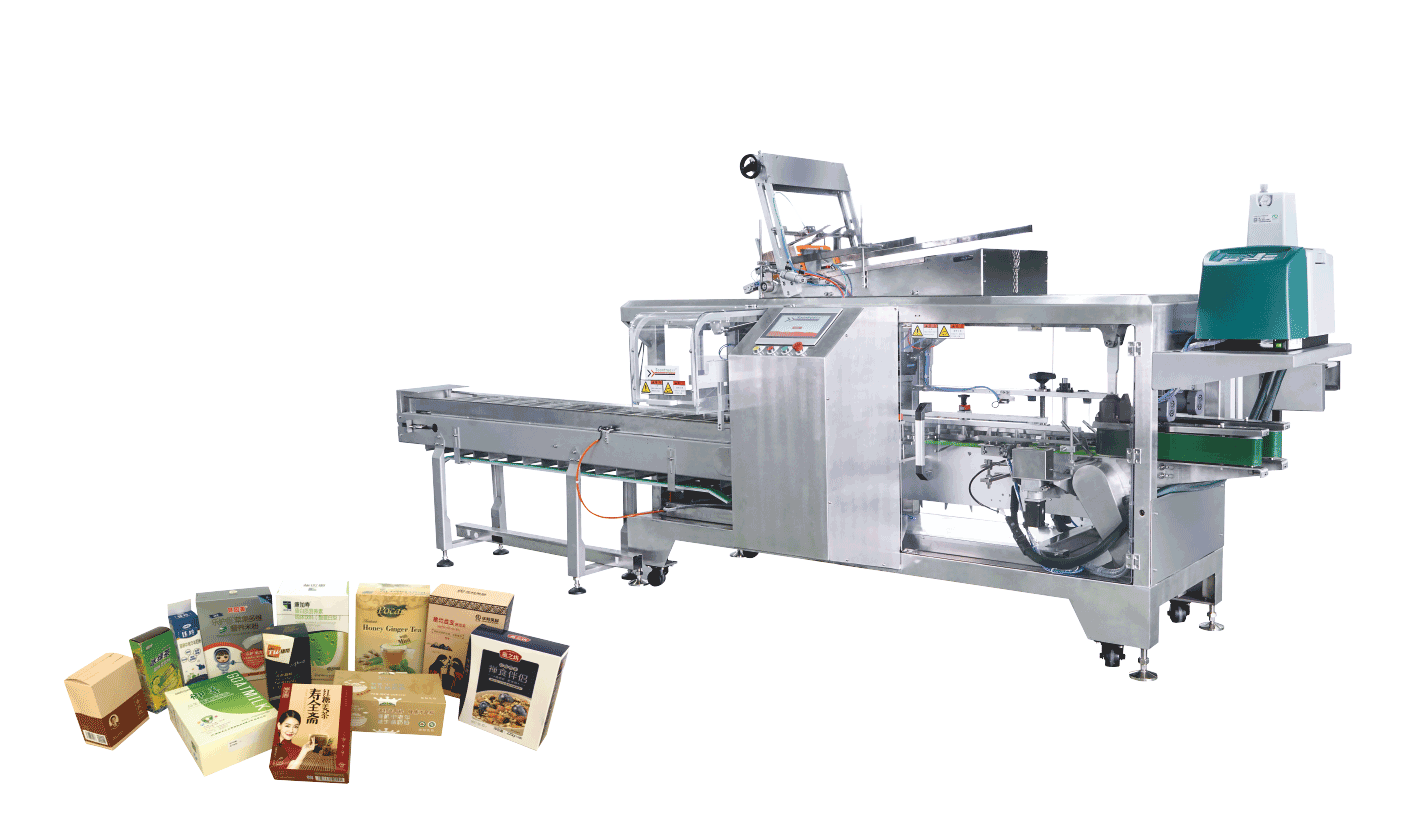
The cartoning section is handled by a full-servo horizontal cartoner of the ZH-200/300 full-servo cartoner class, specified with a washdown-compatible finish and sealed controls for the chilled environment. Ready-meal production means frequent changeovers: the customer runs several retail carton formats across its own brand and multiple private-label accounts, each with its own printed board and closure detail. The servo cartoner stores format recipes and uses servo axes rather than mechanical change parts for the main forming and insertion movements, which keeps changeover to a short, repeatable procedure rather than a mechanical rebuild. During acceptance the line was run through the customer’s full format list, with changeover times recorded against the target.
Because the product is a filled tray that can be damp at the edges, the cartoner’s loading and closing stations were set up to handle the real product rather than a dry dummy, and the guarding and product-contact parts were specified in the appropriate stainless grade. Carton presence and closure checks reject anything not properly formed before it reaches the case packer, which protects the downstream robot from trying to pack a defective carton.
Robotic case packing for repeatable placement
Filled cartons are collated and packed by a two-axis robotic case packer of the ZX-500R robotic case packer type. The robot picks cartons in the required collation and places them into erected cases in layers, with motion and pickup tooling matched to the carton sizes. Choosing a robotic packer over a fixed mechanical packer gave the project two practical advantages in this application: it accommodates the different case and carton arrangements through recipe and tooling changes rather than a new machine, and it keeps the repeatable, high-duty motion inside a sealed robot while reducing the number of exposed mechanical parts in the chilled zone.
The packing pattern, number of cartons per case and layer orientation are set per product, and the cell confirms case presence and that the case is correctly erected before the robot commits a load. Collation conveyors present cartons in the orientation and grouping the pick pattern requires, which is where a great deal of the reliability of a robotic packer is actually won or lost. During cold-environment trials the packer held its placement accuracy across the shift, including the first cycles after a weekend stop, once the cabinet conditioning had brought the controls to a stable operating state.
Case erection, sealing and palletising
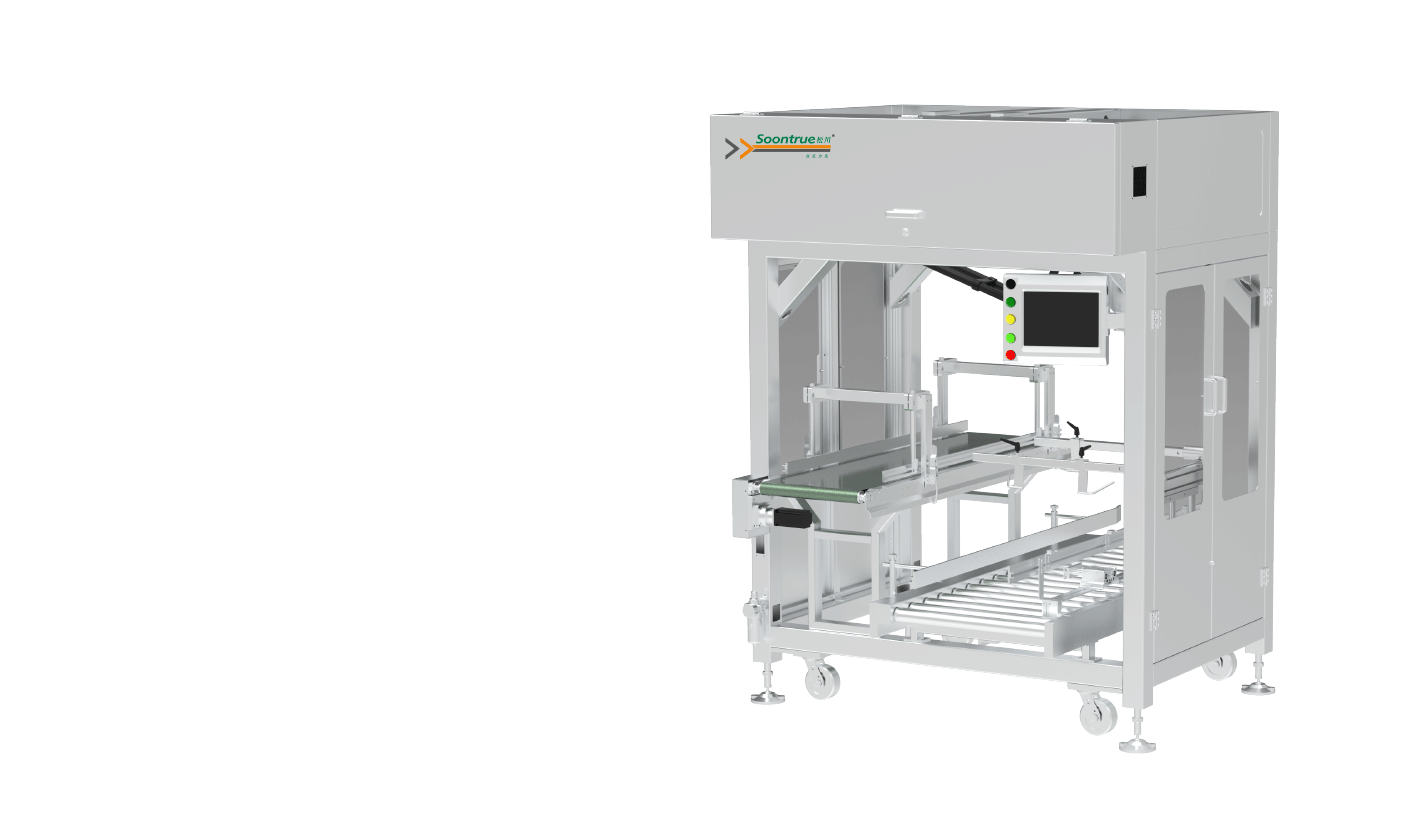
Empty corrugated cases are erected and bottom-sealed at the head of the line by an automatic case erector of the K40T high-speed case erector and bottom sealer class, which keeps the packing station supplied without an operator forming boxes. The erector was sized for the customer’s standard case range rather than the full theoretical variety, deliberately limiting the number of case formats to keep changeover simple. Filled cases are closed and sealed before leaving the packing zone, with the closure specified to bond reliably on cases that have been handled in chilled, slightly damp air.
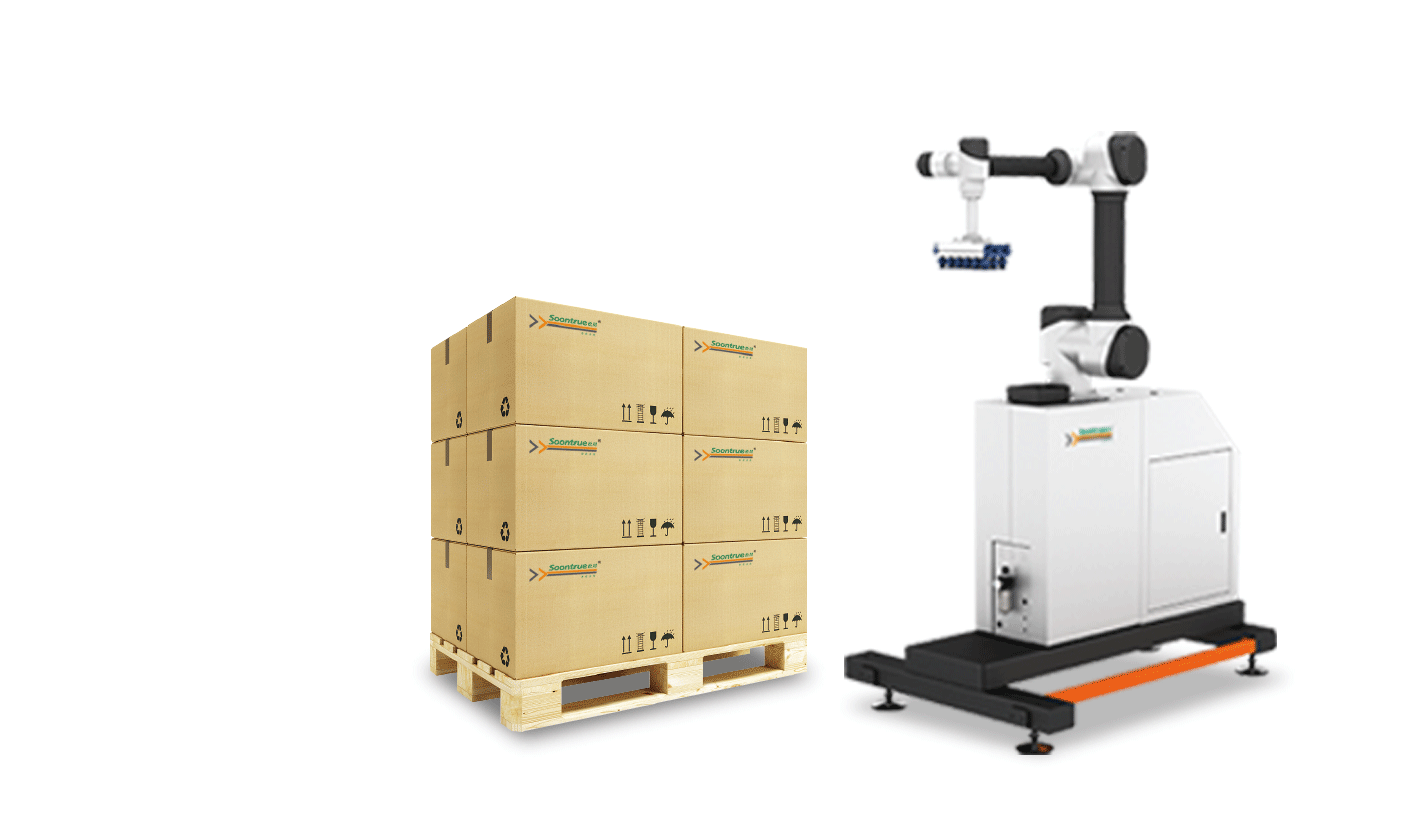
At the end of the line, a collaborative palletising robot of the WP-50 collaborative palletising robot class builds pallet patterns layer by layer. A collaborative machine suited this installation because it works alongside operators in a defined area without the full fenced cell a conventional palletiser requires, which mattered in a building with limited room. Pallet patterns are stored per product, and the robot places cases to keep each layer square and the finished load within the customer’s stability requirements. The finished pallets are then moved to dispatch, where they replace the uneven, hand-stacked loads the customer had previously been shipping.
Engineering for the cold-adjacent layout
A central part of the project was the environment. Ready-meal packing sits between chilled preparation and dispatch, and the customer wanted the cartoning and packing as close to the cold area as practical without placing every machine inside a refrigerated room. SunAura Packaging Machines’ engineering team worked through a boundary layout: the heat-producing and most maintenance-intensive functions sit in the cold-adjacent area, while the machines that handle chilled product are built to tolerate damp, cool air and routine cleaning. The structural and contact parts in the chilled handling zone are stainless, the electrical cabinets are sealed to the required rating and fitted with condensation management, and the drives, cables, seals and lubricants are rated for the low end of the operating range.
This is more expensive than ordering standard ambient machines, but it avoids the predictable alternative. The team’s approach to specifying equipment for these conditions, including stainless grades by zone, IP ratings, cabinet heating and low-temperature-rated mechanical parts, is set out in the technical guide to packaging equipment for cold, wet and washdown environments. On this project the specification was agreed before manufacture, so the environmental features were built in rather than retrofitted after the first winter.
Acceptance, installation and training
Before shipment the line completed a factory-acceptance programme at Qingdao, run on the customer’s actual carton board, cases and a representative sample of product where possible. The programme covered every format in the range, recorded changeover times, and confirmed throughput and pack quality against the agreed figures. Running the full format list at the factory, rather than a single ideal product, is deliberate: most issues on integrated lines surface at the transitions between formats, and they are far cheaper to resolve before the equipment is containerised.
On-site work covered mechanical installation and levelling, electrical and air connections, integration with the customer’s existing conveyors at the entry and dispatch points, and cold-environment trials under real production conditions. SunAura Packaging Machines’ commissioning engineers then trained the customer’s operators and maintenance staff on format changeover, routine servicing, fault recovery and the HMI, and left documentation covering spare parts and the maintenance schedule. The line was handed over once it had held its performance over consecutive shifts rather than a single demonstration run.
Throughput, and the practical reality of the line
Catalog speed is a comfortable number; a running line is judged on what it actually delivers across a shift once changeovers, stoppages and material handling are included. From the outset the project was specified against the customer’s real demand pattern rather than a peak figure on a datasheet. Ready-meal production runs in campaigns: a given meal and its carton format are produced for a block of time, then the line changes to the next. The bottleneck therefore moves with the product, and the line was balanced so that no single machine idles while waiting on the next during steady running, with the case erector and the collation conveyors carrying enough buffer to absorb short interruptions without stopping the cartoner.
The acceptance figures were recorded as sustained throughput over a production block, not as the best minute of the trial, because that is the number the customer can plan against. In operation the line comfortably covers the customer’s current volumes with headroom for the seasonal peaks that drove the investment, which is the point of sizing to the campaign rather than to an average day. Equally important, the integrated layout removes the handling that previously dominated the process: cartons no longer wait in batches between standalone machines, and cases move to sealing and palletising without being trucked around the hall. Removing those intermediate queues both reduces work-in-progress and shortens the time a chilled product spends before it reaches dispatch.
Changeover discipline across a multi-format range
For a co-packer running private label, the ability to change format quickly and reliably is arguably more valuable than outright speed, because the range is wide and individual runs are shorter than a single-brand plant’s. The project treated changeover as a designed feature rather than an operator skill. The servo cartoner and robotic packer store recipes per product, so the machine settings that would otherwise be dialled in by hand are recalled consistently, removing the variation between an experienced operator and a new one. The physical change parts were kept to a minimum and designed to be tool-free or single-tool, colour-coded and stored on a dedicated board so that nothing is searched for mid-change.
A documented changeover procedure, agreed during factory acceptance and refined during on-site trials, sets out the sequence, the checks and the first-good-pack confirmation. The line is not released back into production after a format change until a carton and a full case have been verified, which prevents a run of mis-packed product following a hurried changeover. In practice this discipline turns what had been a variable, sometimes lengthy interruption into a short, predictable event, and it is a large part of why the integrated line can support a widening private-label range without the changeover overhead eroding the capacity gain.
What the customer gains
The project replaces a labour-heavy, inconsistent packing process with a repeatable line that protects the retail presentation of the product and keeps pace with growing volumes. For a private-label supplier, consistency is part of the commercial relationship: cases that are uniformly packed and pallets that arrive square reduce the friction that leads to deductions or lost accounts. Automation also removes the dependence on finding enough seasonal labour for a physically demanding packing task, and it gives the customer a platform onto which additional formats can be added through recipes and, where needed, modest tooling changes rather than a new line.
The installation is the kind of integrated, environment-specific project that sits between SunAura Packaging Machines’ standard machines and fully bespoke work. Customers approaching a similar project can review the underlying equipment in the packaging machinery catalogue, and for layouts that do not match a standard model, the company builds modified and custom end-of-line cells through its custom packaging machine service. The technical guide to selecting turntable, rotary-arm and orbital pallet wrappers covers the dispatch end for customers adding wrapping to a line of this type.
About SunAura Packaging Machines
SunAura Packaging Machines, based in Qingdao, Shandong, designs and builds end-of-line packaging equipment for food, beverage, pharmaceutical, cosmetic and industrial customers, including case erectors and sealers, cartoners, case packers, shrink and flow wrapping equipment, strapping machines, pallet wrappers and palletising robots, together with integrated and custom turn-key lines. The company supports export customers from specification and factory acceptance through installation, training and after-sales service, with regional commissioning and spare-parts support across its main markets. Ready-meal and frozen-food producers planning an end-of-line project are invited to contact the applications team with their format range, throughput and layout to develop a specification.
By the SunAura Packaging Machines project and communications team. For details of this installation or to discuss a similar ready-meal, frozen-food or chilled-product end-of-line, contact the applications engineering team in Qingdao.

James oversees the engineering architecture for full end-of-line projects: defining machine sequence, conveyor layout, line balance, footprint and expansion capacity before individual machines are ordered. He reviews customer specifications, production rates and facility constraints, and signs off on the engineering drawings and acceptance tests. His articles take the system-level view a procurement manager needs.
See Full Bio ›