

Most wrapping machines are sold to stabilise a pallet, but a large class of industrial product is not a pallet at all. It is a coil of steel strip, a bundle of steel wire rod, a bearing or stack of tyres, a roll of paper or nonwoven fabric, a reel of cable, a roll of film or foil, or a long cylindrical or annular load that does not sit squarely on a turntable and cannot be wrapped by simply rotating it on the floor. These products need wrapping equipment built around their geometry, and when buyers try to make do with a standard pallet wrapper they end up with uncovered faces, loose packs, damaged edges or machines that cannot physically accept the load.
Coil and roll wrapping is therefore its own category, with four main machine families: horizontal coil wrappers that rotate the load about a horizontal axis, vertical ring wrappers that pass film through the eye of a standing coil, radial or axial roll wrappers for cylindrical rolls, and orbital wrappers that carry wrapping material around a long load as it moves through a ring. Choosing correctly is a question of how the load is oriented, where its eye points, what the wrapping has to protect against, and how the machine fits into handling. This guide works through each family, the loads they suit, the specification points that matter, and the faults we see when the wrong architecture is chosen.
Start from the load, not the machine
The specification should begin with a precise description of the product, because the geometry alone usually determines the machine. Before approaching a supplier, document the following.
- Shape and orientation. Is the load an annular coil with a central eye, a solid cylinder, a long bar or bundle of profiles, or a roll wound on a core? Does it travel and store lying on its eye (horizontal) or standing on its rim (vertical)?
- Dimensions and mass. Outer diameter, inner eye diameter, width or length, and weight per coil. Heavy steel coils can weigh many tonnes, which dictates the structural and roller design.
- Wrapping coverage required. Enclosure of the outer circumference only, wrapping through the eye to bind the coil, full coverage including the inner and outer faces, or protection of the edges and eye against moisture and impact.
- Material. Woven or VCI anti-rust fabric, stretch or composite film, kraft or laminated paper, or combinations where the product is steel that must not corrode in sea export.
- Handling. How coils arrive at the station (crane, C-hook, transfer car, conveyor or forklift), whether the machine must rotate or upend the coil, and how wrapped loads leave.
A recurring point for steel and metal exporters is corrosion. A coil that crosses an ocean in a container can arrive with rust if it is wrapped only in a single layer of ordinary film. Export packs commonly combine an inner VCI (vapour corrosion inhibitor) layer or anti-rust paper with an outer woven or film enclosure, sealed at the eye and the outer faces, and sometimes an inner and outer edge protector. The machine must be able to apply these layers in the order and overlap the export specification requires, which is why the wrapping standard needs to be agreed before the machine is built rather than discovered at the first audit.
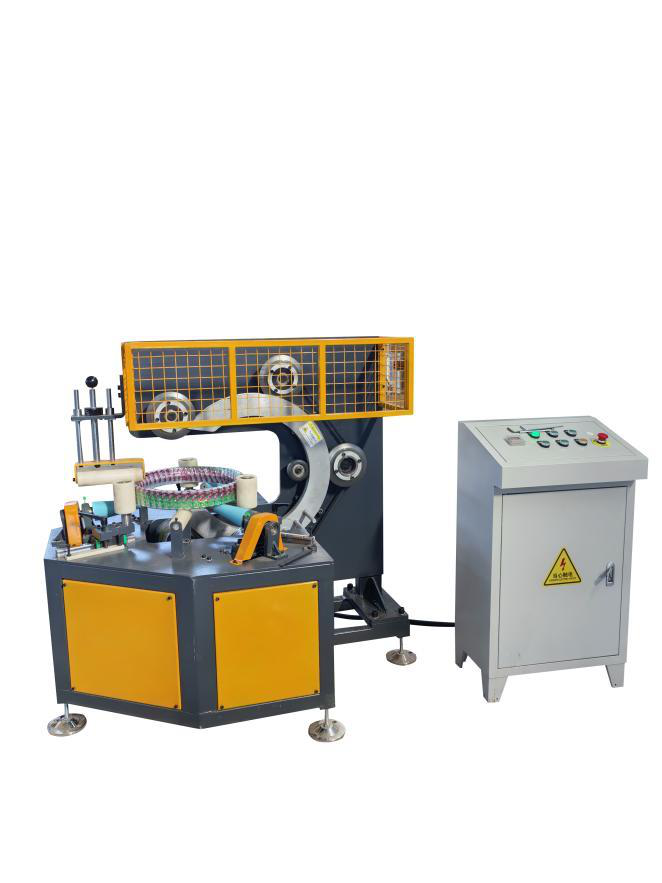
Horizontal coil wrappers
The horizontal coil wrapper is the standard answer for steel coils, wire rod bundles and similar annular loads that lie on their eye. The coil rests on powered rollers or a rotating carriage and is turned about its horizontal axis while a dispensing unit feeds wrapping material across the width of the coil, overlapping as it goes. The wrapping head traverses to cover the outer circumference and, depending on the machine and setup, can extend over the inner and outer faces so the pack is enclosed rather than banded only around the outside.
This orientation suits the way most steel service centres and rolling mills handle coils, with C-hooks and transfer cars moving coils horizontally and eye-directional handling already established. The horizontal coil wrapping machine covers the general range, while heavier, wider or denser coils move to the heavy horizontal coil wrapper, which is built with heavier rollers, more drive torque and a frame sized for the larger mass. The key specification points are the coil diameter and width range, the maximum weight the rollers must carry and turn, the overlap and number of layers the export standard demands, and whether the machine applies multiple material types in sequence. Because the load is turning under power, the drive must be sized to start and move a full-weight coil smoothly rather than relying on a motor rated only for the wrapping head.
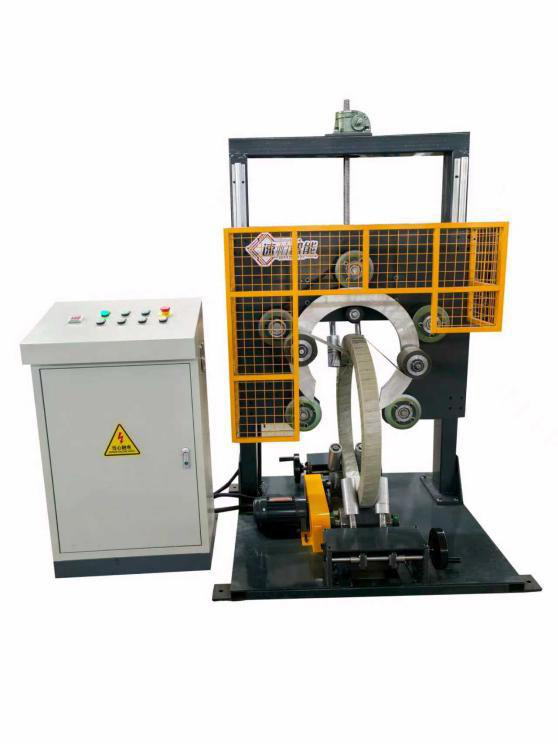
Vertical ring wrappers for standing coils
Some coils are handled and stored standing on their rim, with the eye horizontal, and the most effective wrapping then passes the material through the eye. A vertical ring wrapper uses a rotating ring that carries the wrapping material around the coil, passing through the central eye and around the outside so that the finished pack binds the coil as a whole and covers both the inner circumference and the outer body. This is the machine that produces the tightly enclosed, eye-wrapped packs common on high-value steel and metal coils, because wrapping through the eye closes the one part a horizontal outer wrap cannot reach.
The vertical coil ring wrapper handles the general standing-coil range, and the heavy vertical ring wrapper is built for the largest, heaviest coils with a correspondingly massive ring and drive. Specifying a ring machine means defining the eye diameter carefully: the ring and its carriage have to pass through the smallest eye in the range, and a coil whose eye is too small for the machine cannot be wrapped on it. Coil height and outer diameter set the ring size, weight sets the structure and the loading method, and the choice of film, woven fabric or laminate sets the dispenser and tension control. Loading is typically by crane or transfer car placing the standing coil into the wrapping station, so the layout around the machine needs clearance for that handling rather than only for forklifts.
Radial and axial roll wrappers
Paper, nonwoven, film, foil, textile and converted-product rolls are usually wound on cores and present a different problem: they are cylindrical, sometimes long relative to their diameter, and the wrapping typically protects the outer surface and the ends against moisture, dust and damage rather than binding through an eye. A radial cylindrical roll wrapper applies material around the circumference of the roll as it turns, with the wrapping head traversing along the roll to cover its length and the ends. The radial cylindrical roll wrapper is the general machine for these rolls, sized by roll diameter and length, weight, and the material being applied.
Where rolls are large, heavy or produced at high volume, and where handling them onto a single station is itself a bottleneck, a gantry architecture removes the manual placement. The gantry radial roll wrapper combines a moving gantry with the wrapping function, allowing rolls to be handled and wrapped in sequence with less crane dependence, and it suits plants that produce a steady flow of large rolls rather than occasional ones. The specification points here overlap with the horizontal machines, driven roll or carriage torque and a traversing wrapping head, but the dispenser and tension system must handle the often wider, lighter wrapping materials used on paper and converted rolls, and the machine should protect the roll surface from scuffing as it turns.
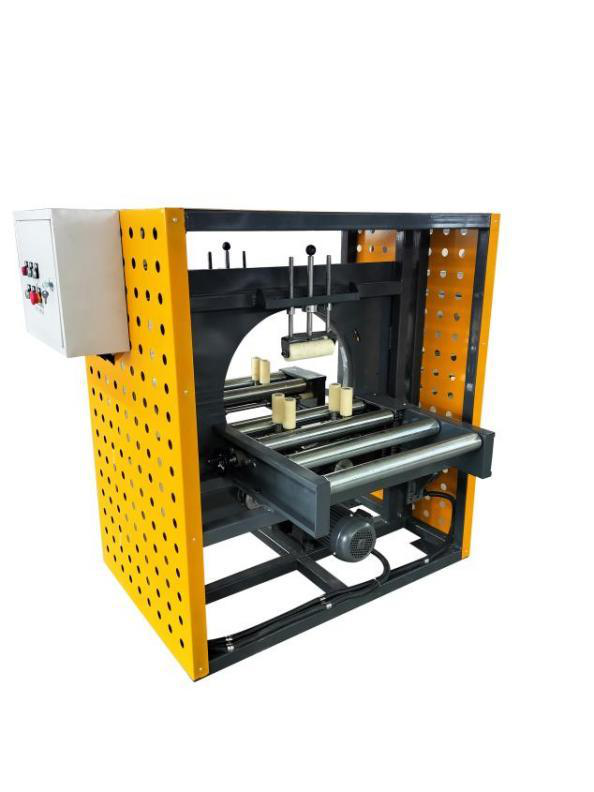
Orbital wrappers for long loads
The fourth family addresses long, relatively narrow loads that are not coils at all: bundles of timber, profiles, pipes, rods, skirting, extrusions, furniture parts or long assemblies. An orbital wrapper passes the load horizontally through a ring that carries a roll of stretch film, and the ring rotates around the load as it advances, producing a continuous spiral wrap along its length. The load never has to be turned; it simply moves through the ring on conveyors or roller tables, which is why orbital wrapping handles long and sometimes awkward products without rotating a heavy or unbalanced mass.
The compact horizontal orbital wrapper suits smaller footprints and lighter long loads, giving a small ring and a short infeed. Heavier, longer or higher-throughput bundles move to the larger horizontal orbital machines, which pair the ring with powered infeed and outfeed conveyors so the wrap is continuous and the load is supported along its length. Specification is driven by the maximum cross-section that must pass through the ring (width and height of the bundle), the minimum and maximum load length, weight per metre, and the desired overlap between spiral turns. Because the film is applied in a spiral with the load moving, ring speed and conveyor speed are coupled to set the overlap; getting that relationship right is the difference between a tight, weather-resistant pack and a loose spiral that gaps at the corners.
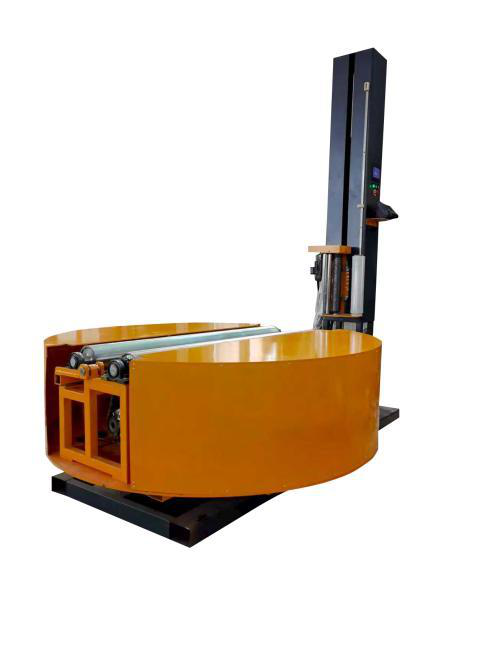
Turntables and special heavy rolls
Not every cylindrical load fits the dedicated coil architectures, and some heavy, wide rolls or annular products are wrapped on heavy turntable machines with roller tables that accept the load and rotate it in place. The heavy turntable wrapper with roller table combines a powered roller presentation with a rotating table, which suits heavy rolls and coils that arrive on roller conveyors and need to be wrapped without separate crane placement. For exceptionally large but conventionally palletised loads, the large turntable pallet wrapper provides the envelope and capacity of a heavy pallet machine. The choice between a dedicated coil wrapper and a roller-table turntable comes down to orientation and handling: if the load already moves on roller tables in a horizontal orientation and a rotating table can wrap it, the combined machine can simplify the cell; if the pack requires material through the eye or full face enclosure on standing coils, a ring machine is the better tool.
How the families compare
| Family | Typical loads | Orientation / eye | Coverage |
|---|---|---|---|
| Horizontal coil wrapper | Steel coils, wire rod, annular coils on their eye | Horizontal, eye horizontal across rollers | Outer circumference and faces; multi-layer possible |
| Vertical ring wrapper | Standing steel and metal coils | Vertical, eye horizontal, ring passes through eye | Inner eye, outer body and faces fully enclosed |
| Radial / gantry roll wrapper | Paper, nonwoven, film, foil, textile rolls | Cylindrical rolls turned on axis | Circumference and ends, surface protection |
| Orbital wrapper | Timber, profiles, pipes, long bundles | Load conveyed horizontally through ring | Continuous spiral along the length |
| Heavy turntable + roller table | Heavy rolls and coils on roller conveyors | Horizontal on rotating table | Outer wrap as the table turns |
Integration, throughput and automation
At low volumes a standalone machine loaded by forklift or crane is adequate, and the wrapping station operates as a discrete step. As volume rises, though, the handling around the wrapper tends to become the real constraint: waiting for a crane, placing each coil by hand, or moving wrapped loads one at a time. Higher-throughput cells add powered roller conveyors, transfer cars, upenders or tilters to change orientation, and automatic weighing or labelling so that a coil moves through wrapping without repeated crane calls. A 90-degree upender can turn a coil between horizontal and vertical handling, and a transfer car can shuttle coils between stations; these are the pieces that turn a wrapper into a continuous coil-handling line.
The level of automation should match the actual flow. A plant wrapping a handful of coils a day gains little from a fully automated transfer system and is better served by a well-built standalone machine; a rolling mill or large service centre moving coils continuously will lose more time in manual handling than the automation costs. Throughput on these machines is governed by the wrapping cycle, number of layers, and loading and unloading time, not only by the wrapping head speed, which is why the whole handling sequence has to be considered when sizing the cell. The approach to judging real rather than catalog throughput, and to integrating equipment into an existing line, applies as much to coil wrapping as to any end-of-line machine.
The faults that point to a wrong choice
- Uncovered eye or inner face on a standing coil. An outer-only wrap on a machine that cannot pass material through the eye; a vertical ring wrapper is required for full enclosure.
- Film tearing or slipping on heavy coils. Underpowered rotation or inadequate tension control; the drive must turn a full-weight coil and the dispenser must match the material.
- Ring will not enter the coil eye. The eye diameter was not checked against the ring size; the machine envelope must be specified against the smallest eye.
- Gaps in the spiral on long bundles. Ring and conveyor speeds not matched to the overlap; the two speeds must be set together.
- Scuffed or damaged roll surfaces. Hard rollers or poor support as the roll turns; use suitable contact surfaces and support along the length.
- Rust after export despite wrapping. Single-layer film with no corrosion inhibitor or sealed faces; build up the VCI/paper and outer enclosure to the export standard.
- Long waits on cranes between wraps. The machine is adequate but handling is manual; add transfer cars, conveyors or upenders for continuous flow.
Specifying the machine in your RFQ
Give the supplier the load geometry and the export standard rather than asking for a generic “coil wrapping machine”. State the outer and inner diameters, width, length and weight ranges, the orientation in which coils are handled, the exact materials and number of layers, the coverage required through the eye and across the faces, and how coils will arrive and leave. Ask for the drive torque and roller or ring capacity at maximum load, the tension and overlap control, the cycle time on a representative coil including handling, and the options for conveyors, transfer cars and upenders. A supplier that specifies from the load geometry is engineering the cell; one that offers only a standard turntable at a low price is leaving the risk of an unsuitable pack with you.
The full range of coil, roll and orbital machines sits within the packaging machinery catalogue, alongside pallet wrappers and the load-stabilisation options compared in the guide to turntable, rotary-arm and orbital pallet wrappers. Where a standard model does not match the coil dimensions, eye size or handling layout, we build modified and fully custom coil-handling cells through the custom packaging machine service. Specifying the architecture around the load is a fraction of the cost of converting a machine that cannot accept the coil once it reaches the floor.
By the SunAura Packaging Machines applications and mechanical engineering team in Qingdao. We design and build coil, roll and orbital wrapping equipment for steel, metal, paper, nonwoven and converting customers, including heavy export cells integrated with transfer cars, conveyors and upenders.

David leads our case sealing and cartoning engineering team. Over 14 years he has specified, installed and commissioned hundreds of random-size case sealers, top- and side-loading cartoners, and automatic case packers for food, household and industrial product lines. He writes buying guides and troubleshooting articles around seal quality, tape and hot-melt glue selection, and carton throughput limits.
See Full Bio ›