

If you are responsible for a warehouse or an end-of-line operation, the stretch wrapper is easy to overlook until the monthly consumables bill arrives. Film looks cheap per roll, but across two or three shifts it becomes one of the largest recurring costs in the packing area — often larger than the finance payment on the machine itself. At SunAura Packaging Machines, our application engineers are routinely asked why two factories wrapping apparently identical pallets can report film costs that differ by 30% or more. The answer is almost never a single number on a quotation. It is the combination of film specification, prestretch settings, wrap pattern, load profile and machine condition.
This guide explains how to calculate stretch film consumption and the true wrapping cost per pallet, how to identify where film is being wasted, and how to specify a machine that holds those settings over time. Buyers searching for terms such as “stretch wrap cost per load”, “pallet wrapping film consumption calculation” or “how much stretch film per pallet” are usually trying to build an accurate operating budget rather than compare catalogue prices. The method below gives you that budget from measurements you can take on your own floor.
Why film cost matters more than the machine price
A mid-range turntable wrapper might consume, over a five-year life, somewhere between 800 and 1,500 rolls of film depending on throughput. At industrial pricing that translates into a consumables spend several times the capital cost of the machine. This is why a slightly more expensive wrapper with an efficient prestretch carriage and consistent tension control can pay for itself inside the first year, while a cheap machine that stretches film poorly becomes a permanent cost leak. When evaluating a purchase, the correct comparison is total cost per wrapped pallet over the life of the equipment, not the invoice price of the machine.
SunAura Packaging Machines application engineers always recommend modelling both figures before a purchase decision. A machine that delivers 250% prestretch reliably is not a marketing detail; it directly reduces the grams of film needed to hold a load, and grams are what you pay for.
The core formula: film weight per pallet
Stretch film is sold by weight, so the most reliable way to calculate consumption is to work out the weight of film applied to one pallet. The calculation follows four inputs:
- Film width (commonly 500 mm, sometimes 450 or 600 mm);
- Film thickness (the gauge, in micrometres/µm — machine film is commonly 17–23 µm before stretching);
- Film density (linear low-density polyethylene is approximately 0.918 g/cm³);
- The length of film actually wrapped, after prestretch, around the load.
The weight of film before application is: length (m) × width (m) × thickness (µm converted to m) × density. Because prestretch elongates the film, the length you start with on the roll is shorter than the length applied to the pallet. A carriage set to 250% prestretch turns 1 metre of roll film into roughly 3.5 metres on the load, while thinning it proportionally. In practice the simplest and most accurate method on a working line is to measure roll usage directly rather than rely on theoretical settings.
A worked example you can replicate
Suppose an operation wraps 400 pallets per day and uses a 500 mm wide, 20 µm machine film. A full roll weighs 16 kg. Over a measured shift the team records that 20 rolls are consumed for 400 pallets. The film weight per pallet is therefore (20 × 16 kg) ÷ 400 = 0.8 kg per pallet. At a delivered film price of, for example, 2.0 per kg, the film cost is 1.6 per pallet. Across 400 pallets per day and 250 working days, that is 160,000 per year in film alone. The same load wrapped on a poorly maintained machine achieving only 120% prestretch might require 1.1–1.2 kg per pallet — a 40% increase worth tens of thousands annually.
These figures are illustrative; film prices and gauges vary, and you should substitute your own supplier quotes and measured usage. The point is the sensitivity: small changes in applied film weight compound very quickly at volume.
How prestretch actually reduces cost
Prestretch is the percentage by which the film is elongated between two powered rollers before it touches the load. A carriage rated at 250% elongates the film to 3.5 times its original length; 300% takes it to four times. There are two economic benefits: less film is pulled from the roll for each revolution, and the film’s elastic memory creates tighter containment as it tries to recover. The catch is that film has a physical limit. Machine cast film is formulated to stretch to a target range, and pushing beyond it — or stretching film that was not designed for it — causes neck-down (the film narrows), tear-offs and weak corners.
The correct prestretch is matched to the film you buy. A reputable wrapper supplier will help you align carriage gearing with a film grade so that you achieve the published stretch without punctures. This is one of the configuration details worth confirming during a machine enquiry.
Wrap pattern, revolutions and where film is wasted
Containment is not uniform across a pallet. The base and top of the load carry most of the stabilising force, which is why wrappers apply extra bottom and top wraps. A typical program might use 3–4 bottom revolutions, a set number of spirals up and down, and 2–3 top revolutions. Waste commonly appears in three places:
- Excess top/bottom revolutions left over from an old program that was never adjusted when the product changed;
- Overlap set too high — a 50% overlap doubles film use versus the 25–30% that is usually sufficient;
- Fixed programs used for every load, so a light, single-layer product receives the same film as a heavy stacked drum.
Modern wrappers store multiple wrap programs and let operators select the correct one per product. Taking the time to tune each program to its load is the single fastest way to cut film consumption without buying new equipment.
Load profile: matching the machine to the product
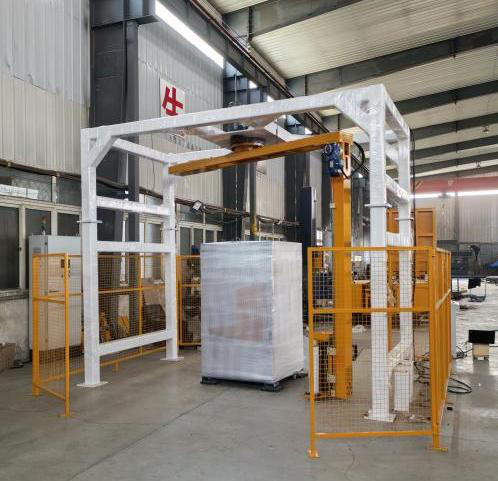
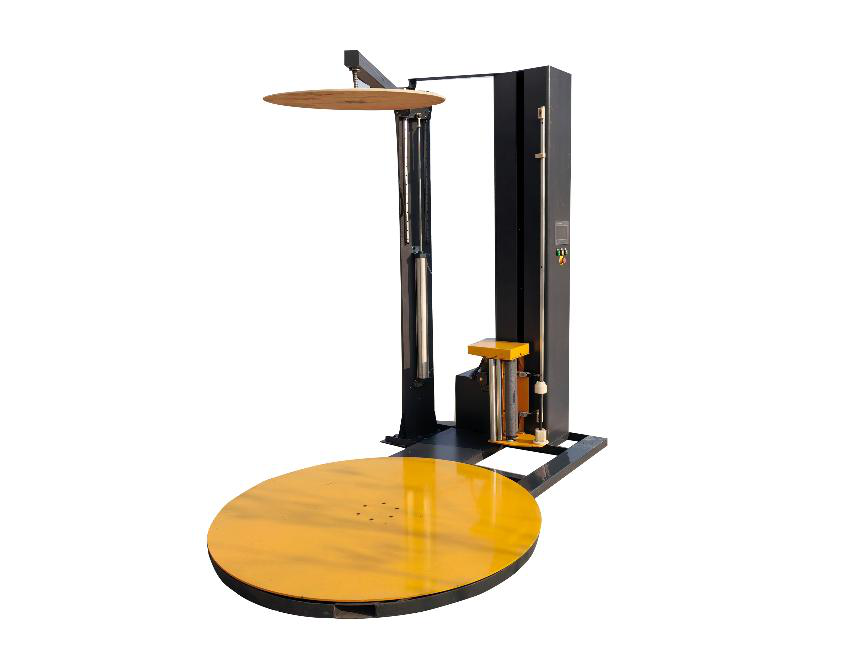
Not every load suits a turntable. Lightweight, unstable or very tall products can topple when rotated, which forces operators to slow the table or apply extra film to compensate. For these loads a rotary arm wrapper keeps the load stationary while the arm orbits it, often at lower overall film use because the application is more controlled. Very heavy, stable loads on the other hand suit a high-turntable machine, and loads with fragile tops benefit from a top platen that holds the product during wrapping so fewer revolutions are needed for stability.
Tension, corners and punctures
Film tension is the second lever after prestretch. Higher tension improves containment but concentrates force at the four corners of a rectangular load, where the film travels fastest and thins most. If tension is set aggressively on a load with sharp edges, the film tears or punctures, operators reduce the prestretch to compensate, and film use rises. Corner boards, a slightly wider film, or an electronic tension-control system that eases force through the corners all allow you to maintain high prestretch without failures. Electronic tension control is especially valuable on mixed fleets where load profiles change during the day.
Maintenance: the silent film waster
A wrapper’s efficiency drifts as components wear. Slipping clutch rollers fail to reach the set prestretch, worn guide rollers introduce drag, and a tired brake lets film run on after the cycle. The result is a machine that still wraps pallets but quietly uses more film. A short preventive routine — cleaning the carriage, checking roller gearing and clutches, verifying prestretch with a marked length of film, and replacing worn pads — keeps consumption at the original specification. Measuring film-per-pallet once a month is the quickest way to detect this drift before it shows in the annual bill.
Comparing wrapper types on operating cost
| Machine type | Best load | Typical prestretch | Operating-cost note |
|---|---|---|---|
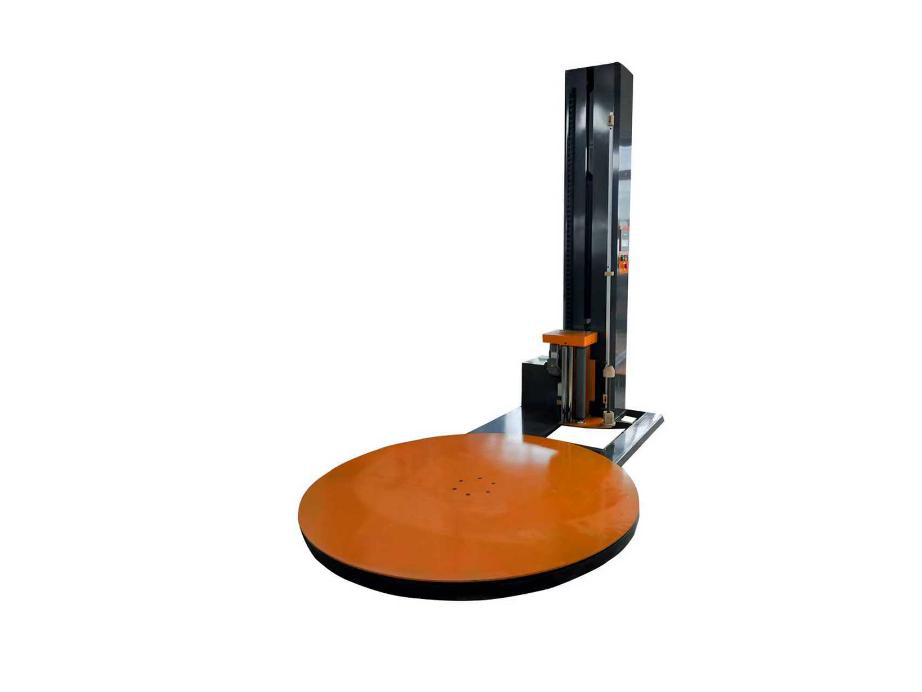
| Turntable wrapper | Stable, medium/heavy loads | 200–300% | Lowest capital; film efficiency depends on carriage quality |
| Rotary arm wrapper | Light, unstable, tall loads | 200–300% | Stationary load reduces compensation film |
| Top-platen turntable | Fragile/light stacked loads | 200–250% | Platen removes need for extra stabilising wraps |
| Inline high-speed wrapper | High-volume uniform lines | 250–300% | Consistent settings at throughput; best cost per load |
How to run a film audit on your floor
A practical audit takes a single day and produces a defensible number. First, record the film specification and delivered price per kg. Second, weigh or count rolls consumed across a known number of pallets for each major product. Third, calculate kg per pallet and cost per pallet. Fourth, inspect the machine settings — prestretch, overlap, top/bottom revolutions — and compare them to the film’s rated range. Finally, tune one program, re-measure, and document the saving. Most operations find a double-digit percentage reduction available from settings and maintenance alone, before any capital is spent.
Frequently asked questions
How much stretch film does one pallet typically need?
It varies widely with load height and stability, but a well-set machine commonly applies somewhere in the range of 0.5–1.0 kg of film per standard pallet. Measuring your own rolls is more accurate than any rule of thumb.
Does higher prestretch always save money?
Up to the film’s rated limit, yes. Beyond it you get neck-down, tears and weak corners, which increase waste. Match the carriage to a film grade rated for that stretch.
Is a powered prestretch carriage worth the extra cost?
Almost always for any machine running more than a handful of pallets per day. The film savings typically recover the premium quickly and continue for the life of the machine.
Why has my film consumption risen over time?
The usual causes are worn clutch rollers slipping below set prestretch, programs adjusted for a one-off product and never reset, or a change to a thinner/cheaper film that does not stretch as specified.
Cast versus blown film: cost and performance
Machine stretch film is produced in two main ways. Cast film is cooled on rollers, giving a clear, quiet film that unwinds smoothly and releases evenly from a powered carriage — the usual choice for high-prestretch machine wrapping. Blown film is cooled in air and tends to be tougher and more puncture-resistant, with greater holding force, but it is hazier, noisier and often priced slightly higher. For loads with sharp edges or outdoor storage, blown film’s resistance can justify the premium; for general palletising in a warehouse, cast film usually offers the best balance of stretch percentage, clarity and price. The cheapest film is rarely the least expensive to use, because a film that neck-downs or tears at your target prestretch forces you to lower the setting and apply more kilograms per pallet.
When comparing quotes, compare the delivered price per kilogram alongside the guaranteed prestretch the film will achieve on your carriage. A slightly dearer film that reliably reaches 250% can cost less per wrapped pallet than a cheap film limited to 150%.
Top sheets, hoods and when stretch wrap is the wrong tool
Stretch film holds a load together but it is not waterproof across the top. For products stored outdoors or exposed to rain, a top sheet laid over the pallet before the final wraps sheds water, and many wrappers can apply it automatically. Very heavy, dense loads such as filled drums, or products that must be fully weatherproofed, may be better suited to a stretch hood that covers the entire pallet in one tubular film. Specifying the correct protection up front avoids the far larger cost of water-damaged goods in transit. If your supply chain includes open yards or port handling, raise this during the machine enquiry so the wrapper or hooding equipment is configured correctly rather than added manually later.
Recommended equipment
- For stable, everyday loads: our standard turntable pallet wrapper with powered prestretch;
- For light or unstable products: the inline rotary arm wrapper;
- For fragile or tall loads: a turntable wrapper with top platen.
SunAura Packaging Machines can size a wrapper against your actual pallet dimensions, throughput and film grade, and help you build the cost-per-pallet calculation into your purchase decision. Contact our application team with your load details, or learn more about how we build equipment on the about page.

Kevin works on machine development for shrink bundling, shrink hoods and vacuum packaging. He tests film shrink ratios, tunnel heat zones, seal bar performance and chamber cycle times, and feeds that back into machine frame and conveyor design. He writes technical articles on shrink film selection, tunnel temperature balancing and vacuum packaging for industrial and food-adjacent secondary packs.
See Full Bio ›