
Introduction
A pallet wrapping machine is the last line of defense between your product and the truck. Wrap it poorly and you get shifting loads, crushed corners, and damaged goods on arrival. Wrap it right and you get stable, shrink-wrapped pallets that survive cross-country shipping and warehouse handling.
With 18+ years of end-of-line engineering and customers in 100+ countries, SunAura Packaging Machines builds turntable, rotary-arm and orbital-ring stretch wrappers for every pallet load type — from light cartons to heavy steel coils. This guide walks you through the selection criteria, so you can pick the right wrapper for your load, not just the cheapest machine on the list.
What Is a Pallet Wrapping Machine?
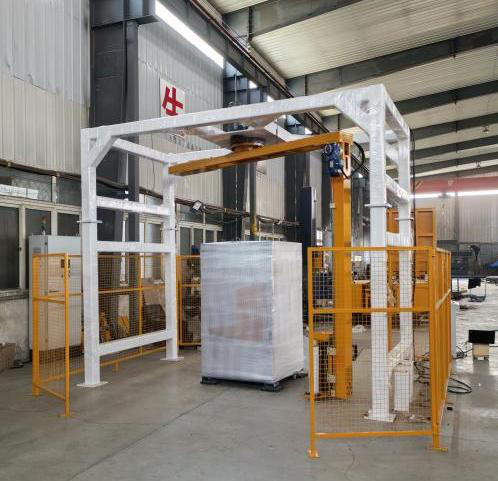
A pallet stretch wrapper applies stretch film around a loaded pallet to stabilize the load, protect it from dust and moisture, and prevent shifting during transport. The film is stretched as it’s applied — typically 200–300% pre-stretch — so it tightens around the load and holds it together.
Three primary configurations dominate the market: turntable wrappers (load rotates on a rotating table), rotary-arm wrappers (film arm orbits a stationary load), and orbital ring wrappers (film ring rotates around the load horizontally, ideal for long or unstable products).
Types of Pallet Wrapping Machines
| Type | Speed | Best For | SunAura Packaging Machines Series |
|---|---|---|---|
| Semi-automatic turntable | 15–25 pallets/hour | Low volume, variable loads, budget-critical | B26 / B30 |
| Fully automatic turntable | 25–40 pallets/hour | High-volume, integrated end-of-line | B30A / B40A |
| Rotary arm wrapper | 20–30 pallets/hour | Unstable or very heavy loads (can’t rotate) | RA Series |
| Orbital ring wrapper | 15–25 loads/hour | Long products, coils, bundles, unstable loads | OR Series |
SunAura Packaging Machines tip: If your load is unstable (loose bags, tall loads, lightweight products that would slide on a rotating table), choose a rotary arm wrapper — the load stays stationary while the film orbits. If you wrap very long products (lumber, pipes, profiles), choose an orbital ring wrapper.
How to Choose — Decision Checklist
Five inputs determine the right wrapper for your operation.
1. Load Weight & Stability
Heavy loads (1,500+ kg) need a heavy-duty turntable or rotary arm. Unstable loads (loose bags, tall, lightweight) can’t rotate — use a rotary arm. Very long loads (over 2 m) need an orbital ring.
2. Throughput Target
How many pallets per hour? Semi-automatic handles 15–25 pallets/hour with operator involvement. Fully automatic integrated wrappers do 25–40 pallets/hour hands-free.
3. Pre-Stretch Ratio
Pre-stretch stretches the film before it reaches the load — 200–300% pre-stretch means you use 1/3 to 1/2 the film, saving money on consumables. A non-pre-stretch machine saves money upfront but costs more per pallet in film.
4. Film Width & Gauge
Standard film is 500 mm wide, 20–25 micron gauge. Heavier loads need thicker film. Confirm the wrapper’s film carriage handles your chosen film size — some machines only accept specific widths.
5. Integration Level
Is this a standalone machine where an operator drives a pallet on? Or will it integrate with a conveyor, palletizer and case erector into a fully automatic line? Automatic integration needs conveyor interfaces and PLC handshake.
6. Environment
Cold storage, outdoors, or washdown areas need stainless steel and sealed electricals. Standard wrappers are painted mild steel for dry warehouse use.
Turntable vs Rotary Arm vs Orbital Ring
| Turntable | Rotary Arm | Orbital Ring | |
|---|---|---|---|
| How it works | Load rotates on table | Arm orbits stationary load | Ring rotates film around load horizontally |
| Max load weight | 2,000 kg | 2,000 kg | 1,500 kg |
| Unstable loads? | No — load slides | Yes — load stays still | Yes — load stays still |
| Long products? | No — standard pallets only | No — standard pallets only | Yes — lumber, pipes, profiles |
| Speed | 25–40 pallets/hr | 20–30 pallets/hr | 15–25 loads/hr |
| Relative cost | Lowest | Medium | Highest (specialized) |
Cost & Quote Factors
What drives the price of a pallet wrapping machine:
- Machine type — turntable (cheapest), rotary arm, orbital ring (most expensive)
- Automation level — semi-automatic (operator-driven) vs fully automatic (conveyor-integrated)
- Pre-stretch carriage — no pre-stretch (cheap, wasteful) vs powered pre-stretch (200–300%, saves film)
- Load capacity — heavier loads need heavier frames and bearings
- Options — top sheet dispenser, film break sensing, scale integration, labeling
- Construction — painted steel (standard) vs stainless (washdown/cold storage)
| Spec | Typical Range | SunAura Packaging Machines Note |
|---|---|---|
| Speed | 15–40 pallets/hour | B30A fully automatic handles up to 35 pallets/hr |
| Load capacity | Up to 2,000 kg | Heavy-duty turntable with robotic rotation |
| Pre-stretch | 200–300% | Powered pre-stretch carriage standard on all SunAura Packaging Machines wrappers |
| Film width | 500 mm standard | Adjustable for 450–500 mm film rolls |
| Power | 220V / 380V, 50/60Hz | Configured to your supply |
Film Cost & ROI
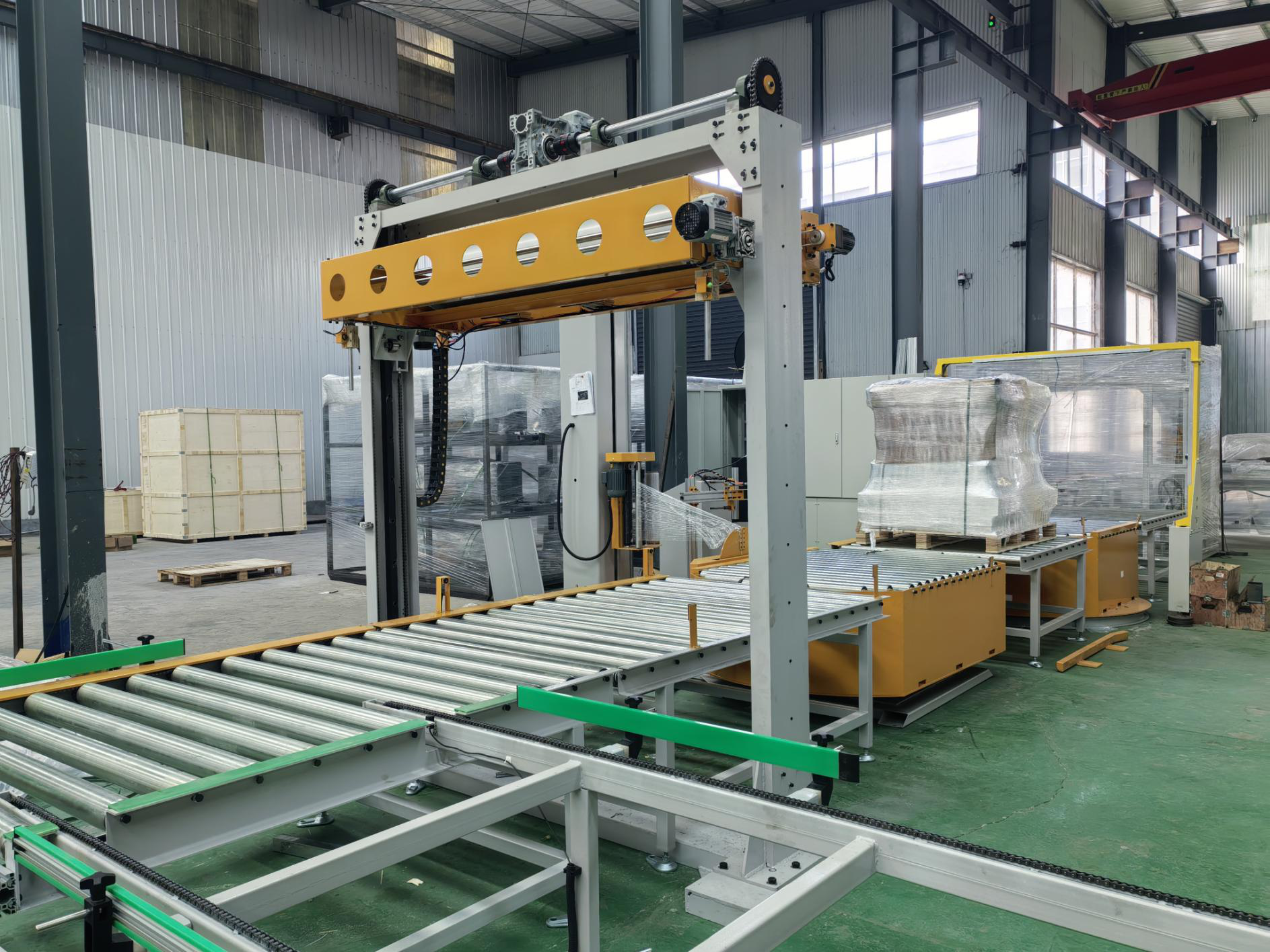
The wrapper you choose affects consumable cost for years. A wrapper without powered pre-stretch uses 2–3× more film than a 250% pre-stretch machine. Over 100 pallets/day, that’s the difference between $3 and $9 of film per pallet — $100,000+ per year. The pre-stretch carriage pays for itself in 3–6 months.
SunAura Packaging Machines tip: Always calculate total cost of ownership (machine + 5 years of film + labor) when comparing wrappers. A $5,000 cheaper machine without pre-stretch will cost you $30,000+ extra in film over 5 years.
SunAura Packaging Machines Stretch Wrapper Range
SunAura Packaging Machines builds turntable, rotary-arm and orbital-ring wrappers in our 48,000 m² Qingdao factory — all with powered pre-stretch as standard.
What every SunAura Packaging Machines wrapper includes:
- Powered pre-stretch carriage (200–300%) — saves 60% on film cost
- HMI with wrap recipe storage (number of bottom/top wraps, ramp up/down)
- Film break sensing and automatic stop
- SS304 contact parts (where specified)
- 72-hour pre-shipment test with your actual load
- Bilingual manual + step-by-step video guides
Standard lead time: 15–25 working days. Warranty: 12 months from commissioning.
Explore the range: Pallet Wrapping Machine Catalog
Industry Case Study
A Turkish steel service center commissioned SunAura Packaging Machines to supply a heavy-duty orbital ring wrapper and strapping cell for steel coils. The challenge: 2-ton coils that can’t rotate, plus corrosion protection for export. SunAura Packaging Machines delivered an orbital ring wrapper with VCI film capability, integrated with automatic strapping — running 30+ coils per day with zero load damage in transit.
Frequently Asked Questions
What is a pallet wrapping machine and why do I need one?
A pallet stretch wrapper applies stretch film around a loaded pallet to stabilize the load, protect it from dust and moisture, and prevent shifting during transport. Without proper wrapping, loads can shift in transit, causing product damage, forklift accidents and wasted freight. A wrapper pays for itself by eliminating damaged goods and reducing labor.
Turntable vs rotary arm wrapper — which do I need?
Choose a turntable wrapper for stable, uniform loads (cartons, bags in uniform stacks) on standard pallets — it’s the lowest-cost option. Choose a rotary arm wrapper for unstable, tall or very heavy loads that can’t safely rotate (loose bags, lightweight products, 2-ton loads). The load stays stationary while the film arm orbits it.
How much does a pallet wrapping machine cost?
Semi-automatic turntable wrappers start at $5,000–$10,000. Fully automatic conveyor-integrated turntable wrappers range from $15,000 to $30,000. Rotary arm wrappers start at $25,000–$40,000. Orbital ring wrappers for specialized loads (coils, long products) range $40,000–$80,000. As a direct Qingdao factory, SunAura Packaging Machines typically prices 30–40% below Tier 1 European OEMs.
What is pre-stretch and why does it matter?
Pre-stretch stretches the film mechanically before it reaches the load — typically 200–300% — so you use 1/3 to 1/2 the film per pallet. A wrapper without pre-stretch saves money upfront but costs 2–3× more in film consumables. Over 100 pallets/day, powered pre-stretch pays for itself in 3–6 months. All SunAura Packaging Machines wrappers include powered pre-stretch as standard.
How many pallets per hour can a wrapper handle?
Semi-automatic turntable wrappers handle 15–25 pallets/hour with operator loading. Fully automatic conveyor-integrated wrappers handle 25–40 pallets/hour hands-free. Rotary arm wrappers do 20–30 pallets/hour. The exact speed depends on load height, number of film revolutions, and pre-stretch carriage speed.
Conclusion & CTA
Choosing a pallet wrapping machine comes down to load stability, throughput and total cost of ownership — including film consumables, not just machine price. SunAura Packaging Machines offers CE-certified stretch wrappers with powered pre-stretch as standard, at factory-direct pricing.
Request a quote with your pallet dimensions, load weight and daily volume — our sales-engineer team replies within 24 working hours via the product inquiry page.
Related & Internal Links

Kevin works on machine development for shrink bundling, shrink hoods and vacuum packaging. He tests film shrink ratios, tunnel heat zones, seal bar performance and chamber cycle times, and feeds that back into machine frame and conveyor design. He writes technical articles on shrink film selection, tunnel temperature balancing and vacuum packaging for industrial and food-adjacent secondary packs.
See Full Bio ›