

SunAura Packaging Machines has commissioned a heavy coil wrapping and strapping cell for a steel service centre in north-western Turkey, equipping the site to export wrapped steel coils with corrosion protection and secure retention through a single integrated station. The installation, handed over after on-site assembly, trials with the customer’s heaviest coils and operator training, combines a heavy vertical ring wrapper, horizontal coil handling and inline strapping, and replaces a process in which coils were wrapped partly by hand with cranes moving each load through several disconnected steps.
The customer processes and distributes hot- and cold-rolled steel coils, slit strip and wire rod for domestic manufacturers and for export across the Mediterranean and Black Sea regions. Its existing packing operation was labour-intensive and inconsistent: the quality of the wrap depended on the crew and shift, the eye and faces of standing coils were not reliably enclosed, and the time taken to wrap each coil limited throughput as export orders grew. The brief asked for a cell that could accept the full coil range, enclose coils for sea export with an anti-rust layer, strap them for lifting and handling, and work with the site’s existing crane and transfer arrangements.
The scope of the cell
The installed line is built around the way the service centre handles its coils, which arrive and are processed in a mix of orientations before being packed for dispatch. Coils are brought into the cell by transfer car and crane, presented to the wrapping station, enclosed with the specified layers, strapped and then moved to the dispatch area. The cell is organised so that a coil progresses through wrapping and strapping without repeated crane lifts between separate machines, which had been the main source of delay in the old operation.
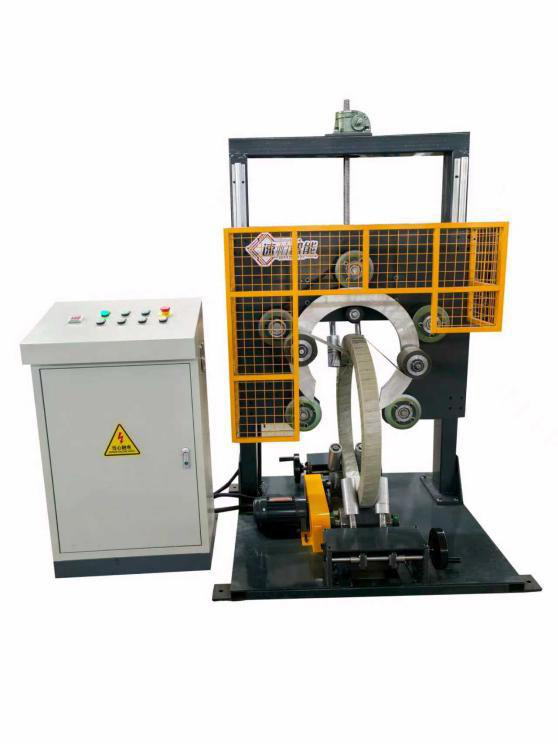
Enclosing standing coils through the eye
The heart of the installation is a heavy vertical ring wrapper of the heavy vertical ring wrapper class, specified to accept the customer’s largest standing coils. The ring carries the wrapping material through the central eye and around the outside of each coil, enclosing the inner circumference, the outer body and both faces rather than banding only around the exterior. This was the capability the manual process could not reliably provide. For export coils the machine applies an inner corrosion-inhibiting layer and an outer woven or film enclosure, with the overlap and number of layers set to the customer’s export standard so that coils cross the sea without rusting.
Specifying the ring machine meant working carefully through the coil geometry. The ring and its carriage have to pass through the smallest eye in the customer’s range, while the ring diameter and frame must accept the largest outer coil and carry its weight. SunAura Packaging Machines’ engineers confirmed the full diameter, eye and width range during the design phase and ran the acceptance programme across representative coils rather than a single convenient size, because a ring that wraps the average coil but not the extremes would leave part of the range back on the manual process.
Horizontal handling and the full coil range
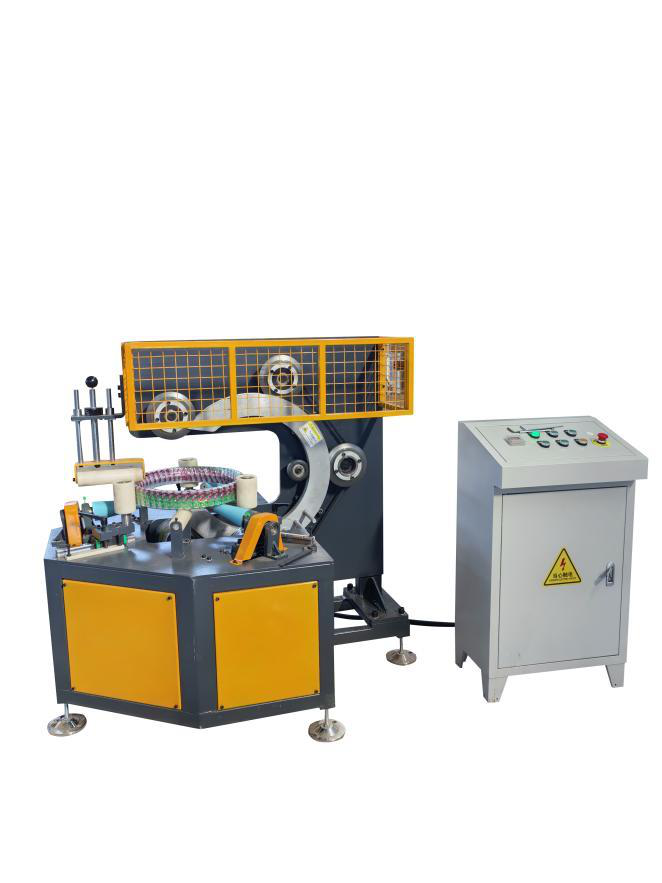
Not all of the customer’s coils are packed standing. Wire rod bundles and coils handled on their eye move through a horizontal wrapping station of the heavy horizontal coil wrapper type, which turns the load on powered rollers while a traversing head applies the outer wrap across the width and faces. Including both ring and horizontal stations in one cell lets the service centre pack the full range in the orientation each product already uses, rather than upending every coil to suit a single machine. The cell layout positions the two stations around a shared transfer arrangement so that a coil is routed to the correct wrapper with minimal additional handling.
For cylindrical rolls and slit coils that are better handled radially, the cell also accommodates a radial wrapping configuration of the radial roll wrapper class. This three-way coverage, ring for standing coils, horizontal for coils on their eye, and radial for rolls, is what makes the installation a complete coil-packing cell rather than a single wrapper with the rest left manual. The architecture and the loads each family suits are set out in the technical guide to coil and roll wrapping machines, which the project used as the basis for the layout.
Strapping for lifting and handling
Wrapped coils are strapped before they leave the cell, both to hold the enclosure in place and to provide the secure bands used when coils are lifted by crane and handled at the destination. The strapping station is specified for the heavy, high-strength bands that steel coils require and integrated with the wrapping sequence so that a coil is wrapped and strapped in one pass through the cell. Where loads need the positive retention of a band in addition to the all-round enclosure of the wrap, combining the two processes is standard practice for heavy metal export, and it avoids the wrapped pack loosening if the outer film is damaged in handling.
Engineering for heavy, continuous duty
A steel service centre is a demanding environment. Coils weigh many tonnes, the equipment runs around production schedules, and any fault in the packing cell holds up dispatch of finished goods. The machines were built with heavy rollers and ring structures, drives sized to start and move full-weight coils smoothly, and tension and overlap control matched to the woven and film materials used. The wrapping heads handle the anti-rust and outer layers in sequence, and the cell is laid out for crane and transfer-car access with clearance for the largest loads. Because the customer exports through a port with defined moisture and damage expectations, the pack quality is part of the commercial relationship, and the cell produces it consistently rather than relying on operator technique.
Acceptance, installation and training
Before shipment, the wrapping and strapping equipment completed a factory-acceptance programme at SunAura Packaging Machines’ Qingdao works, with the cycle, layer sequence and overlap verified against the export standard. On site, the work covered mechanical installation and levelling, integration with the customer’s transfer cars and crane handling, and trials with the heaviest coils under real production conditions. SunAura Packaging Machines’ commissioning engineers then trained the operators and maintenance staff on coil routing, format changes, the wrapping and strapping sequence, routine servicing and fault recovery, and left documentation covering spares and the maintenance schedule. The cell was handed over once it had wrapped and strapped the full coil range at the required rate over consecutive shifts.
The corrosion question in export packing
For steel crossing an ocean, the wrapping is not cosmetic; it is the only thing standing between a bright coil and a rust claim. The inside of a shipping container is a harsh environment, with wide temperature swings and condensation forming as the load moves between climates. A single layer of ordinary film is rarely enough. The pack specified on this project builds up in stages: the cleaned coil is first enclosed with a corrosion-inhibiting layer, typically VCI film or anti-rust paper that releases protective vapour within the sealed pack, then an outer enclosure of woven fabric or heavy film protects against mechanical damage and moisture, with the eye and both faces closed rather than left open. Edge protectors shield the inner and outer edges where lifting and strapping concentrate force.
The machine’s role is to apply those layers with a consistent overlap and number of turns that a manual crew cannot match shift after shift. Under-wrapping leaves a path for moisture; over-wrapping wastes material and time. The ring wrapper sets the overlap and layer count to the export standard and repeats it on every coil, and the strapping station then holds the enclosure in place for lifting. The customer can hand the same pack to any shipping line and auditor with confidence that it was produced to one specification, which is the practical value of automating the corrosion pack rather than treating it as a wrapping chore.
Throughput and the practical cycle
As with any heavy cell, the number that matters is not the wrapping head’s peak speed but the time a coil spends in the cell from arrival to dispatch, including crane placement, the layer sequence, strapping and removal. The old manual operation’s bottleneck was not the application of film alone but the repeated crane calls and the crew working around a standing coil, which made the cycle long and unpredictable. The integrated cell removes most of those intermediate lifts: a coil is routed to the correct wrapper by the shared transfer arrangement, wrapped and strapped in sequence, and moved out, with the cranes used for placement and removal rather than for shuffling between stations.
During acceptance the cycle was measured on representative coils across the range, not only the smallest and easiest, because the heavy end of the range sets the real throughput the customer can plan against. In operation the cell comfortably covers current export volumes with headroom, and it converts what had been a variable interruption into a predictable takt that the dispatch schedule can be built around. Reducing the time coils wait in the packing area also frees floor space and cranes, which in a service centre running a mix of domestic and export work is a benefit almost as valuable as the wrapping itself.
What the customer gains
The installation turns an inconsistent, crane-bound manual operation into a repeatable export packing cell that encloses the eye and faces the manual process left exposed and that keeps pace with growing order volumes. For a steel exporter, that consistency protects against the two costs that matter most: corrosion claims when a coil arrives rusted, and handling damage when a pack is not securely strapped. It also removes a physically demanding task from the workforce and shortens the time each coil spends in the packing area, freeing the cranes and crew for production rather than wrapping.
There is also a safety dimension. Hand-wrapping a standing steel coil means crew working close beneath and around a load that weighs several tonnes, reaching through the eye and moving around crane movements. Enclosing the coil by machine keeps people clear of the suspended load and removes a task that is both physically demanding and exposed to sharp strip edges, which reduces the ergonomic and injury exposure that plant managers have to account for. With the ring and roller machines doing the application, the operator’s role is to present the coil, select the program and confirm the cycle, rather than to handle the wrap itself.
The project is typical of the heavy, product-specific work that sits between SunAura Packaging Machines’ standard coil machines and fully bespoke lines. Customers in steel, metals, paper and converting can review the equipment in the packaging machinery catalogue, and for layouts that combine ring, horizontal and radial stations with transfer cars and strapping, the company builds custom coil-handling cells through its custom packaging machine service.
About SunAura Packaging Machines
SunAura Packaging Machines, based in Qingdao, Shandong, manufactures end-of-line and load-protection packaging equipment for industrial and consumer markets, including coil and roll wrappers, orbital machines, pallet wrappers, strapping equipment, case erection and sealing, cartoners, case packers and palletising robots, together with integrated turn-key lines. The company supports export customers from specification and factory acceptance through installation, training and after-sales service. Steel service centres, rolling mills and metal exporters planning a coil wrapping and strapping cell are invited to contact the applications team with their coil dimensions, eye sizes, throughput and export standard.
By the SunAura Packaging Machines project and communications team. For details of this installation or to discuss a similar heavy coil wrapping and strapping cell, contact the applications engineering team in Qingdao.

Sarah evaluates packaging consumables against machine capability: film gauge and prestretch, PP versus PET and steel strapping, core width, tension settings and corner board use. Her articles connect film and band choice to machine settings, freight damage rates and total cost per pallet, rather than recommending the cheapest consumable on paper.
See Full Bio ›