

On almost every end-of-line, there is a point where tape alone is no longer enough. A sealed carton still has to be held tight, a pallet of boxes has to be bound into one load, and a bundle of timber, pipe or profiles needs a band that will not let go after a week on a truck. That is the job of a strapping machine (also called a banding machine). Yet strapping is one of the most frequently under-specified steps in a packaging line: buyers search for “automatic strapping machine”, “PP vs PET strapping” or “pallet strapping machine for sale” and end up choosing on price alone, only to find the arch too small, the seal failing in cold weather, or the cycle speed unable to keep up with the case sealer upstream.
This guide explains how to choose a strapping machine the way a packaging engineer would — band material first, then machine architecture, arch size, sealing method and throughput — so the unit you buy still performs in year five. SunAura Packaging Machines builds semi-automatic, fully automatic, unmanned inline and pallet strapping equipment, and the recommendations below link to the specific machines.
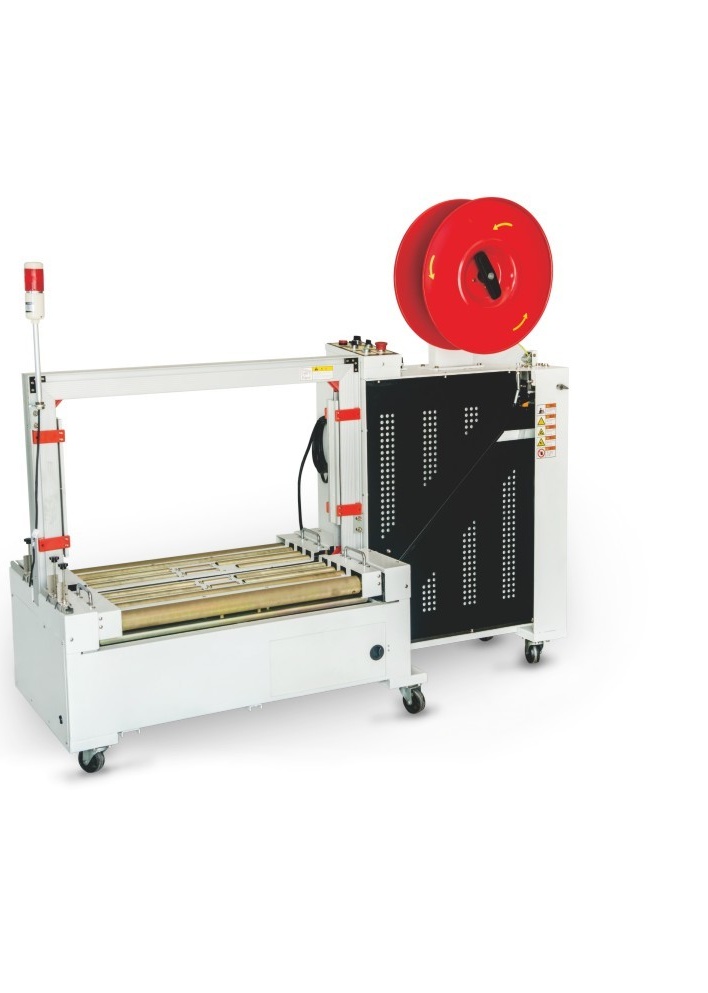
What strapping actually does in your line
Strapping places a tensioned band — polypropylene (PP), polyester (PET), steel or, less commonly, paper or woven cord — around a load, tensions it to a controlled force and joins the overlapping ends. The difference between strapping and stretch wrapping matters: stretch film wraps a load in elastic film and is good at containing loose, irregular products, while strapping creates a high-tension, positive hold that keeps rigid loads rigid. Many robust end-of-lines use both: film to contain and protect, straps to lock the load to the pallet. If you are still deciding between the two, our comparison of machine wrapping versus manual handling covers the load-stability trade-offs.
Strapping is used for three distinct jobs, and the machine for each is different:
- Unitizing cartons and bundles — joining one or several boxes, parcels or products into a single handleable unit, usually with a side- or bottom-seal machine.
- Bundling long or rigid products — timber, profiles, pipe, panels and bundles of printed matter, often strapped horizontally.
- Securing full pallets — vertical straps over the top of a load, horizontal bands around the stack, or both, using dedicated pallet strapping equipment.
Step 1: Choose the band material before the machine
The single most common strapping mistake is buying a machine built for light PP and then running heavy PET through it, or specifying PET when cheap PP would have done the job for a fraction of the cost. The material determines tension capacity, coil dimensions, sealing temperature and ultimately which machines can run it.
| Property | PP (polypropylene) | PET (polyester) |
|---|---|---|
| Best for | Light cartons, bundles, retail packs, temporary unitizing | Heavy pallets, bricks, timber, metal, load-bearing unitizing |
| Tension & retained strength | Lower; loses tension over time (relaxation) | High; retains tension, behaves closest to steel |
| Elongation / recovery | Stretches easily, limited recovery | Controlled elongation with good recovery |
| Cost | Lowest consumable cost | Higher, but replaces steel band in many loads |
| Typical widths | 5–15 mm on standard machines | 9–19 mm and above on heavy-duty machines |
A practical rule: if the strap is for appearance or light unitizing on cartons that are already contained, PP is the sensible, low-cost choice. If the strap is the primary thing holding a heavy load together for sea freight, PET is almost always correct. Tell your supplier the band width, thickness and material at the RFQ stage — the machine’s track, tensioning motor and sealing head are all sized around it. For a complete list of what to send a manufacturer, see our RFQ checklist for packaging machinery.
Step 2: Match the machine architecture to the job
Strapping machines range from a handheld tool to fully integrated inline systems, and price rises steeply with automation. The right level depends on cycles per day and whether an operator can be dedicated to the task.
Manual and semi-automatic machines
For low volumes — a few dozen straps a day — a manual tensioner/sealer or a tabletop semi-automatic arch machine is adequate. On a semi-automatic unit the operator places the product, the machine feeds and tensions the band around the arch, heat-seals the joint and dispenses the next length. The KZ-101 semi-automatic strapping machine is typical: compact, mobile, low capital cost, ideal for a packing bench or small warehouse. It is a poor choice only when throughput exceeds what one operator can feed.
Fully automatic and unmanned inline machines
A fully automatic machine adds powered coil feeding, automatic tensioning and a faster cycle, but still has an operator positioning the product. An unmanned machine goes further: products travel through the arch on a conveyor, are detected, strapped and released without anyone touching them, so it can be wired directly after a case sealer. The fully automatic strapping machine suits high-volume bundling, while the automatic unmanned strapping machine is built for continuous inline duty with a conveyor interface and a signal handshake to adjacent equipment.
Pallet strapping: vertical, horizontal, through-eye and rotary
Full pallets need a different class of machine, and the choice depends on whether straps run over the top or around the sides:
- Horizontal / side-seal pallet strapping applies bands around the body of the load at set heights — good for stable, stackable goods. The horizontal pallet strapping machine HE80A is built for this duty.
- Through-eye (vertical) strapping drives the band vertically through the voids of a pallet and over the top, locking the load down to the pallet — essential when goods could lift or slide. See the through-eye pallet strapping machine.
- Rotary positioning strapping turns or indexes the pallet so bands can be placed on multiple sides automatically, as on the rotary pallet strapping machine FR1800.
These are often combined with a turntable or rotary-arm wrapper. If your loads also need film, a combined pallet wrapping and strapping machine AO77B-FG2000B performs both operations on one frame, which saves floor space and avoids transferring a load between two units.
Step 3: Get the arch size and strap track right
The arch (the rectangular frame the band travels through) must clear the largest product with margin, not exactly match it. A carton that brushes the arch will jam the line and wear the track prematurely. As a rule, size the arch opening roughly 80–100 mm wider and 50–80 mm taller than the maximum pack, and confirm the minimum product the machine can reliably strap — very small items may not trip the sensor or reach the tensioner.
Also confirm the track is matched to the strap width: a track built for 12 mm band will not run 6 mm band reliably, and forcing a wider strap through a narrow track damages the guides. If you run several widths, specify a machine with changeable tracks or keep dedicated units per width.
Step 4: Understand the sealing method
Most automatic machines use a heat (fusion) seal, where a heated blade melts the overlapping band ends, which are then pressed together and cooled. Heat seals are clean and need no consumable clips, but their strength depends on correct temperature, sufficient cooling time before the strap is loaded, and the ambient conditions. In very cold or draughty loading bays a seal that is released before it has set will peel apart — a common winter complaint that is fixed by adjusting the cooling dwell, not by replacing the machine.
Heavy-duty PET tools more often use friction-weld sealing, which vibrates the ends together and creates a strong joint less sensitive to temperature. Manual steel band uses mechanical seals or notch joints. Ask which method your machine uses and what the rated joint efficiency is (a good heat seal reaches roughly 70–80% of the band’s own strength).
Step 5: Size for real throughput
Catalog cycles (“2 straps per second”) describe an empty machine, not your line. Real throughput is set by how fast product reaches the arch, how many straps each load needs, and the sealing/cooling time. Rather than taking the rated figure, calculate the required cycles per minute from your actual case rate and straps per load — our method for calculating real equipment throughput walks through this. A strapping machine that is marginally faster than the upstream case sealer is the correct target; specifying far more speed simply wastes capital.
Combined machines and integration
Where floor space is tight or labor is expensive, combining operations is often the best value. Beyond wrap-and-strap pallet systems, carton sealing and strapping can be done on one frame: the case sealing and strapping machine FP500AJ-301A seals the carton and applies the band in a single pass. For e-commerce packs, the e-commerce sealing and strapping machine FG40OLDS-FG400C handles the smaller, varied boxes typical of fulfilment. When integrating, confirm the conveyor heights and the signal handshake between units so a backed-up downstream machine does not feed product into a full arch.
Common strapping mistakes to avoid
- Running the wrong material. Heavy PET through a PP machine destroys the tensioner and seal head; light PP on a heavy load simply fails in transit.
- Arch too small. A tight fit causes jams and wear; always leave clearance for the largest pack.
- Ignoring the cooling dwell. Seals released too soon peel apart, especially in cold bays.
- Believing catalog speed. Real throughput is governed by upstream rate and straps per load, not the empty-machine cycle.
- Skipping maintenance. Dirty tracks, worn heater blades and tired tensioner springs cause most strapping faults; follow the preventive maintenance schedule and keep the recommended spare parts (heater blade, tensioner, feed wheels) on the shelf.
- Buying on price without checking joint strength. A cheap machine with weak seals costs more in re-strapped, damaged loads than the capital saved.
Recommended SunAura Packaging Machines strapping equipment
Based on the typical duties above, these are the machines buyers most often land on:
- Low volume, packing bench: KZ-101 semi-automatic strapping machine
- High-volume bundling with an operator: fully automatic strapping machine
- Unmanned inline duty after a case sealer: automatic unmanned strapping machine
- Horizontal pallet bands: horizontal pallet strapping machine HE80A
- Vertical load lock-down: through-eye pallet strapping machine
- Multi-side rotary strapping: rotary pallet strapping machine FR1800
- Film plus strap on one frame: wrapping and strapping machine AO77B-FG2000B
Safety, guarding and operator considerations
An automatic strapping machine combines a tensioning mechanism, a heated blade and a moving band, so guarding matters. On inline units the arch and sealing head should be enclosed with interlocked guards where an operator could reach in, and the conveyor should stop if a guard is opened. Tension settings deserve attention too: a machine set to its maximum tension on a light carton can crush the product or cause the band to snap back, while too little tension produces loose loads that shift in transit. Set tension per product rather than leaving the machine at one global value, and train operators to load coils correctly — a mis-threaded band is behind a large share of strapping downtime.
Noise and ergonomics are easy to overlook. A dedicated inline machine removes the repetitive manual action of a handheld tool, which is a genuine benefit where an operator would otherwise strap hundreds of times per shift. If the machine will sit near a packing bench, ask about the duty-cycle rating and whether the unit is designed to run continuously or only intermittently; an entry-level machine run flat-out all day will overheat and wear far sooner than a rated inline model.
Questions to ask before you order
A short set of questions separates a machine that will perform from one that will frustrate:
- What band widths, thicknesses and materials (PP and/or PET) is the machine rated for, and can the track be changed?
- What is the maximum tension in newtons, and what is the sealing method and rated joint efficiency?
- What is the real cycle time including cooling dwell, not just the empty-machine figure?
- What are the arch opening and the minimum and maximum product dimensions?
- How does the machine integrate with a conveyor and adjacent equipment, and what signals does it use?
- Which parts are wear items, what do they cost, and how quickly are spares supplied?
- What warranty and remote support are included, and who handles commissioning and operator training?
How a supplier answers these questions — and whether they ask you about band material and load dimensions — is itself a useful indicator of engineering depth. If a sales contact simply quotes the cheapest unit without asking what you are strapping, that is a warning sign worth heeding.
When you need a non-standard strapping solution
Standard machines cover the majority of loads, but unusual dimensions, very high tension, multiple strap positions, or integration into an existing bespoke line sometimes call for engineering beyond the catalogue. In those cases SunAura Packaging Machines starts from a proven platform and modifies the arch, conveyor and sealing head rather than building from a blank sheet — the approach described on our custom packaging machine page. You can also see real engineered-to-order projects in the customer case studies.
If you are not yet sure which architecture fits your load, the fastest route is to send your product and pallet dimensions, the band material you prefer (or a sample of what you use today), your required straps per load and your case rate. SunAura Packaging Machines’ engineers will recommend a standard machine where one fits and quote a modified unit where it does not — and you can contact the support and sales team here.

James oversees the engineering architecture for full end-of-line projects: defining machine sequence, conveyor layout, line balance, footprint and expansion capacity before individual machines are ordered. He reviews customer specifications, production rates and facility constraints, and signs off on the engineering drawings and acceptance tests. His articles take the system-level view a procurement manager needs.
See Full Bio ›