

Standard units are indoor. Outdoor-rated wrappers have weather guarding and heaters for cold climates.
Do I need a conveyor after the wrapper?
For semi-automatic, the forklift picks up the pallet directly. For fully automatic, an outfeed conveyor to stretch hooding or to the shipping dock is required.
Summary
Semi-automatic for small manned warehouses; fully automatic for high-speed lines; top-platen for unstable loads; low-profile for finished floors; scale-integrated for food/pharma. Always spec powered pre-stretch. Send us your pallet weight, height and throughput and we will spec the right turntable wrapper — and tell you if a cheaper option will do.
Related products: Turntable pallet wrappers · KZ-101 semi-automatic strapping machine.
Standard wrappers handle 800×1200 to 1000×1200 mm pallets, up to 2000 kg. Larger or heavier loads need a custom heavy-duty model.
Can it wrap outdoors?
Standard units are indoor. Outdoor-rated wrappers have weather guarding and heaters for cold climates.
Do I need a conveyor after the wrapper?
For semi-automatic, the forklift picks up the pallet directly. For fully automatic, an outfeed conveyor to stretch hooding or to the shipping dock is required.
Summary
Semi-automatic for small manned warehouses; fully automatic for high-speed lines; top-platen for unstable loads; low-profile for finished floors; scale-integrated for food/pharma. Always spec powered pre-stretch. Send us your pallet weight, height and throughput and we will spec the right turntable wrapper — and tell you if a cheaper option will do.
Related products: Turntable pallet wrappers · KZ-101 semi-automatic strapping machine.
Typically 60–90 seconds per pallet, depending on wrap height and number of revolutions.
What pallet sizes can it handle?
Standard wrappers handle 800×1200 to 1000×1200 mm pallets, up to 2000 kg. Larger or heavier loads need a custom heavy-duty model.
Can it wrap outdoors?
Standard units are indoor. Outdoor-rated wrappers have weather guarding and heaters for cold climates.
Do I need a conveyor after the wrapper?
For semi-automatic, the forklift picks up the pallet directly. For fully automatic, an outfeed conveyor to stretch hooding or to the shipping dock is required.
Summary
Semi-automatic for small manned warehouses; fully automatic for high-speed lines; top-platen for unstable loads; low-profile for finished floors; scale-integrated for food/pharma. Always spec powered pre-stretch. Send us your pallet weight, height and throughput and we will spec the right turntable wrapper — and tell you if a cheaper option will do.
Related products: Turntable pallet wrappers · KZ-101 semi-automatic strapping machine.
Turntable Pallet Wrapper Buying Guide 2026: Semi-Automatic vs Fully Automatic, Top-Platen vs Standard, Price and Payback
A turntable stretch wrapper is the most common machine in any warehouse. It sits at the end of the line, spins the pallet, and wraps stretch film around the load. But when buyers go to spec one, they are faced with a half-dozen variants — semi-automatic, fully automatic, top-platen, scale-integrated, low-profile, and more. This guide compares the variants by throughput, load stability, price and integration, and tells you which one fits your warehouse.
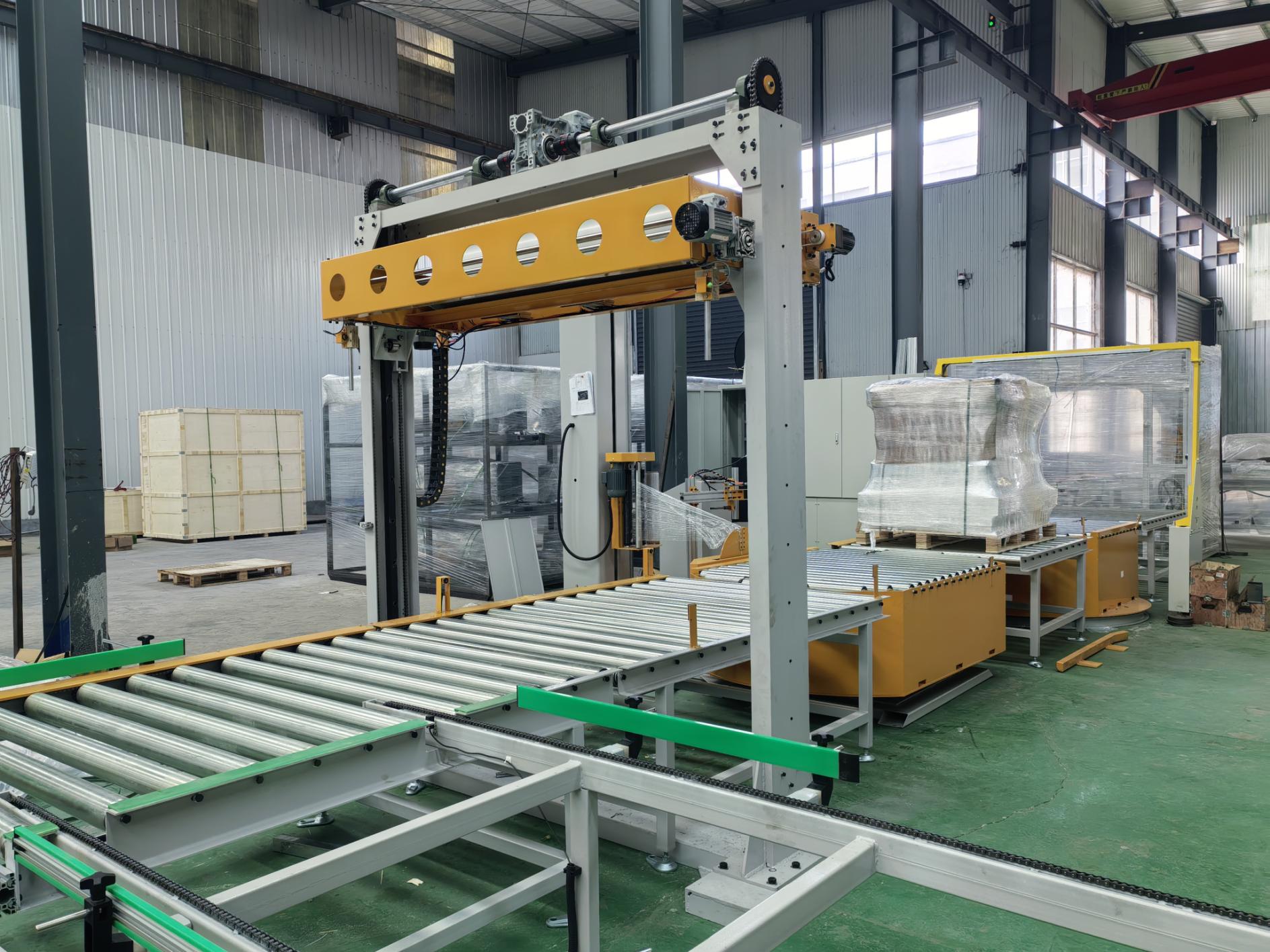
How a turntable wrapper works
The pallet sits on a rotating turntable. A film carriage moves up and down a mast, applying stretch film as the pallet turns. The operator attaches the film to the pallet, presses start, and the machine spirals the film up and down the load, applies a top wrap, and cuts the film. The wrapped pallet comes off ready for a forklift. It is the simplest, cheapest and most maintainable stretch wrapper format.
Semi-automatic vs fully automatic
A semi-automatic turntable wrapper requires an operator: they place the pallet on the turntable, attach the film, press start, and cut the film when done. It handles 15–30 pallets per hour and costs $5k–$15k. A fully automatic wrapper is integrated into a conveyor line: the pallet rolls on, the machine picks up the film automatically, wraps, cuts and discharges. It runs 30–60 pallets per hour and costs $25k–$60k. If you have a manned warehouse with one operator doing 50 pallets a shift, semi-automatic is enough. If you have a high-speed line or a lights-out DC, go automatic.
| Semi-automatic | Fully automatic | |
|---|---|---|
| Throughput | 15–30 pallets/hr | 30–60 pallets/hr |
| Operator needed | Yes | No (conveyor-fed) |
| Price band (USD) | $5k–$15k | $25k–$60k |
| Footprint | Small | Large (with conveyor) |
| Best for | Small DC, one shift | High-speed line, 24/7 |
Standard vs top-platen
A standard turntable wrapper spins the pallet on an open platform. A top-platen wrapper has a powered plate that comes down on top of the load during wrapping, pressing it down. This is essential for light, tall or unstable loads — stacked bags of powder, empty plastic bottles, stacked cans — that would topple during rotation. For a load of rigid boxed goods, top-platen is unnecessary and adds cost. For bagged or unstable loads, it is non-negotiable. Turntable wrappers with top platen are available in both semi and auto versions.
Low-profile vs pit-embedded
A standard turntable is 200–500 mm off the floor, so the forklift drives up a ramp. A low-profile or pit-embedded turntable is flush with the floor, no ramp needed. If your forklift cannot climb a ramp, or your warehouse floor is finished, spec the pit-embedded version. It adds $2k–$5k and requires a concrete pit.
Integrated scale vs standalone
For food and pharma, customers often need to weigh the pallet before shipping. A scale-integrated wrapper weighs the load during wrapping and prints a label. It adds $5k–$10k but eliminates a separate checkweigher station. For general merchandise, it is unnecessary.
Pre-stretch and film savings
A non-stretch wrapper applies film at 10–20% elongation. A powered pre-stretch carriage stretches film 150–300% before it touches the load, cutting film use by 50%. On 50 pallets a day, that pays back the pre-stretch option ($1k–$3k) within a year. Always spec powered pre-stretch.
Film carriage and mast height
The mast height determines the maximum pallet height. Standard masts wrap up to 2000 mm; tall masts go to 2400 mm. If your pallet exceeds the mast height, the top of the load goes unwrapped. Measure the tallest loaded pallet you ship, add 200 mm, and spec the mast to that. The film carriage travels up and down the mast; a double-carriage machine applies two films at once, useful for loads that need a top and bottom wrap. For most users, single carriage is enough.
Wrap programs: ring, full, top-sheet
Modern turntable wrappers store multiple wrap programs. A ring wrap puts a tight band around the middle of the load. A full wrap spirals film from bottom to top. A top-sheet applies a flat film sheet on top for dust and rain protection. For indoor distribution, ring + full wrap is enough. For outdoor shipping, add a top sheet. For hygroscopic products (cement, fertilizer), top sheet is essential.
Safety and guarding
A rotating turntable is a pinch point. OSHA (US) and CE (EU) require a safety fence or light curtain around the turntable. For semi-automatic machines, a two-hand control or a light curtain prevents the operator from reaching in while the turntable spins. For fully automatic machines integrated with conveyors, interlocked gates are required. Specify the guarding at quote time; retrofitting safety guards after installation is more expensive.
Film choice: cast vs blown, gauge
Cast stretch film is clearer, quieter, and easier to apply; it is the standard for general-purpose pallet wrapping. Blown film is stronger and better for heavy or sharp loads. Film gauge ranges from 17 micron (light) to 35 micron (heavy). With powered pre-stretch, you can use thinner gauge film (20–23 micron) because the pre-stretch carriage does the work. Under-specifying the film gauge causes film breaks mid-wrap; over-specifying wastes money. SunAura recommends film gauge based on your load weight and sharpness.
What not to buy
Do not buy a turntable wrapper for loads over 1500 kg — the turntable cannot handle the weight, and the load will not rotate smoothly. Do not buy a standard wrapper for bagged or unstable loads — they will topple. Do not skip the pre-stretch carriage — film waste adds up. And do not forget the ramp or pit.
Payback
A semi-automatic wrapper replaces 1–2 manual wrap stations. On a two-shift plant, it pays back in 12–18 months. A fully automatic wrapper replaces 2–3 operators per shift, paying back in 18–24 months. Add film savings from pre-stretch and it shortens by 3–6 months.
FAQ
How long does it take to wrap one pallet?
Typically 60–90 seconds per pallet, depending on wrap height and number of revolutions.
What pallet sizes can it handle?
Standard wrappers handle 800×1200 to 1000×1200 mm pallets, up to 2000 kg. Larger or heavier loads need a custom heavy-duty model.
Can it wrap outdoors?
Standard units are indoor. Outdoor-rated wrappers have weather guarding and heaters for cold climates.
Do I need a conveyor after the wrapper?
For semi-automatic, the forklift picks up the pallet directly. For fully automatic, an outfeed conveyor to stretch hooding or to the shipping dock is required.
Summary
Semi-automatic for small manned warehouses; fully automatic for high-speed lines; top-platen for unstable loads; low-profile for finished floors; scale-integrated for food/pharma. Always spec powered pre-stretch. Send us your pallet weight, height and throughput and we will spec the right turntable wrapper — and tell you if a cheaper option will do.
Related products: Turntable pallet wrappers · KZ-101 semi-automatic strapping machine.

Kevin works on machine development for shrink bundling, shrink hoods and vacuum packaging. He tests film shrink ratios, tunnel heat zones, seal bar performance and chamber cycle times, and feeds that back into machine frame and conveyor design. He writes technical articles on shrink film selection, tunnel temperature balancing and vacuum packaging for industrial and food-adjacent secondary packs.
See Full Bio ›