

Every year, packaging engineers and warehouse managers run the same spreadsheet and reach the same uncomfortable conclusion: the hand-held stretch gun that “costs almost nothing” is quietly one of the most expensive stations on the floor. A worker walking up to a pallet with a roll of film seems like the lowest-cost way to secure a load, but once you load in labor hours, film waste, transit damage, injury claims, and throughput limits, the gap between manual wrapping and an automatic pallet wrapper almost always closes inside one shift pattern. This guide from SunAura Packaging Machines walks purchasing managers, plant engineers, and logistics managers through a real-world total-cost comparison so you can decide when manual wrapping still makes sense and when a stretch wrapper has already paid for itself.
Why the “obvious” cheap option is usually the wrong one
수동 wrapping is capital-light: a battery-powered or pneumatic stretch dispenser, a few rolls of hand film, and an operator. That upfront cost is so small it rarely lands on a capital request, which is exactly why it survives in plants long after volume has outgrown it. The problem is that manual wrapping never appears as a line item in the budget — it hides inside overtime, damage credits, and rework. The only way to make a fair decision is to build the total cost of ownership (TCO) around the number of pallets you actually ship per week, not around the price of the dispenser.
The comparison that matters is not “a machine versus nothing.” It is “a controlled, repeatable wrapping process versus an uncontrolled one.” An automatic stretch wrapper applies a programmed film pattern at a consistent force, with pre-stretch, a top-sheet, and a safety wrap at the base. A human operator applies roughly the number of wraps they remember, with the tension they happen to feel, on a pallet shape that changes every day. That repeatability gap is where the cost difference lives.
The labor cost nobody fully loads in
A reasonably experienced operator needs between 90 and 150 seconds to wrap a single pallet by hand — walk around the load, tuck the film, pull the tail under the bottom, and tie it off. On a 120-second average, that is 30 pallets per hour per person. When you add pallet positioning, fork-truck waiting, film roll changes, and breaks, the real figure drops closer to 20–24 pallets per productive hour.
Take a 250-pallet-per-day operation. At 22 pallets per productive hour, manual wrapping consumes roughly 11.4 labor-hours per day just to secure loads. Fully loaded with wages, employer taxes, benefits, and a 30% burden, a warehouse hour in many markets lands between USD 28 and USD 45. At USD 36/hour, that station alone costs just over USD 410 per day — about USD 105,000 per year on a five-day week, and closer to USD 145,000 on a six-day schedule.
A turntable or rotary-arm wrapper typically cycles a pallet in 45–75 seconds unattended. Even allowing one operator to load and unload, the same 250 pallets move through in roughly 4–5 labor-hours, because the operator’s job becomes load-and-release rather than walking in circles. That is where the first and biggest saving shows up: you are buying back hours, not replacing a person.
Film consumption: the second silent line item
Hand wrap and machine film are not the same product, and that matters for cost. Hand film is usually applied without pre-stretch, so the operator pays for the full roll weight while getting only the stretch they can pull by hand — typically 10–25% elongation. An automatic wrapper with a powered pre-stretch carriage elongates film to 200–300% before it touches the load. The result: a machine can apply the same or better holding force with 35–55% less film per pallet.
Run the math on a typical load. A manual station uses roughly 180–220 grams of standard hand film per pallet. A pre-stretch machine uses 80–110 grams of machine-grade stretch film to deliver equal or better containment. At USD 16–20 per kilogram of film, that 90–110 gram saving per pallet is USD 1.60–2.20 per pallet. At 250 pallets a day, 250 working days a year, the film saving alone is USD 20,000–USD 27,500 annually — before labor. Add the fact that machine-grade film usually buys cheaper per kilogram than specialty hand film, and the gap widens further.
The hidden bonus is film waste. 작업자 tear tails, drop rolls, over-wrap “to be safe,” and discard partial rolls. Plants that move from hand wrapping to a controlled carriage frequently report 15–25% lower film spend than the theoretical calculation, because waste disappears along with inconsistency.
Load integrity, damage, and the cost of a bad wrap
This is where the comparison gets uncomfortable for manual wrapping. A wrap that is too loose allows columns of cartons to shift in transit; a wrap that is over-tight crushes lightweight loads; a wrap with no bottom safety loop lets the load open at the fork truck. Each failure lands as a charge someone has to absorb: a damage credit, a rework in the receiving dock, a rejected container, or a customer complaint. Even at a conservative 2% damage rate on a USD 180 pallet load, 250 pallets a day, the exposure is USD 180 × 2% × 250 × 250 = USD 225,000 a year. You do not need to eliminate all of that to justify a machine; removing a third of it is already decisive.
A programmed wrapper also documents what it did. Consistent wrap count, consistent tension, consistent film width on the base loop give you a repeatable containment force that survives truck vibration, rail jostling, and ocean stacking. For export pallets — where one shifted load can contaminate an entire container — that repeatability is not a luxury; it is an insurance policy. When you are engineering load stability alongside your upstream equipment, it helps to think through the same discipline we describe in our guide on calculating the real throughput of automatic packaging equipment and how end-of-line stability feeds back into acceptance.
Safety: the cost you cannot price until it happens
수동 wrapping is a repetitive-strain and fall-risk task. The operator leans under loads, reaches over tall stacks, walks on uneven floor, and repeatedly tugs film at shoulder height. Soft-tissue injuries, back strains, and trips are common. Beyond the direct workers’-compensation cost, there is the production loss when the wrapper-operator role is vacant or short-staffed — and in a tight labor market, a physically grueling station is exactly the one you cannot keep filled.
An automatic wrapper moves the human out of the wrap path. Doors and interlocked guards, low loading heights, and fork-truck-side operation remove the repetitive bending and pulling entirely. For plants running audits, the safety record also simplifies: a guarded machine with defined guarding is far easier to defend than a manual best-practice that depends on individual discipline.
Throughput and the ceiling manual wrapping cannot break
수동 wrapping throughput is capped by two things: how fast a person can walk, and how many people you can staff at the station. Once demand crosses roughly 150 pallets a day, the station becomes a bottleneck that blocks the warehouse. Late trucks, staging congestion, and weekend overtime all trace back to a wrap station that cannot keep up.
An automatic wrapper scales without adding heads. A standard turntable wrapper handles 40–60 pallets per hour; a rotary-arm wrapper (for unstable or very tall loads that cannot rotate) handles 30–50; a ring or inline wrapper integrated with a conveyor handles 60–120. For SunAura Packaging Machines customers pairing stretch wrapping with palletizing, we typically quote a rotary arm or turntable pallet wrapping machine sized to the upstream robotic cell so the slowest element in the loop is never the film.
A realistic TCO worksheet
Let’s put numbers on a mid-size plant. Assumptions: 250 pallets/day, 250 working days, USD 36 fully loaded labor, USD 18/kg film, 2% baseline damage, and a USD 28,000 semi-automatic or fully automatic wrapper installed over five years.
| Cost element (annualized) | 수동 wrapping | 자동matic wrapper |
|---|---|---|
| Wrapping labor (hours/day × days × rate) | 11.4 h × 250 × $36 = $102,600 | 4.5 h × 250 × $36 = $40,500 |
| Stretch film (per pallet) | 200 g × 250 × 250 × $18/kg = $22,500 | 95 g × 250 × 250 × $18/kg = $10,688 |
| Transit damage exposure (33% vs 10%) | $225,000 × 33% = $74,250 | $225,000 × 10% = $22,500 |
| Machine depreciation + maintenance | — | $28,000/5 yr + $1,800 = $7,400 |
| Annual total | ≈ $199,350 | ≈ $81,088 |
On this worksheet the automatic wrapper saves about USD 118,000 per year. Even if you halve the damage credit because you are skeptical, the saving is still USD 90,000+ against a USD 28,000 machine — a payback measured in weeks to a few months, not years. The exact numbers change with your wages, film price, and damage history, but the direction almost never reverses above ~100 pallets a day. If you want to pressure-test your own assumptions against capex, our separate article on the total cost of ownership of automatic packaging lines goes deeper into the same modeling approach.
When manual wrapping still wins
Being honest: below roughly 40–60 pallets a day, the math flips. At that volume, a used dispenser and one part-time operator are cheaper than a machine that spends most of its day idle. 수동 also wins when loads are extremely varied in shape and weight and your volumes are too low to justify programming recipes. In those cases, a semi-automatic stretch stand with a powered pre-stretch carriage is often the sweet spot: you keep the low capital outlay but recover 30–40% of the film saving without committing to a full automated cell.
The trigger point most plants miss is growth. The day you add a second shift, a new SKU, or an export lane, the manual station’s ceiling reappears. Designing for today’s volume but leaving a path to automation — conveyor-ready footprint, available power, a control that talks to your line — saves a painful retrofit later. This is exactly the integration thinking covered in our guide on integrating packaging machinery with existing production lines.
What to actually select when you buy
If the TCO case closes, select the wrapper around four parameters, not the brochure price:
- Load size and weight range. Measure your tallest and widest pallet, plus the heaviest unit load. Turntable capacity is usually rated by pallet weight; a rotary arm is the right choice when loads are tall, lightweight, or unstable.
- Pre-stretch capability. Insist on a powered pre-stretch carriage (typically 200–300%). The carriage is where your film saving comes from; a non-prestretch machine gives you labor saving but not film saving.
- Wrap program flexibility. Look for multiple recipes, top-sheet or dust-cover option, bottom and top wrap counts, and a slow-start/slow-stop ramp to avoid load twist.
- Guarding and safety. Interlocked gates, load sensors, and E-stop circuits are non-negotiable; ask for the CE documentation and guarding layout before you buy. SunAura Packaging Machines supplies documented CE-aligned guarding across its end-of-line range.
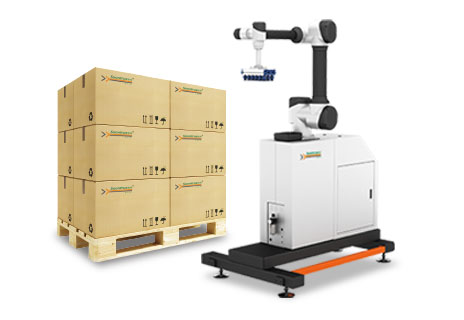
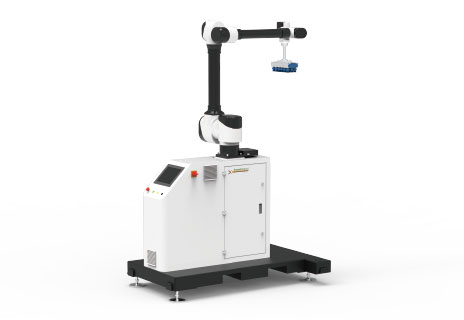
For strapping in addition to film, many plants add a fully automatic strapping machine or a pallet strapping station alongside the wrapper, especially for block-stabilized bags and heavy brick packs. Where space and budget allow, a collaborative arm such as the WP-20 collaborative palletizing robot completes the loop upstream so the wrapper is never waiting on a pallet.
Maintenance and spare parts: don’t forget the post-install phase
A wrapper is only as good as its film carriage and stretch rollers. Plan for periodic carriage calibration, roller replacement, and film-roll handling consumables. A predictable spares list keeps uptime high — the same discipline we outline in our packaging machine spare parts management and downtime guide. Choose a supplier that can quote carriage parts, belts, and sensors up front rather than treating them as unknowns. That quotation discipline is also what we lay out in the complete RFQ checklist for sourcing automatic packaging machinery.
Conclusion: the wrapper pays for the walk it removes
수동 wrapping is not wrong because the equipment is bad. It is expensive because a human being is doing a machine’s job, and every minute of that walk is a minute that does not scale. For any plant moving more than about 100 pallets a day, the labor, film, and damage math resolves the question within the first year. Below that, a powered pre-stretch semi-automatic stand recovers most of the saving without the capital. SunAura Packaging Machines helps customers size turntable, rotary-arm, and inline stretch wrappers to their actual load mix, film specification, and throughput target, and backs them with CE documentation, guarding layouts, and a defined spares list. If you are ready to model your own numbers, request a wrapping cost comparison with SunAura Packaging Machines or browse our end-of-line packaging solutions to see how stretch wrapping, strapping, and robotic palletizing fit together.

Sarah evaluates packaging consumables against machine capability: film gauge and prestretch, PP versus PET and steel strapping, core width, tension settings and corner board use. Her articles connect film and band choice to machine settings, freight damage rates and total cost per pallet, rather than recommending the cheapest consumable on paper.
전체 약력 보기 ›