

A single flow wrapper is responsible for more of the packaged products on a supermarket shelf than almost any other machine. Biscuits, chocolate bars, bread rolls, instant noodles, wet wipes, soap bars, sponges, hardware, single masks, medical devices, bundles of pens — if a product sits inside a sealed, pillow-shaped flexible pack with a crimped seam at each end and a longitudinal fin seal underneath, it came off a horizontal form-fill-seal machine, universally called a flow wrapper or flow pack machine. SunAura Packaging Machines supplies flow wrappers from compact two-axis machines for small workshops up to seven-servo high-speed and reciprocating machines for continuous production, and the questions that decide the right model are remarkably consistent across food and non-food buyers.
This guide explains how a flow wrapper forms, fills and seals a pack in one continuous motion, what the number of servo axes actually means, how to choose between top-feed and bottom-feed film and between a standard and a reciprocating cutting head, and how to size the machine for product dimensions, speed and film type. We will cover gas flushing for modified-atmosphere packaging, automatic feeding, sanitation for food environments, and the integration points that turn a standalone wrapper into an automatic packaging line. If you are comparing an SZ series flow wrapper against a cheaper machine, the sections below follow the same logic our applications engineers use before quoting.
How a flow wrapper works
A flow wrapper performs four operations in a continuous sequence. First, a roll of flat packaging film is unwound and formed into a tube by a forming collar or forming box — the film wraps around the product as it enters. Second, the longitudinal edges of the film are brought together underneath (or, on some configurations, on top) and heat-sealed into a fin seal that runs the length of the pack. Third, the product is fed into the moving film tube at the correct pitch, usually by a series of push lugs on an infeed conveyor. Fourth, a pair of rotating sealing jaws or a reciprocating head crimps and seals the film across the pack at both the trailing edge of one pack and the leading edge of the next, while a knife integrated in the jaws cuts between them. The result is a continuous stream of finished pillow packs, each indexed to the machine’s pitch.
The whole machine is a synchronised motion problem: the film speed, the infeed lug pitch and the sealing-jaw rotation must match so that the cut lands in the gap between products rather than through a product. On simple machines this synchronisation is mechanical; on modern machines it is electronic, with servo motors driving each function and a controller holding the alignment. This is why the number of servos is such a useful shorthand for the machine’s capability.
What the number of servo axes means
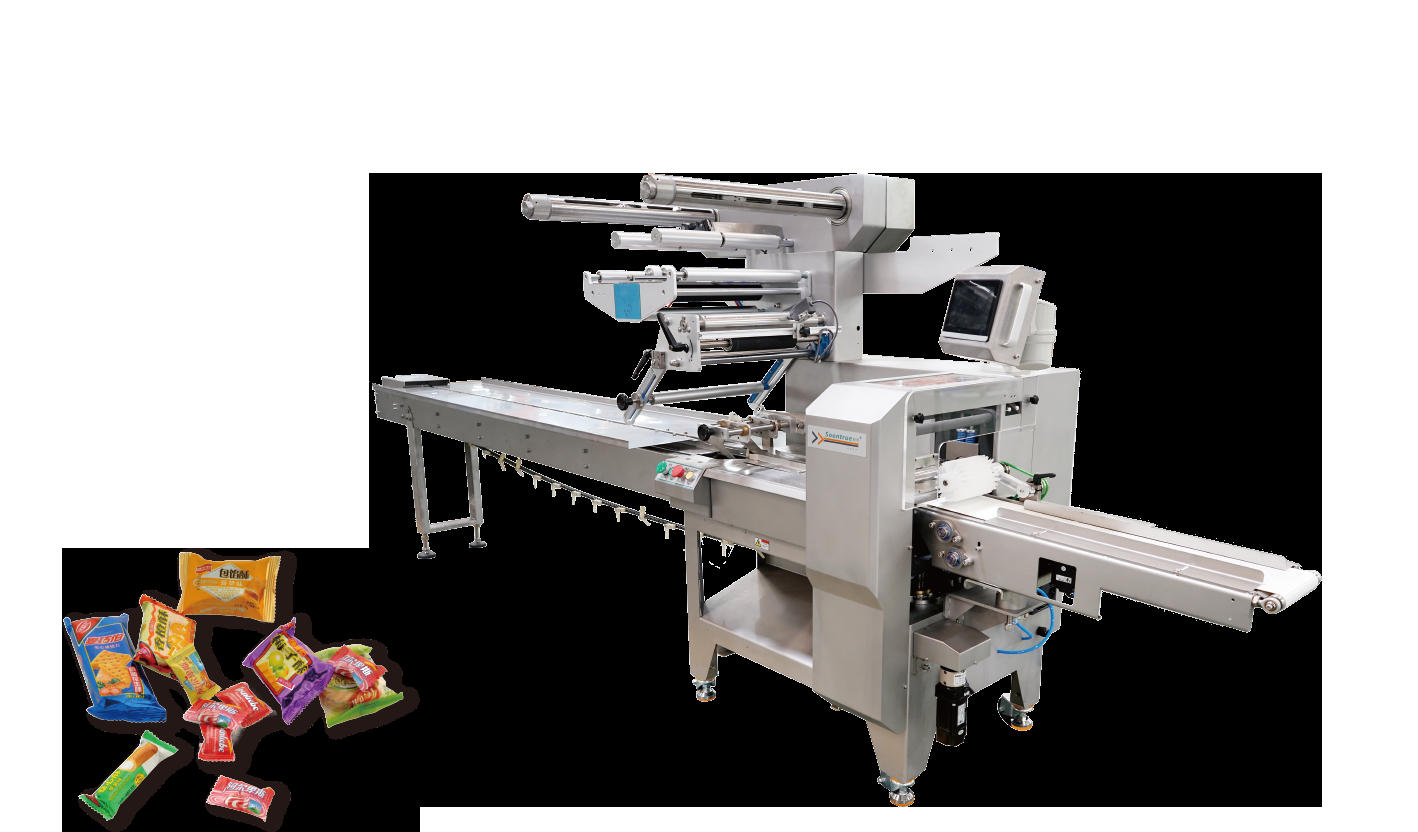
Entry machines use two driven functions — typically the infeed and the sealing jaws — with the film fed mechanically in proportion. These are forgiving on price but less flexible: changing pack length or film requires mechanical adjustments, and alignment recovery after a missed product is slower. A three-servo machine adds independent control of the film feed, so pack length, film speed and jaw timing are set on the HMI and synchronised electronically. This is the most popular configuration for general food and non-food production, represented by machines such as the SZ-350 3-servo flow wrapper and the SZ-450. Changeover between products becomes a recipe recall rather than a mechanical exercise, which matters on multi-SKU lines.
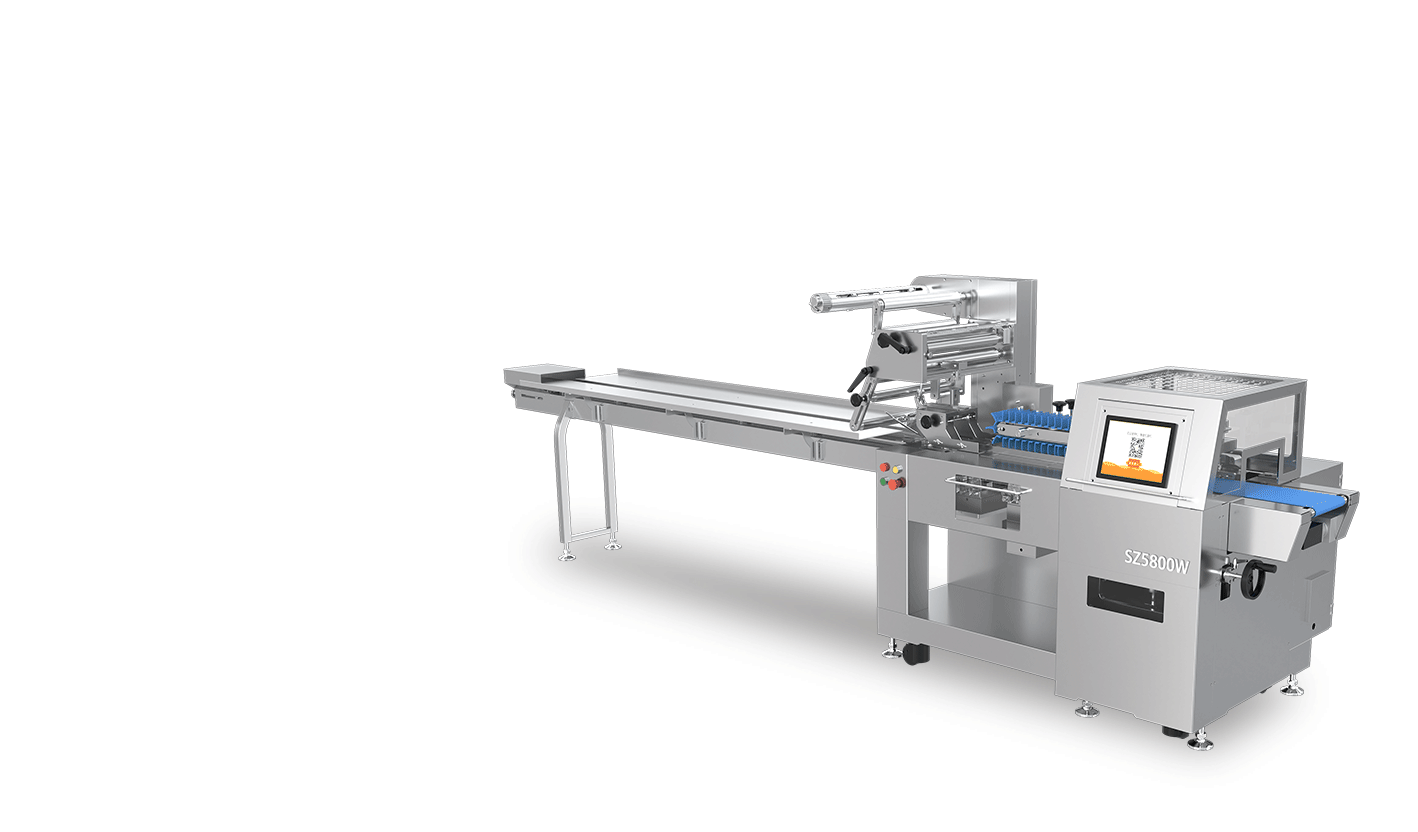
Higher-axis machines separate more functions — independent infeed, film, jaws, and on five-, six- and seven-servo machines, dedicated control of feeding, sealing and discharge for higher speed and tighter synchronisation. The SZ-580 5-servo flow wrapper, the SZ-501 6-servo and the SZ-400W 6-servo suit continuous, high-output production where missed cuts and downtime are expensive. The SZ-5800W 7-servo reciprocating flow wrapper sits at the top, combining full electronic synchronisation with a reciprocating cutting head for products that cannot tolerate the constant motion of rotary jaws.
Rotary jaws vs reciprocating cutting heads
Most flow wrappers use rotary sealing jaws — two jaws mounted on a rotating mechanism that meet, seal and cut as they turn. Rotary jaws are fast and mechanically simple, and they are the right choice for the majority of products. A reciprocating or ‘box-motion’ head instead moves the jaws with the product for a moment — the jaws close, travel horizontally at the same speed as the film while the seal forms, then open and return. This gives a longer dwell time at the seal, which is essential for thick products, difficult films, and products that need a wider or stronger cross-seal. If you wrap stacked or tall products, use films that seal slowly, or run at speeds where a rotary jaw’s contact time is too short to make a reliable seal, a reciprocating head is the difference between packs that hold and packs that leak or open.
Top-feed vs bottom-feed film
Flow wrappers are broadly divided by where the film enters. On a bottom-film or conventional machine, the film is fed from below and wrapped up around the product; the product rides on the film. This suits the majority of regular products. On a top-film machine, the film comes from above and wraps down, which is advantageous for delicate, sticky or irregular products that are better supported on a flat belt until the film covers them — for example, soft bakery, trays of small items, or products that mark easily. Machines such as the SZ-280XS are configured around specific film-feed arrangements, and the choice should be made with the product in mind rather than assumed from the machine style you have seen before.
Sizing for product dimensions and film width
Three product dimensions set the machine size: the product width across the machine, the product height, and the pack length along the film. The film width is derived from the product circumference plus the fin seal — roughly twice the width plus twice the height plus overlap — so a product that is 100 mm wide and 40 mm high needs a film web in the region of 300 mm. Machine model numbers in the SZ range generally correspond to the maximum film width, which is why matching the largest product to the web capacity is the first sizing step. Pack length sets the infeed pitch and the jaw timing, and the machine’s minimum and maximum pack lengths define the usable range. Oversized machines run small packs inefficiently; undersized machines cannot clear the largest product, so the range of SKUs — not just the current best seller — should drive the choice.
Throughput: packs per minute in the real world
Flow wrapper speed is quoted in packs per minute, but the headline number is a peak achieved with a single product, continuous automatic feeding and an easy film. Real throughput depends on how the product reaches the infeed. If an operator places products by hand on the belt, the machine is operator-limited regardless of its rated speed; if an automatic feeder, depositor or upstream line supplies product at a consistent pitch, the machine can run near its rated output. A machine quoted at 150 packs a minute may deliver 60–80 with hand loading and 120–140 with automatic feeding. As with other end-of-line machines, we recommend planning at 70–80% of the rated peak, leaving margin for film splices, roll changes, misfeeds and start-up. For high-output plants, the SZ-750W wide flow wrapper and the large SZ-3000 provide the web width and speed that smaller machines cannot, but they only earn their cost when the upstream supply keeps them fed.
Films, sealing and modified-atmosphere packaging
Flow wrappers handle a wide range of films — plain and printed polypropylene, laminates, cold-seal films for chocolate, peelable materials, micro-perforated films for produce, and shrink films on specific machines. Each film has its own sealing temperature and dwell requirements, which is why multi-servo machines with precise temperature control are more forgiving when you change materials. For products with a short shelf life — bakery, meats, cheese, ready meals — the machine can be fitted with gas flushing that displaces the air inside the pack with a nitrogen or gas mixture before sealing, extending shelf life under modified-atmosphere packaging. Gas flushing adds a gas supply, injection tubes and tighter control of the forming area, and it must be specified with the film and the desired residual oxygen level in mind. Buying a machine ‘MAP-ready’ and adding gas flushing later is possible but more disruptive than specifying it up front.
Automatic feeding and the labour question
The wrapper itself is rarely the constraint on a flow-pack line — feeding is. Products arrive in rows from a cooling conveyor, a depositor, a baking line or a processing machine, and they must be singulated and placed at the correct pitch. Automatic feeders, aligning conveyors and product-sensing systems remove the operator and let the machine run continuously. For irregular or delicate products, feeding systems can be as significant a part of the project as the wrapper. Where full automation is not justified, a well-designed hand-load station with comfortable reach and clear product spacing still lets one or two operators feed the machine efficiently. The decision is economic: at modest volumes a hand-loaded three-servo wrapper is the sensible investment; at high volumes the labour saved and the speed recovered by automatic feeding justify the extra equipment.
Food safety, sanitation and construction
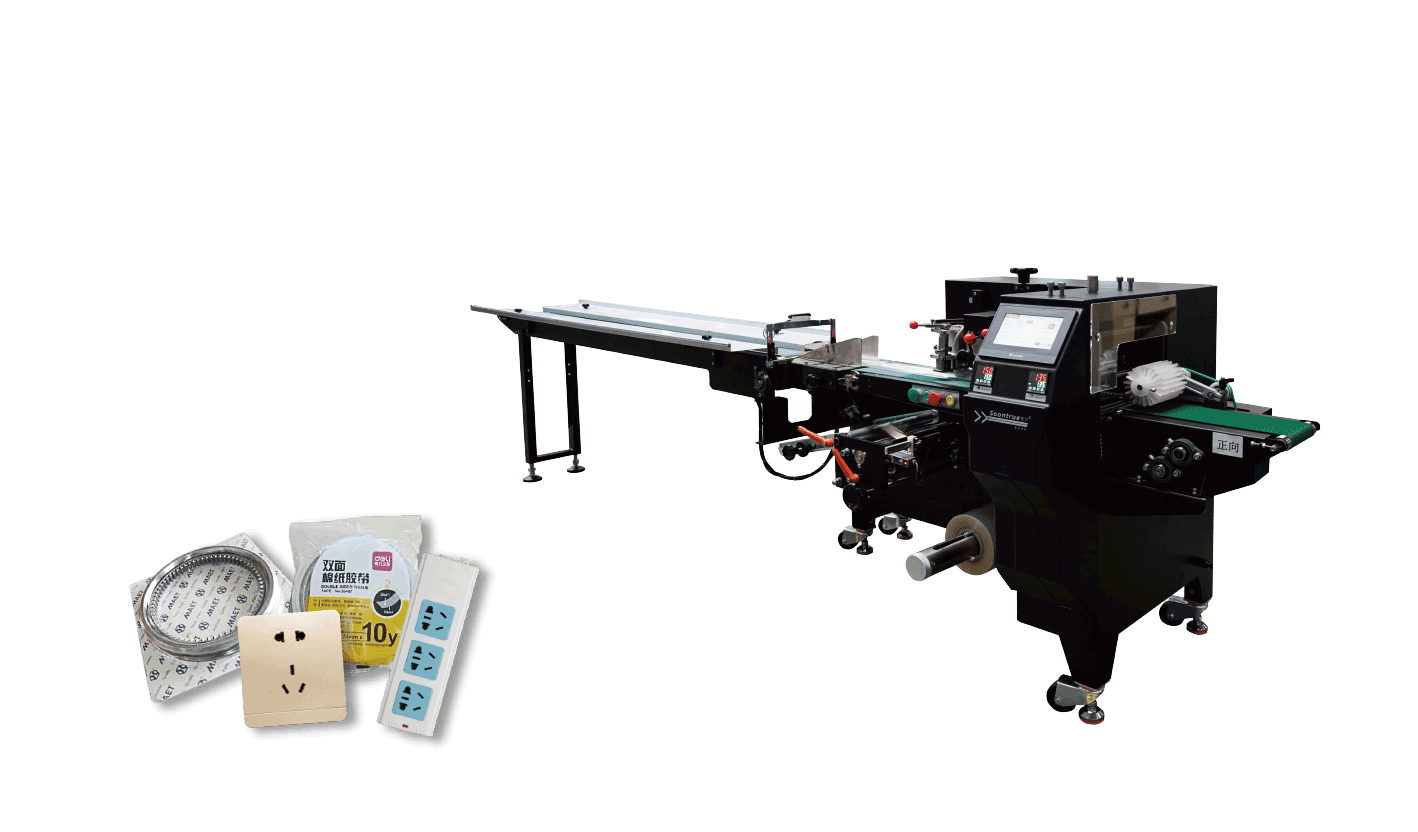
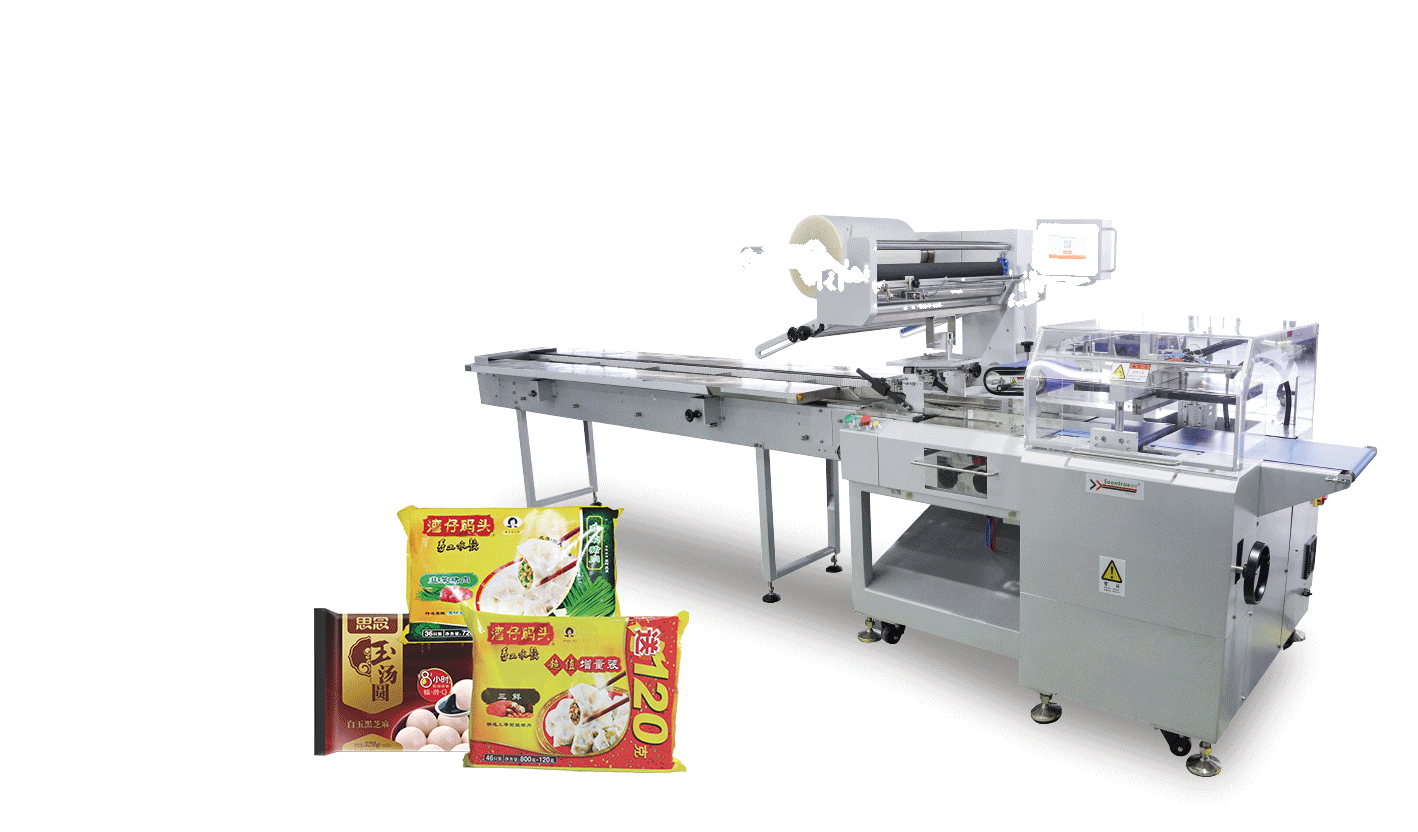
For food applications the machine’s construction matters as much as its speed. Stainless steel contact surfaces and frames, sloped and accessible surfaces, removable belts and guards, and IP-rated motors and sensors support the cleaning and inspection regimes that food safety audits require. Printed film registration, date and batch coders, and inspection for open seals or missing product are commonly integrated at the discharge. Non-food applications — such as the hardware and electrical products shown above — can use painted or black-frame machines where food-grade construction is unnecessary, reducing cost. Matching the construction to the actual environment avoids both overpaying for stainless on an industrial product and under-specifying a painted machine in a food plant.
Integration into a complete line
A flow wrapper is frequently one station in a longer process. Upstream it may connect to a depositor, oven discharge, cooling belt or counting system; downstream it may feed a metal detector, check weigher, cartoner that groups packs into boxes, case packer, and eventually palletising. The SL-150 trayless flow wrapper and the compact SW60X/SW80X often serve as the flexible-packaging station before packs are cartoned, while dedicated production lines use high-speed machines feeding automatic cartoners. Specifying the wrapper with its upstream and downstream neighbours in mind — sharing control signals, matching speeds, and agreeing the handoff — prevents the classic problem of a fast wrapper starved by a slow feeder or blocked by a cartoner that cannot accept its output.
Common specification mistakes
- Sizing to today’s product only. A new, larger SKU then exceeds the film width or pack-length range and cannot run.
- Ignoring the feeding method. A 150-pack-per-minute machine hand-loaded to 60 is wasted capital.
- Choosing rotary jaws for a thick or slow-sealing product. Inadequate dwell produces weak cross seals and leakers.
- Not planning for MAP. Retrofitting gas flushing is more costly and disruptive than specifying it initially.
- Mismatching film and machine. Cold-seal, laminate and shrink films each impose different requirements on the wrapper.
- Using a painted machine in a food environment. Sanitation and audit requirements call for food-grade construction.
- Planning at peak speed. No derating for roll changes, splices and misfeeds guarantees a shortfall.
Frequently asked questions
What products can a flow wrapper pack?
Any solid product that can be conveyed at a consistent pitch and enclosed in a flexible film — bakery and confectionery, chocolate, snacks, cheese, meat and ready meals with suitable films, wet wipes and tissues, soap and personal-care items, masks and medical devices, hardware, toys, stationery and many non-food goods. Liquids, bulk powders and products requiring a formed rigid container use different machines, such as vertical form-fill-seal or cartoning equipment.
How do I choose the right film width?
The web width is derived from the product’s cross-section: roughly twice the product width plus twice its height, plus the material needed for the longitudinal fin seal. Provide your product dimensions and our engineers will calculate the exact web width and confirm which SZ model accommodates it, including margin for printed-film registration.
Do I need a reciprocating machine?
You need a reciprocating head if your product is thick or stacked, your film needs a long seal dwell, or you require a particularly wide or strong cross-seal at speed. Standard products on conventional films run efficiently on rotary jaws. If you are unsure, the seal test on your actual film and product is the decisive check.
Can the machine print dates and batch codes?
Yes. Coders — thermal, inkjet or hot-foil — are commonly mounted to print the film before forming or the finished pack at discharge, and they integrate with the machine’s timing. Registration systems also keep pre-printed film aligned so branding lands correctly on each pack.
What is the difference between a flow wrapper and a shrink wrapper?
A flow wrapper forms and seals a pillow pack around the product without heat shrinking the film; a shrink wrapper loosely encloses the product in film and then passes it through a heat tunnel that shrinks the film tightly. Some machines handle shrink films, but the standard flow pack is a sealed flexible pouch, not a tight shrink wrap.
How fast can I realistically run?
Real output is set by feeding. With automatic, continuous supply and a single product, a multi-servo machine can run near its rated packs per minute; with hand loading, expect the operator to set the pace. Plan at 70–80% of the rated peak and confirm the speed on your product and film during a trial.
Conclusion
A flow wrapper is a synchronised motion system as much as a packaging machine, and the correct model follows from the product dimensions, the film, the cutting head and — above all — how the product is fed. Compact two- and three-servo machines cover workshops and multi-SKU production; five-, six- and seven-servo machines cover continuous high output; reciprocating heads cover thick and difficult products; and gas flushing, automatic feeding and food-grade construction extend the machine into shelf-life and sanitation-critical applications. Sized with the full SKU range and a realistic derating margin, a flow wrapper becomes a dependable core station rather than a speed-rated machine starved by its infeed.
If you are automating a bakery, confectionery, personal-care or hardware product, or replacing a labour-intensive hand-pack operation, SunAura Packaging Machines can size a flow wrapper against your dimensions, film and target packs per minute and integrate it with feeding, coding and cartoning. Send our team your product size, film and output target for a configuration rather than a generic quote, or browse the products hub for the complete SZ series and the larger SZ-601/801W large-bag machines.

David leads our case sealing and cartoning engineering team. Over 14 years he has specified, installed and commissioned hundreds of random-size case sealers, top- and side-loading cartoners, and automatic case packers for food, household and industrial product lines. He writes buying guides and troubleshooting articles around seal quality, tape and hot-melt glue selection, and carton throughput limits.
See Full Bio ›